



The Hunter 38 is a mid-size family cruiser introduced by Hunter Marine in 2004 and drawn by Glenn Henderson with the explicit aim of blending easy, user-friendly deck ergonomics and interior liveability with noticeably improved sailing performance compared with the company’s earlier designs. Conceived as a comfortable coastal cruiser for couples and families who also want a boat that can be handled short-handed and occasionally sailed briskly, the 38 arrived with Hunter’s signature B&R fractional rig, an open cockpit and a transom swim platform—features that helped it find a steady following in North America. It was produced through the late 2000s and now circulates on the used market where it attracts private owners, couples trading up into a more comfortable cruising platform, and a modest number of flotilla/charter-style operations; well-kept examples remain sought after by buyers who value a roomy interior without giving up lively on-water behavior.
Design and Construction
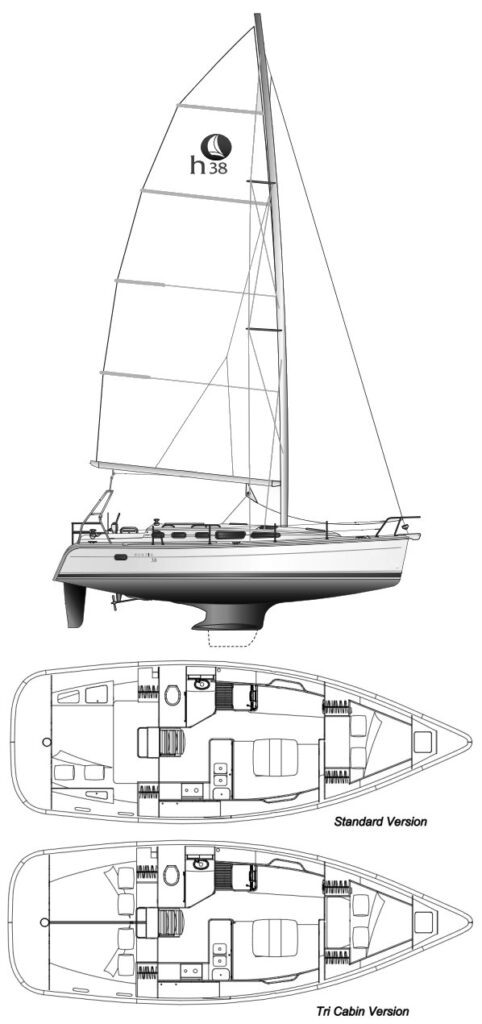
Hunter conceived the 38 as a modern production cruiser: hand-laid fiberglass hull, molded structural grid, and an open plan that places the mainsheet on an arch aft of the cockpit to keep lines clear and cockpit space hospitable for families. The hull runs a fairly full aft section with a fin keel (deep and shoal/wing options were offered) and an internally mounted spade rudder, while the B&R rig eliminates a backstay and uses swept spreaders to control mast bend and roach—choices that simplify deck layout and allow for a larger roachy mainsail. Those design decisions translate into practical advantages for owners: the structural grid and solid laminate in high-load areas make deck and hull repairs straightforward for most yards, and the arch/traveler arrangement reduces clutter and makes short-handed sail handling safer; on the flip side, the B&R geometry requires attention to correct rig tuning and mast support, and owners should confirm chainplate/bed integrity during surveys. In short, construction and naval architecture favor owner comfort and neat systems integration while offering a level of durability and repairability consistent with mainstream production boats of the era.
Performance
On the water the Hunter 38 generally sails faster than older, heavier production cruisers of similar length, accelerating well in puffs and feeling responsive to helm inputs thanks to its relatively modern underwater sections and well-balanced rudder. The B&R fractional rig gives a powerful mainsail and a modest headsail that make tacking with a small crew easier, though the swept spreader geometry limits how far the boom can be eased dead downwind without rig interference—sailors often adapt by using spinnaker/parasail tactics or sailing off angles when running. In a seaway the boat’s displacement and ballast provide a reassuring, predictable motion rather than an athletic one; compared with sleeker European cruisers it won’t match the light-air edge, but compared with older American cruisers or many similarly sized coastal boats it represents a solid compromise of speed, control and family-friendly handling. Owners and reviewers have noted that it rewards sailing “up right” rather than heeled excessively and that, when tuned and reefed appropriately, it makes a confident coastal passage-maker.
Comfort and Accommodations
Interior space is one of the Hunter 38’s strongest selling points: full-beam aft cabin options, generous headroom (reported near 6’6″), and a layout that prioritizes an owner’s stateroom aft, a well-ventilated saloon and an efficient galley. For a cruising couple or a small family the boat comfortably supports weekend cruising and extended coastal trips: tankage, tank placement and locker space are reasonable for its size, and the cockpit-forward ergonomics make day sailing and socializing easy. That said, while the interior finishes are comfortable and practical, long-term liveaboard use will expose the usual limitations of a 38-foot hull—storage and private space become tight if you carry three or more adults permanently aboard—so buyers seeking full-time liveaboard capability should expect to trade off some comfort or plan a refit for optimized storage and systems. The joinery and layouts on most market examples age acceptably when moisture is controlled, and many owners modernize electronics, upholstery and galley gear as part of normal turnover.
Safety and Practicality
Deck ergonomics and the stainless-steel arch give the Hunter 38 a practical safety advantage: lines are routed away from the cockpit, the stern platform eases boarding and recovery, and wide side decks with reasonable lifeline height make moving around under way manageable. Systems are generally accessible—engine compartments and service points are reachable without dismantling critical furniture—which keeps routine servicing less costly and faster than on more tightly packed European designs; however, the B&R rig and the choice of in-mast or vertical-battens in some setups mean owners must keep a close eye on rig wear and batten/reefing condition. For coastal cruising and coastal passages the vessel is well suited out of the box; for serious offshore work owners typically upgrade electronics, add redundant safety gear and evaluate additional through-hull backups and stronger ground tackle prior to heavy offshore voyaging.
Known Issues with the Hunter 38
Owners and forum threads consistently point to a handful of recurring inspection items rather than systemic design failures. Common findings on surveys include chainplate bedding and deck-core attention around high-load fittings (a risk shared by many cored deck production boats), wear on running rigging and vertical batten systems, and the usual engine/service items on aging Yanmar installations—check oil, mounts, and coolant systems carefully. The B&R rig can complicate some downwind sail choices and may require bespoke solutions if an owner wants larger downwind sail area; similarly, in-mast or vertically battened mains used for convenience can shorten sail life and reduce light-air performance, so many owners prefer a conventional slab-reefing main for longevity and sail shape. Typical, sensible upgrades seen in good listings include fresh standing rigging where age dictates, modern autopilot/electronics, new furling gear or propeller changes for better motoring economy, and rebedding of deck fittings—investments that materially improve safety, comfort and resale value.
Market Availability and Pricing in the U.S.
The Hunter 38 is out of production and available only on the used market; production ran through much of the mid-2000s making the fleet a second-hand staple in many U.S. sailing regions. Listings currently appear across the East Coast (New England, Chesapeake), the Southeast (Florida, Gulf harbors) and West Coast hubs, with prices reflecting condition, equipment and refit history—examples actively marketed in the U.S. commonly list between $80,000–$120,000 for well-equipped, maintained boats, with lower prices for projects and higher asking prices for recent refits or charter-ready examples. Overall demand skews to private buyers—couples and families looking for a comfortable 38-footer—while broker inventory can fluctuate with seasons and local marina economics.
Here’s a comparison with similar models:
| Model | LOA | Approx. years built | Typical US used price | Main differences |
|---|---|---|---|---|
| Hunter 38 | ~38.2 ft | 2004–2009 | $80,000–$120,000 | B&R rig, roomy aft cabin options, arch-mounted mainsheet, focus on cockpit comfort and easy handling. |
| Beneteau Oceanis 37 | ~37.7 ft | 2006–2014 | $70,000–$160,000 | European hull lines, slightly lighter displacement, performance-leaning Finot design with varied layouts. |
| Catalina 375 | ~38.5 ft | 2008–~2012 | $120,000–$180,000 | Conservative American cruiser: larger cockpit lockers, robust systems, options for in-mast furling and heavy comfort gear. |
| Jeanneau Sun Odyssey 36i | ~35.9 ft | 2007–2014 | $60,000–$120,000 | Injection-molded deck, European build, emphasis on a balance of sailing performance and cruising comfort. |
Hunter 38 vs Beneteau Oceanis 37

The Hunter 38 emphasizes cockpit comfort and owner-focused ergonomics with its arch/twin-control layout and aft-cabin options, whereas the Oceanis 37 shows a sleeker European hull and a slightly more performance-oriented underwater profile that rewards trimming and tuning. Practically, a buyer who values weekend social sailing, easy cockpit circulation and straightforward systems will find the Hunter appealing; a buyer whose priority is light-air speed and sharper pointing will tilt toward the Oceanis and should be prepared to invest a little more in sails and tuning to extract that advantage.
From a maintenance and ownership perspective the Hunter’s systems and hardware are common in U.S. yards and often easier to source locally; the Oceanis may require a bit more attention to performance rigging and could incur slightly higher routine sail service if it’s sailed aggressively, but it often offers a higher potential resale premium among performance-minded buyers.
► Learn more about the Beneteau Oceanis 37
Hunter 38 vs Catalina 375
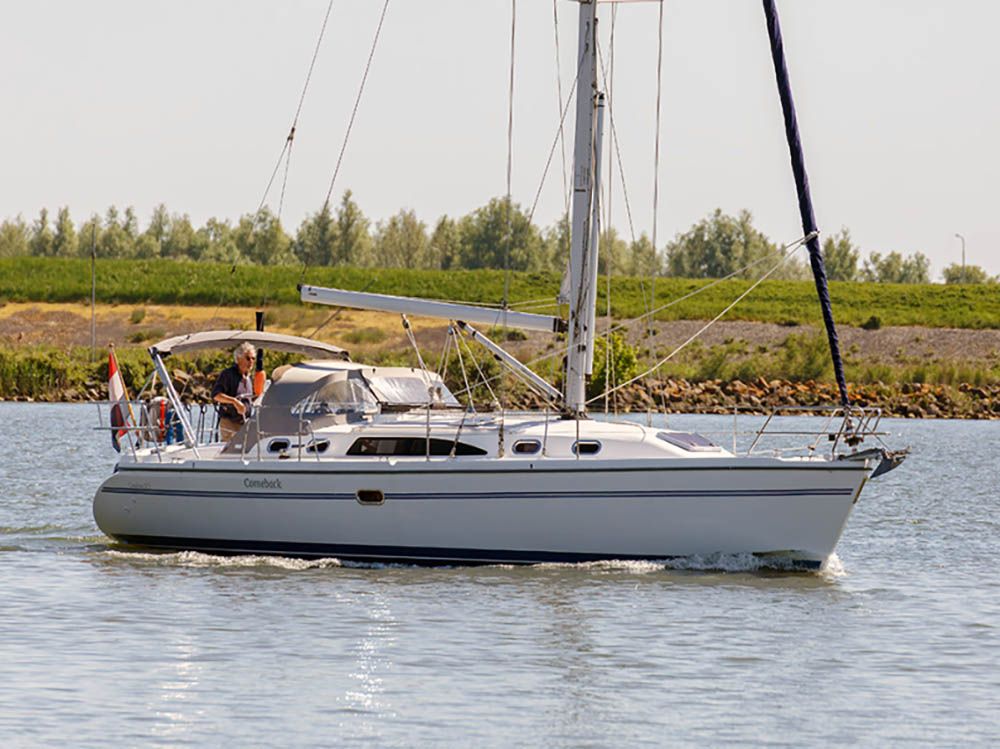
Compared with the Catalina 375, the Hunter 38 is generally the more performance-minded of the two American designs, offering livelier helm feedback and a more modern underwater shape, while the Catalina trades some of that edge for very deliberate emphasis on accommodations, storage and heavy-weather comfort. For family cruising where interior volume, large lockers and integrated systems (generator/AC space) matter, the Catalina frequently presents a lower-stress day-to-day ownership experience; owners who prefer a slightly firmer sailing feel and a more open cockpit for social sailing will favor the Hunter.
In terms of upkeep, Catalinas are traditionally straightforward and conservative in specification, which can simplify maintenance and parts sourcing; Hunters, with their B&R rig and arch arrangements, require attention to rig setup and bedding work but remain well supported in U.S. service networks—so the practical difference is often between tolerance for tuning (Hunter) versus preference for simplicity (Catalina).
► Learn more about the Catalina 375
Hunter 38 vs Jeanneau Sun Odyssey 36 Mk I

The Sun Odyssey 36i brings a European design philosophy—often a lighter displacement and injection-molded deck construction—resulting in a boat that tends to accelerate and point slightly better in many conditions, while the Hunter 38 favors American styling cues, cockpit sociability and ease of handling with its arch and control layout. Buyers seeking sharper passage times and a slightly sportier feel under sail will find Jeanneau’s hull tuning attractive; those prioritizing living comfort, simpler on-deck ergonomics and a flexible aft cabin arrangement will see the Hunter as the better family cruiser.
Maintaining the Sun Odyssey often means understanding some European construction practices and parts channels, while the Hunter’s U.S. centric design and common components can make routine maintenance and sourcing easier in many American ports—an ownership practical consideration that often determines long-term satisfaction as much as raw sailing performance.
► Learn more about the Jeanneau Sun Odyssey 36 Mk I
Maintenance Costs of a Hunter 38 in the U.S.
Below are realistic annual and periodic expense ranges for a Hunter 38; each line lists the cost item in bold followed by a concise comment. Regional differences are material—marina rates and yard labor vary widely between coasts and inland waterways.
- Mooring / slip fees: $1,200–$10,000 per year.
(Premium slips on the West Coast and Florida or seasonal New England berths sit at the top end; municipal moorings or winter haul-outs lower the cost.) - Insurance: $400–$2,000 per year.
(Depends on insured value, cruising range and owner experience; offshore endorsements raise premiums.) - Engine servicing & routine mechanicals: $300–$1,500 per year.
(Oil changes, filters, impellers, belts and routine checks; repower or major repairs are additional.) - Antifouling / haul-out & bottom care: $600–$3,500 every 1–2 years.
(Haul, pressure wash, bottom paint and zincs; higher if hull fairing or osmosis treatment required.) - Standing rigging replacement (periodic): $1,500–$6,000 one-time (every ~10–15 years).
(Mast height and rig complexity drive price; removal, hardware and certification add cost.) - Running rigging & deck hardware (annual amortized): $150–$1,000.
(Sheets, halyards, blocks, winch service—cost rises with active sailing or club racing.) - Sails (repairs and replacement): $0–$8,000+ amortized.
(A single new main or genoa typically ranges $1,200–$4,000; performance or laminated sails cost more.) - Electronics & electrical: $500–$8,000+ (upgrades/major replacements).
(Chartplotter, autopilot, AIS, battery bank: a modern chart/electronics package is a major discretionary expense.) - Winterization / storage / shrinkwrap: $200–$3,000 seasonal.
(Region dependent; New England winter storage is expensive, Florida minimal.) - Consumables and small repairs: $300–$1,200 per year.
(Hoses, zincs, pump replacements, small plumbing/electrical fixes.) - Survey, structural remediation & unexpected repairs: $500–$20,000+ as needed.
(Deck core, chainplate reinforcement, keel/shaft work or major fiberglass repairs can be expensive if found on survey.)
Significant one-time costs to budget separately include a full sail inventory replacement ($3,000–$12,000), a standing rigging renewal ($1,500–$6,000), an electronics/autopilot refit ($1,500–$8,000), or a repower ($8,000–$20,000+).
Owner-maintenance vs. professional services: Many Hunter 38 owners perform routine tasks themselves—polishing, small electrical fixes, oil changes and some fibreglass or varnish work—which lowers annual cash outflow substantially. Conversely, specialized jobs (standing rigging, major structural repairs, complex electrical installs, certification work) require professional yards; choosing professional labor increases short-term cost but reduces risk and generally improves resale value when documented. The time and skill the owner can contribute are therefore significant cost levers.
Overall assessment: for a 38-foot production cruiser the Hunter 38 sits in the medium ownership-cost category—higher than small pocket cruisers but lower than larger yachts with complex systems. A thoughtfully maintained boat with recent rig, sails and electronics usually holds resale value reasonably well in the U.S. market; conversely, deferred maintenance tends to depress asking price and can make the net ownership equation less favorable.
Conclusion
The Hunter 38’s central appeal is its blend of family-friendly ergonomics, practical systems and a sail plan that rewards sensible handling without demanding a professional crew. Its strengths are a spacious and livable interior (including full-beam aft cabin options), an uncluttered cockpit with arch-mounted controls, and a hull/rig package that offers lively but manageable performance for coastal cruising and weekend rallying. Weaknesses are the familiar ones for production family cruisers of the period—attention required to deck-core bedding, the need to monitor rig and batten systems, and limits to light-air racing competitiveness compared with dedicated performance cruisers. For buyers looking for a comfortable, easy-to-manage 38-foot cruiser that still responds enjoyably under sail, the Hunter 38 is a sensible target: it’s a practical investment for coastal cruising and family use, and when maintained and modestly upgraded it typically offers fair resale prospects within its market niche.
Specifications
| Hull Type | Fin w/spade rudder |
| Rigging Type | B&R |
| LOA | 38.17 ft / 11.63 m |
| LOD | 36.67 ft / 11.18 m |
| LWL | 34.67 ft / 10.57 m |
| S.A. (reported) | 991.00 ft² / 92.07 m² |
| Beam | 12.92 ft / 3.94 m |
| Displacement | 18,342.00 lb / 8,320 kg |
| Ballast | 6,128.00 lb / 2,780 kg |
| Max Draft | 6.50 ft / 1.98 m |
| Construction | FG |
| First Built | 2004 |
| Builder | Hunter Marine (USA) |
| Designer | Glenn Henderson |
| Auxiliary Power | Yanmar Diesel, 29 HP |
| Fuel Capacity | 35 gals / 132 L |
| Water Capacity | 75 gals / 284 L |
| Headroom | 6.50 ft / 1.98 m |
| S.A. / Displ. | 22.88 |
| Bal. / Displ. | 33.41 |
| Disp. / Len. | 196.49 |
| Comfort Ratio | 26.28 |
| Capsize Screening Formula | 1.96 |
| S# | 2.65 |
| Hull Speed | 7.89 kn |
| Pounds/Inch Immersion | 1,600.53 pounds/inch |
| I | 46.67 ft / 14.23 m |
| J | 12.08 ft / 3.68 m |
| P | 47.42 ft / 14.45 m |
| E | 17.75 ft / 5.41 m |
| S.A. Fore | 281.89 ft² / 26.19 m² |
| S.A. Main | 420.85 ft² / 39.10 m² |
| S.A. Total (100% Fore + Main) | 702.74 ft² / 65.29 m² |
| S.A./Displ. (calc.) | 16.23 |
| Est. Forestay Length | 48.21 ft / 14.69 m |
| Mast Height from DWL | 59.08 ft / 18.01 m |
Disclaimer
The considerations and analyses presented regarding the Hunter 38 sailboat are of a general nature and are based on the available information and technical data on this model, interpreted to the best of our knowledge and understanding. It is important to note that the specific characteristics of any particular sailboat may vary due to custom modifications, maintenance performed, and conditions of use over time, among other factors. Therefore, the details and performance of the boat you are considering may not exactly match the information provided here.
We strongly recommend that, before making any purchasing or usage decisions, you conduct a detailed inspection of the boat in question, consult with nautical professionals and other sailors, and consider your personal needs, expectations, and capabilities. Each sailboat may have unique particularities that affect its performance and suitability for different types of sailing and sailors.
The information contained in this analysis should be used as a general guide and not as a definitive reference. Professional evaluation and personal inspection are essential to ensure that the boat meets your specific requirements and expectations.