



The Catalina 350 arrived in the early 2000s as Catalina Yachts’ mid-size coastal cruiser designed to give couples and small families “big-boat” comforts in a manageable hull. Conceived by Gerry Douglas and introduced around 2002–2003, the 350 was intended as a comfortable, spacious cruising platform rather than a club racer — a boat for owners who wanted generous interior volume, simple systems and predictable handling for weekend passages and family vacations. Over the years it has become one of Catalina’s better-known 35-foot designs on the used market, often sought by private cruisers and liveaboard couples who value interior space and straightforward maintenance.
Design and Construction
The Catalina 350’s hull is a relatively beamy, moderate-displacement monohull with conventional fin keel options (including a deep fin and a shoal variant) and a skeg-supported rudder arrangement on many examples. Catalina’s construction approach for this model uses hand-laid fiberglass mouldings with molded interior liners and a lead keel; the layout emphasizes lower cabin sole and higher headroom, which increases perceived volume without making decklines ungainly. Those choices — wider beam, lower cabin sole, and production GRP construction — make the boat comfortable below and relatively straightforward to repair: typical fiberglass and gelcoat repairs, keel bolt inspections and routine through-hull servicing are within the skill set of most marine yards. However, the added interior volume and the places where deck hardware penetrates the deck demand careful inspection at purchase (mast step, chainplate pads, and coachroof fittings) because core or seal failures in those areas are a recurring pre-survey concern.

Performance
As a design tradeoff the Catalina 350 favors comfort and load-carrying over light-air speed. Hull speed settles around the high 7-knot range and owners typically report cruising speeds in the mid-5 to 7 knot band under normal conditions; the higher displacement gives a solid, reassuring feel in a seaway but costs acceleration and light-air performance versus more modern, light-displacement 35-footers. The mainsail-forward plan and relatively generous sail area provide good drive in moderate winds, and the boat tracks predictably on a reach and off-wind. In short, she is a trustworthy coastal cruiser — steady and confidence-inspiring for family passages — but buyers who expect to race or to prioritize sailing in very light conditions should expect lower comparative performance.
Comfort and Accommodations
Where the 350 shines is belowdecks: its broad beam and lowered cabin sole deliver a roomy saloon, a large forward owner’s cabin, a generous galley and a roomy head — features that make the boat feel noticeably larger than many contemporaries. Storage, tankage and creature comforts (ample water capacity, decent refrigeration options and practical galley ergonomics) make the model attractive for weekend cruising, family holidays or extended seasonal use by couples. That said, the finishing reflects production-boat economics of the period, so many buyers upgrade refrigeration insulation, ventilation (additional hatches and vent fans) or soft furnishings when they convert a used 350 into a long-term liveaboard. Overall, the interior ages well when owners invest in preventive maintenance and modest refits, but neglected examples quickly show wear because of the extensive use of veneers and molded joinery.
Safety and Practicality
Deck ergonomics prioritize safe, uncomplicated handling: a secure cockpit, fairly high freeboard for dryness, and a user-friendly deck arrangement allow confident short-handed sailing. Systems access (engine bay, fuel/water tanks, batteries) is generally good for a production 35-footer, which keeps routine servicing feasible and predictable in cost. The boat’s comfort and capsize indices place it in the coastal-to-offshore cruiser bracket for competent owners; owners planning true blue-water passages commonly strengthen systems (rigging refresh, upgraded seacocks, redundant electronics) but do not typically face major structural work if the hull and deck cores have been kept dry and the boat has been surveyed and maintained properly.
Known Issues with the Catalina 350
Owner forums and survey reports repeatedly surface a handful of recurring maintenance items rather than a single fatal flaw. Commonly reported problems include leaks around the mast step and certain deck fittings that can lead to deck-core softening if not addressed, occasional leaks at chainplate and stanchion bases, and localized water ingress around bow fittings such as the anchor locker. Diesel engine age-related service needs (starter, heat exchanger, injectors) and propeller-related cavitation or vibration have also been mentioned on some boats, and a few examples show cosmetic or structural wear where previous owners skimped on bedding and through-hull maintenance. Practical buyer guidance from owners: verify mast-step and deck-core condition at survey, check keel-bolt area for signs of movement or corrosion, and budget for standing-rigging replacement as a matter of course on older boats.
Market Availability and Pricing in the U.S.
The Catalina 350 is out of production and appears regularly on the used market in the U.S., with concentrations in cruising hubs such as Florida, the Southeast, New England and along the Pacific coast. Recent listing snapshots suggest that condition drives price: well-equipped, nicely maintained examples with recent upgrades commonly list in the $80,000–$115,000 band, while project boats or older, lightly-equipped examples can be found lower — sometimes $60,000 and up depending on location and survey results. That pricing makes the 350 competitive relative to other roomy family cruisers of its era: it often sells to owners prioritizing interior comfort and systems that are familiar to U.S. yards, and its broad owner community helps with parts and resale.
Below is a table that positions the Catalina 350 against common alternatives in the same size/era.
| Model | LOA | Approx. Year Built | Typical Used Price (U.S.) | Key Differences |
|---|---|---|---|---|
| Catalina 350 | 35.5 ft | 2003–2008 | $75,000 – $110,000 | Wide beam for extra interior volume, strong systems access, very popular for U.S. coastal cruising. |
| Hunter 356 | 35.5 ft | 2001–2005 | $65,000 – $95,000 | B&R rig, modern deck layout, lighter displacement; interior slightly more compact but efficient. |
| Beneteau 343 | 34.3 ft | 2005–2008 | $60,000 – $85,000 | Smaller LOA, efficient sail plan, lighter handling; interiors less spacious but bright and modern. |
| Jeanneau Sun Odyssey 35 | 35.0 ft | 2003–2007 | $60,000 – $90,000 | European styling, good upwind performance, narrower beam; offers sleek design over volume. |
Catalina 350 vs Hunter 356

The Catalina 350 delivers broader interior volume and a more traditional American cruiser feel belowdecks, while the Hunter 356 emphasizes deck ergonomics and easy short-handed handling with the B&R rig. Performance differences are practical: the Hunter often feels lighter and more responsive in marginal winds, whereas the Catalina will carry more stores and feel heavier in a seaway, translating into steadier motions but slower acceleration.
For a buyer this means the Hunter 356 can be more appealing if you sail primarily as a couple who values simple sail handling and lighter displacement, while the Catalina 350 is a stronger candidate if interior space, tankage and liveaboard comfort are higher priorities and you are prepared to accept occasional higher maintenance attention to decks and fittings.
► Learn more about de Hunter 356
Catalina 350 vs Beneteau Oceanis 343
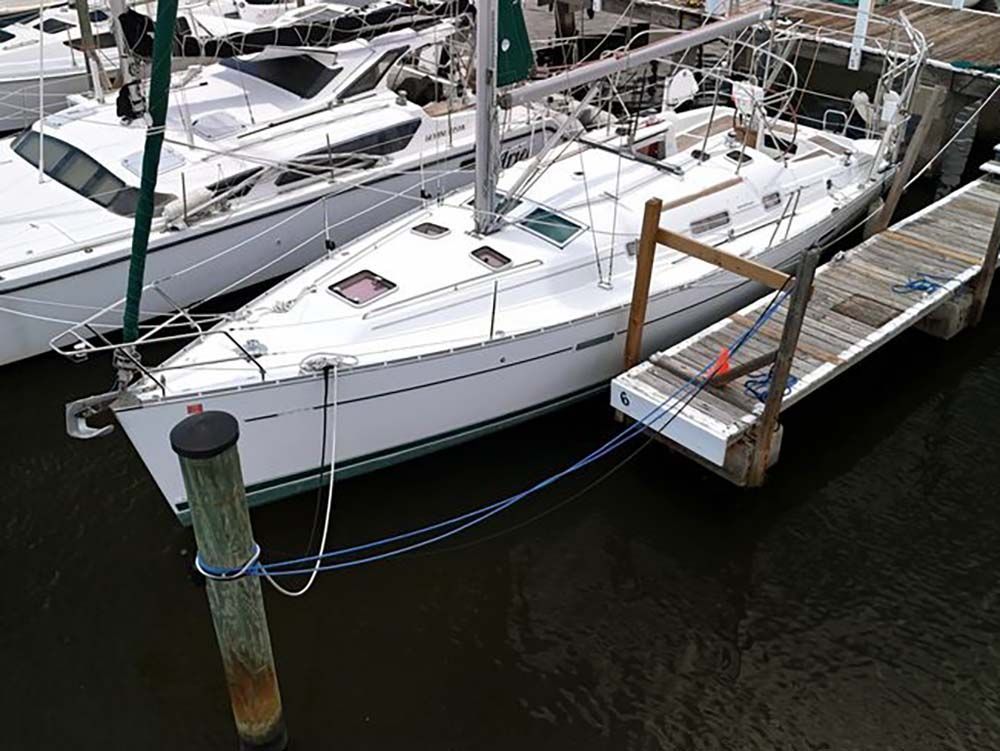
Both the Catalina and the Beneteau models aim at coastal family cruising but approach the brief differently: Beneteau often leans toward European hull tuning and factory systems that can yield a slightly softer motion, whereas the Catalina emphasizes roomy American-style interiors and accessible system layouts for U.S. yards. In practice the Beneteau may feel a touch snappier or more modern under sail for some owners, but the Catalina typically offers a more commodious galley and larger owner’s cabin for the same LOA.
Buyers choosing between them should weigh condition and equipment: a well-equipped Beneteau can be excellent for more offshore-oriented couples who want modern factory systems, while a well-maintained Catalina will better serve owners who prize interior comfort and ease of ownership in U.S. service networks.
► Learn more about de Beneteau Oceanis 343
Catalina 350 vs Jeanneau Sun Odyssey 35

Jeanneau’s Sun Odyssey 35 and the Catalina 350 occupy similar market positions but split on feel and finish: Jeanneau often provides European styling, different hull tuning and factory fit packages, whereas the Catalina favors an American-centric layout with larger interior volume. On the water, owners typically find the Jeanneau to have a slightly different motion and potentially better light-air responsiveness, but the Catalina usually wins on galley space, headroom and storage.
For ownership considerations, Jeanneau examples can come with different factory equipment levels that appeal to cruising purists, while Catalina examples are commonly easier and cheaper to maintain in the U.S. because of the brand’s domestic support network — a practical resale and service advantage for many buyers.
► Learn more about de Jeanneau Sun Odyssey 35
Maintenance Costs for a Catalina 350 in the USA
- Mooring / slip / storage: $2,000–$12,000 per year — depending on region and marina class (inland/low-demand harbors are cheapest; Florida, Southern California and premium New England marinas command top rates).
- Insurance: $600–$2,500 per year — varies with cruising area, owner experience and declared value.
- Engine servicing (routine): $400–$1,500 annually; major engine work or repower can be $3,000–$12,000.
- Antifouling / haul / bottom work: $600–$3,000 every 1–3 years depending on yard and paint choices.
- Standing & running rigging: $0–$300/year for inspections and minor repairs; expect $3,000–$8,000 for scheduled standing rigging replacement (~10–15 year cycle).
- Sails: $0–$700/year for care and small repairs; replacement mainsail and headsail inventory commonly $3,000–$12,000 depending on quality and reefing systems.
- Electronics & systems: $500–$4,000/year for incremental fixes; a full electronics refit (plotter, radar, AIS, autopilot) is commonly $4,000–$15,000 as a one-time upgrade.
Regional differences matter: haulout and labor are pricier in Florida and on both U.S. coasts than in inland or Gulf harbors. Many routine tasks (bottom paint prep, oil changes, small plumbing jobs) can be owner-performed to reduce costs, but structural work, rigging replacement and major diesel or electrical jobs are best left to pros. Significant one-time costs to budget for include standing-rigging replacement, a new sail inventory and a major electronics refit. Overall, anticipate medium annual ownership costs for a well-kept 35-foot cruiser, and recognize that sensible investment in maintenance and targeted upgrades tends to preserve resale value for the Catalina 350 because the model is widely understood and in steady demand.
Conclusion
The Catalina 350 is a sensible, roomy coastal cruiser that answers the needs of couples and small families who put liveability and straightforward ownership above racing performance. Its real strengths are interior volume, sensible systems layout and the practical support network that comes with a popular American production boat; its weaknesses are the predictable maintenance items for any production GRP boat of the era (attention to deck seals, mast step, rig and engine age). For buyers seeking a family cruiser that prioritizes comfort and serviceability in U.S. marinas, the Catalina 350 is worth actively considering — it generally represents good value for coastal cruising and tends to hold resale appeal when maintained conscientiously.
Specifications
| Hull Type | Fin w/spade rudder |
| Rigging Type | Masthead Sloop |
| LOA | 35.42 ft / 10.80 m |
| LWL | 31.27 ft / 9.53 m |
| Sail Area (reported) | 612.00 ft² / 56.86 m² |
| Beam | 12.99 ft / 3.96 m |
| Displacement | 12,937 lb / 5,868 kg |
| Ballast | 5,137 lb / 2,330 kg |
| Max Draft | 6.66 ft / 2.03 m |
| Construction | FG |
| First Built | 2003 |
| Builder | Catalina Yachts (USA) |
| Designer | Gerry Douglas |
Auxiliary Power / Tanks | |
|---|---|
| Make | Yanmar |
| Type | Diesel |
| HP | 30 |
| Fuel | 39 gals / 148 L |
| Water | 88 gals / 333 L |
Sailboat Calculations | |
| S.A. / Displ. | 17.83 |
| Bal. / Displ. | 39.71 |
| Disp / Len | 188.89 |
| Comfort Ratio | 20.22 |
| Capsize Screening Formula | 2.22 |
| S# | 2.95 |
| Hull Speed | 7.49 kn |
| Pounds/Inch Immersion | 1,451.39 lbs/inch |
Rig and Sail Particulars | |
| I | 46.75 ft / 14.25 m |
| J | 14.42 ft / 4.40 m |
| P | 40.92 ft / 12.47 m |
| E | 13.50 ft / 4.11 m |
| S.A. Fore | 337.07 ft² / 31.31 m² |
| S.A. Main | 276.21 ft² / 25.66 m² |
| Total S.A. (100% Fore + Main) | 613.28 ft² / 56.98 m² |
| S.A./Displ. (calc.) | 17.87 |
| Estimated Forestay Length | 48.92 ft / 14.91 m |
Disclaimer
The considerations and analyses presented regarding the Catalina 350 sailboat are of a general nature and are based on the available information and technical data on this model, interpreted to the best of our knowledge and understanding. It is important to note that the specific characteristics of any particular sailboat may vary due to custom modifications, maintenance performed, and conditions of use over time, among other factors. Therefore, the details and performance of the boat you are considering may not exactly match the information provided here.
We strongly recommend that, before making any purchasing or usage decisions, you conduct a detailed inspection of the boat in question, consult with nautical professionals and other sailors, and consider your personal needs, expectations, and capabilities. Each sailboat may have unique particularities that affect its performance and suitability for different types of sailing and sailors.
The information contained in this analysis should be used as a general guide and not as a definitive reference. Professional evaluation and personal inspection are essential to ensure that the boat meets your specific requirements and expectations.