



The Hunter 356 arrived at the turn of the century as Hunter Marine’s answer to buyers who wanted roomy, easy-to-handle coastal cruisers with a modern look and generous accommodations. Designed by Glenn Henderson and introduced around 2000, the 356 was presented as a cruising-first boat with a performance-minded hull and Hunter’s trademark ergonomics (notably the stainless arch and B&R-style rig) to make short-handed sailing simpler. That design intent—comfort plus manageable sail plan—meant the 356 targeted couples and small families who wanted weekend and coastal cruising with occasional longer passages rather than club-level racing. Over the years the model has been reasonably popular on the used market (several hundred hulls built), especially in U.S. coastal hubs where roomy 35- to 36-foot cruisers are in steady demand; typical buyers today include private owners upgrading from smaller boats, live-aboard couples, and brokers reconditioning boats for East/West Coast resale.
Design and Construction
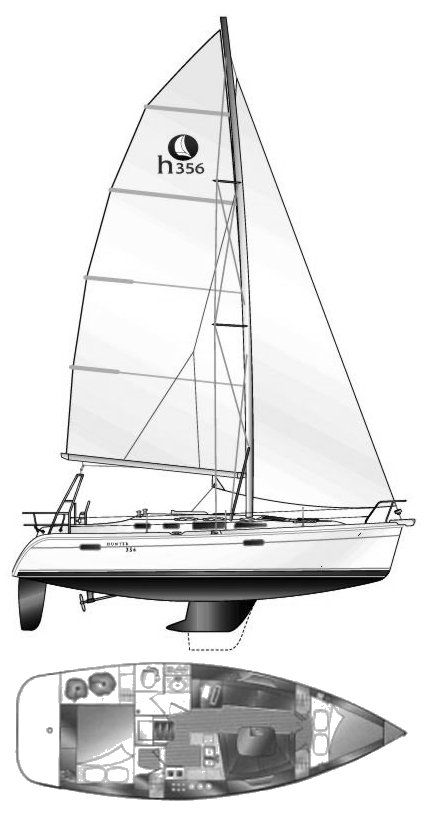
The Hunter 356’s hull is a relatively beamy, fin-keel form with a spade rudder that favors interior volume and forgiving stability over extreme upwind performance. The boat uses the B&R-style swept spreader rig popularized by Hunter, which removes the need for a traditional running backstay by triangulating shrouds and reverse diagonals to create mast support; the mainsheet on an elevated stainless arch keeps the cockpit uncluttered and centralizes loads. Construction is fiberglass (GRP) with sandwich elements and, in some builds, reinforced laminates (manufacturers and brokers note Kevlar or local reinforcements in high-impact areas on many boats), while hull and deck are bonded and through-bolted at high-load points—details that matter for long-term integrity and for buyers who plan structural upgrades. Those choices translate into practical consequences: the wide beam and lighter displacement make for roomy cabins and good initial stability, the B&R rig simplifies rigging but changes sail-handling characteristics (reef early, learn to control boom movement), and the construction approach is generally repairable by competent yards—although composite repairs and chainplate/through-bolting attention are typical maintenance items.
Performance
On the water the 356 sails as a comfortable, predictable cruiser: it accelerates in light airs thanks to a generous sail area, tracks well on reach and run, and is not frighteningly tender because its beam and ballast provide respectable form stability. Upwind she will not point like a modern racer-cruiser, but she will make steady progress and holds momentum well in puffy, coastal conditions; in strong winds the emphasis shifts toward reefing the large main rather than flogging a tiny headsail. Maneuverability under power and in tight slips is commonly improved by owners who fit three-blade or folding props; under sail, the swept spreader/B&R arrangement simplifies rig loads but requires different trimming and makes pushing the boom well off the centerline harder without a baby stay or additional gear. Compared with contemporaries in the 35–36′ class the 356 sits in the comfortable middle: quicker than many heavy-displacement cruisers in light air, but not as lively as performance-oriented designs from the same era. Owners and reviewers have praised her for reliable, cruise-oriented behavior rather than outright speed.
Comfort and Accommodations
Inside, the 356 leans into livability: wide beam, high headroom in the saloon, and a layout that gives priority to a large galley and livable salon for extended weekends or seasons aboard. The typical interior plan sleeps a family comfortably (forward V-berth, midships or aft cabin options depending on the layout) and offers abundant lockers—making provisioning and gear stowage straightforward for cruising couples or families. Ventilation and natural light are generally good for a boat of this size, and the elevated coachhouse and cockpit ergonomics make moving about under sail easier; these are practical wins for owners who spend many hours at anchor or on passages. That said, Hunters of this era were built with an eye toward volume and comfort rather than the last ounce of finish detail—so interiors often show owner-driven refits (updated upholstery, galley upgrades, newer heads, electronics) that both refresh livability and impact resale. For liveaboard use the 356 is quite capable, especially once owners modernize systems and refrigeration; for buyers seeking bare-bones performance or minimalist offshore passage rigs, the 356’s interior priorities should be weighed against those goals.
Safety and Practicality
Deck ergonomics are one of the 356’s selling points: broad side decks, a deep cockpit, and strong handholds (including the arch and grab rails) make moving the boat in a seaway less stressful for a short-handed crew. The elevated arch that carries the mainsheet places major loads away from the toerail and cockpit sole, which is convenient for cruising but means inspecting and maintaining the arch fittings and traveler attachments is important for safety. Access to the water (swim platform or sugar-scoop stern depending on year/options) is typically good, and halyards and sheets are led aft in many examples—an asset for single- or couple-crews. Regarding offshore capability: with proper seakeeping upgrades (stronger ground tackle, redundant bilge and electrical systems, nav electronics, and attention to rig tuning and chainplate integrity) the 356 can handle coastal passages and limited offshore work, but buyers should not assume blue-water capability without targeted refit work. Systems access is often reasonable (engine under companionway steps, service panels reachable), but electrical and plumbing upgrades are a common checklist item for long-term ownership.
Known Issues with the Beneteau Oceanis 361
Owners’ forums and owner reviews surface a handful of recurring themes rather than a single fatal flaw. Leaks around deck-to-hull penetrations and cabin-house windows have been reported and in many cases were corrected by careful rebedding and sealant work—buyers should inspect for evidence of past leaks or soft structures around chainplates and windows. Some owners report mast-base movement noise or concerns that call for tuning or inspection of the mast step and partners; the B&R rig also changes sail-handling tradeoffs (larger mainsail, tendency to “blanket” headsails at certain angles), which is operational rather than structural. Corrosion or fatigue of stainless fittings and the need to rebond or reinforce chainplates and backing in older boats appears periodically in threads and owner reports. Osmosis is not a dominant, model-specific epidemic for this generation, but buyers should evaluate the usual blistering/laminate checks as part of survey due diligence. Common practical upgrades recommended by owners include better propellers (3-blade or folding), modern electronics/AIS, upgraded sails or reefing systems, and attention to chainplate bedding and window seals.
Market Availability and Pricing in the U.S.
Hunter 356 hulls are no longer in production and are sold only on the used market; listings appear regularly on major broker sites and classified marketplaces, with concentrations on both U.S. coasts (New England, Mid-Atlantic, Florida) and Pacific hubs (California, Pacific Northwest). The condition you’ll find ranges from well-kept owner boats to examples that have been refitted by brokers and are offered “turn-key.” Current asking prices (as observed across recent listings and broker sites) typically fall in the range $55,000–$110,000, with many clean, serviced examples clustering between $65k–$90k depending on year, equipment, and refit level. For buyers on a budget the 356 frequently presents an attractive value proposition: a comfortable, roomy 35-foot cruiser for a price that undercuts newer production cruisers while offering substantial liveaboard comfort; for sellers, the model re-sells reasonably well in coastal markets because of Hunter’s brand recognition and the 356’s balance of accommodations and handling.
Below is a table that positions the Hunter 356 against common alternatives in the same size/era.
| Model | LOA | Years (approx.) | Typical used price (U.S.) | Key differences |
|---|---|---|---|---|
| Hunter 356 | 35.5 ft | ~2000–2006 | $55,000–$110,000 | B&R rig, arch traveler, emphasis on interior volume and ease of short-handed sailing. |
| Catalina 350 | ≈35.4 ft | ~2003–2010 | $75,000–$125,000 | A more traditional masthead/rig balance, very roomy interior, often heavier displacement and strong owner community. |
| Beneteau Oceanis 361 | ≈36.5 ft | ~1999–2004 | $65,000–$110,000 | Euro-style hull, emphasis on seaworthiness and comfort; often larger tankage and layout flexibility. |
| Jeanneau Sun Odyssey 36.2 | ≈36.0 ft | ~1997–2003 | $50,000–$80,000 | Euro performance cruiser: balanced handling, good build quality for the era, often a slightly sportier feel than typical Hunter layouts. |
Hunter 356 vs Catalina 350

The Hunter 356 and the Catalina 350 both aim at the cruising couple who prize liveable interiors, but they reach that goal differently. The 356 emphasizes a more modern look and the B&R rig/arch arrangement that simplifies cockpit work and gives a clean cockpit for short-handed sailing; Catalina’s 350 leans toward a conventional mast and rig layout with a slightly broader beam-forward profile that favors a larger forward cabin and a more traditional sail-handling approach. In practice that means the 356 can feel lighter on its feet in light winds and is easier to reef from the cockpit, while the Catalina often offers a roomier galley and, to some owners, a more conservative and familiar rig before retrofit. Owners deciding between them should weigh whether they value the Hunter’s simplified handling and cockpit ergonomics or the Catalina’s slightly more conventional rig and interior proportions.
From a maintenance and resale perspective the Catalina tends to attract buyers who prefer simple, familiar systems (and thus can be marginally easier to market to a broad U.S. audience), while the 356 draws buyers who appreciate modern cruising conveniences and are willing to learn or adapt to the B&R characteristics. The 356’s arch and hardware require inspection for through-bolts and traveler mounts over time, whereas the Catalina’s more conventional traveler and standing rigging make mast servicing straightforward for yards used to traditional mastboats. If club racing is a secondary goal the Catalina’s conservative rig may be slightly more flexible without major changes, but for coastal cruising and weekend comfort the Hunter’s cockpit layout and interior ergonomics are competitive strengths.
► Learn more about de Catalina 350
Hunter 356 vs Beneteau Oceanis 361

Both the Hunter 356 and the Beneteau 361 target comfortable family cruising, yet Beneteau brings a European hull shape and interior planning that often emphasize tankage and seakeeping, while the Hunter places more visible emphasis on cockpit ergonomics and simpler short-hand systems. The 361 typically offers somewhat greater tankage and a hull form tuned for steady offshore motion, which can give it an edge on longer coastal passages; the 356, with its relatively lighter displacement and roomy interior, tends to accelerate earlier in lighter airs and feels livelier while still providing cruisers’ comforts. For a buyer who plans regular multi-day passages the Oceanis’ emphasis on offshore-oriented provisioning and hull motion may be appealing, while the Hunter is attractive for owners who prioritize immediate livability, easy cockpit control and lower initial refit outlays.
Service and parts culture also diverge: Beneteau platforms of this era have a wide European owner base and many compatible systems, whereas Hunters have strong American dealer and owner networks that simplify certain local upgrades. In terms of resale, both show reasonable demand; however, the Oceanis may command a premium in markets that value offshore capability, while the Hunter often trades on practical cockpit conveniences and a reputation for comfortable coastal cruising.
► Learn more about de Beneteau Oceanis 361
Hunter 356 vs Jeanneau Sun Odyssey 36.2
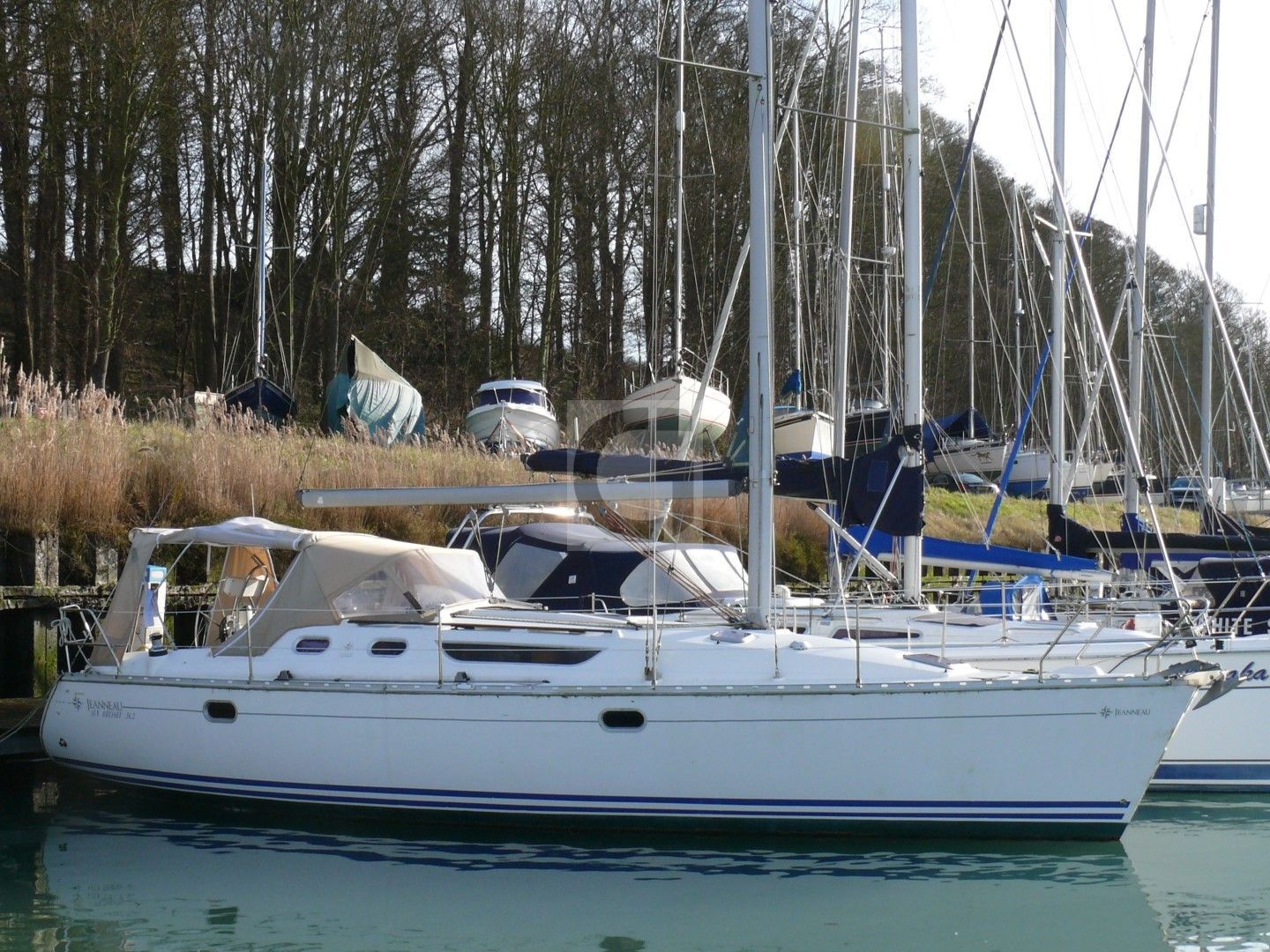
The Jeanneau Sun Odyssey 36.2 and the Hunter 356 are broadly comparable as mid-size cruisers but reflect different design philosophies: Jeanneau’s European approach prioritizes hull finesse and a slightly performance-tuned balance, whereas the 356 skews toward user-friendly cockpit layout and interior volume. On the water the Jeanneau can feel more balanced on a variety of points of sail and is often praised for predictable handling; the 356’s larger mainsail and swept spreader rig require more active reefing and trimming but reward owners with excellent light-air acceleration. For families, Jeanneau’s layouts often optimize liveability and ergonomic passage planning, while Hunter’s open salon and cockpit ergonomics emphasize social and short-handed cruising comfort.
Maintenance patterns differ as well: Jeanneaus from this period commonly benefit from robust European supply chains for replacement parts, and Hunters benefit from North American service familiarity—both reduce ownership friction in different regions. If your sailing is primarily coastal weekending with occasional week-long trips, the 356’s conveniences and simpler dockside handling may be more attractive; if you lean toward longer, faster passages with a slightly sportier feel, the Jeanneau reward that choice with a hull and deck plan that favors those conditions.
► Learn more about de Jeanneau Sun Odyssey 36.2
Maintenance Costs for a Hunter 356 in the USA
Typical annual running and maintenance expenses a buyer should budget (figures are approximate and will vary by region and condition):
- Mooring / Slip fees: $2,400–$8,000+ per year (northern marinas and seasonal slips cost more).
- Insurance: $700–$2,000+ per year (depends on coverage, region, and deductibles).
- Engine servicing (annual): $400–$1,200 (oil, filter, belts, winterizing where applicable).
- Antifouling / haulout / bottom paint: $800–$2,000 (annual or every 1–2 years depending on growth and region).
- Standing & running rigging inspection / small replacements: $300–$1,500 annually averaged (major rigging replacement every 10–15 years is a larger cost).
- Sails (annual repairs / deferred replacement): $200–$1,500 for repairs; full sail replacement $4,000–$12,000 depending on inventory and type.
- Electrical / electronics upkeep (battery replacement, chartplotter updates): $200–$2,500 annually averaged; major upgrades $2,000–$8,000.
- Misc. yard work, varnish, upholstery, plumbing: $500–$4,000 (highly variable).
Regional differences are significant: Florida and the Gulf may have lower haulout costs but higher hurricane insurance; New England marinas have higher seasonal slip fees and winterization costs. Significant one-time costs that buyers commonly encounter include prop replacement or upgrade (~$800–$3,000 installed), chainplate reinforcement or deck re-bedding work ($1,000–$6,000 depending on scope), and comprehensive electronics refits ($3,000–$12,000). Much routine maintenance (basic engine service, bedding, varnish, systems checks) can be owner-performed if the buyer is capable and has workspace, but critical jobs—rigging work, composite repairs, major engine overhauls—require professional service and therefore raise the ownership budget. Overall, for a boat of this size and intended coastal/family use the 356 sits in the medium maintenance cost tier: not as cheap as small weekenders, but generally less expensive to keep than larger or older classical yachts; good resale can offset refit investments if upgrades are sensible and well-documented
Conclusion
The Hunter 356 is a coherent proposition: a 35-foot cruiser that privileges livability, simplified short-handed sailing, and a cockpit-centric ergonomic approach. Its strengths are clear—roomy interior for the length, accessible systems, and a sailing character that rewards sensible sail choices rather than pushing for racing performance. Tradeoffs to accept include the B&R rig’s different handling traits (larger main, reef early) and the need to inspect key structural interfaces such as chainplates, window seals, and arch attachments on older boats. For the shopper seeking a comfortable coastal cruiser that can be single- or double-handed without constant crew, Hunter 356 examples offer strong value; for those whose primary priorities are aggressive upwind pointing, minimal drag for racing, or an already-proven offshore pedigree with factory-heavy systems, other contemporaries might be preferable. In short: if you want a practical, comfortable 35-foot cruiser that makes weekend sailing easy and costs less to buy than many newer alternatives, the Hunter 356 is worth actively looking for—provided you do a careful survey, factor in the common recommended updates, and prioritize boats with documented maintenance and sensible upgrades.
Specifications
| Hull Type | Fin w/spade rudder |
| Rigging Type | B&R |
| LOA | 35.50 ft / 10.82 m |
| LOD | 34.50 ft / 10.52 m |
| LWL | 30.58 ft / 9.32 m |
| Beam | 12.00 ft / 3.66 m |
| Displacement | 13,900 lb / 6,305 kg |
| Ballast | 5,023 lb / 2,278 kg |
| Max Draft | 6.42 ft / 1.96 m |
| Construction | Fiberglass (FG) |
| First Built | 2000 |
| # Built | 500 |
| Builder | Hunter Marine (USA) |
| Designer | Glenn Henderson |
| Auxiliary Power | Yanmar Diesel, 27 HP |
| Fuel Capacity | 38 gals / 144 L |
| Water Capacity | 75 gals / 284 L |
| Headroom | 6.42 ft / 1.96 m |
| S.A. (reported) | 721.00 ft² / 66.98 m² |
| S.A. / Displ. | 20.03 |
| Bal. / Displ. | 36.14 |
| Disp. / Len. | 217.00 |
| Comfort Ratio | 24.48 |
| Capsize Screening Formula | 2.00 |
| S# | 2.57 |
| Hull Speed | 7.41 kn |
| Pounds/Inch Immersion | 1,311.19 lb/inch |
| I | 44.83 ft / 13.66 m |
| J | 13.16 ft / 4.01 m |
| P | 44.92 ft / 13.69 m |
| E | 15.00 ft / 4.57 m |
| S.A. Fore | 294.98 ft² / 27.40 m² |
| S.A. Main | 336.90 ft² / 31.30 m² |
| S.A. Total (100% Fore + Main) | 631.88 ft² / 58.70 m² |
| S.A./Displ. (calc.) | 17.55 |
| Est. Forestay Length | 46.72 ft / 14.24 m |
| Mast Height from DWL | 55.25 ft / 16.84 m |
Disclaimer
The considerations and analyses presented regarding the Hunter 356 sailboat are of a general nature and are based on the available information and technical data on this model, interpreted to the best of our knowledge and understanding. It is important to note that the specific characteristics of any particular sailboat may vary due to custom modifications, maintenance performed, and conditions of use over time, among other factors. Therefore, the details and performance of the boat you are considering may not exactly match the information provided here.
We strongly recommend that, before making any purchasing or usage decisions, you conduct a detailed inspection of the boat in question, consult with nautical professionals and other sailors, and consider your personal needs, expectations, and capabilities. Each sailboat may have unique particularities that affect its performance and suitability for different types of sailing and sailors.
The information contained in this analysis should be used as a general guide and not as a definitive reference. Professional evaluation and personal inspection are essential to ensure that the boat meets your specific requirements and expectations.