


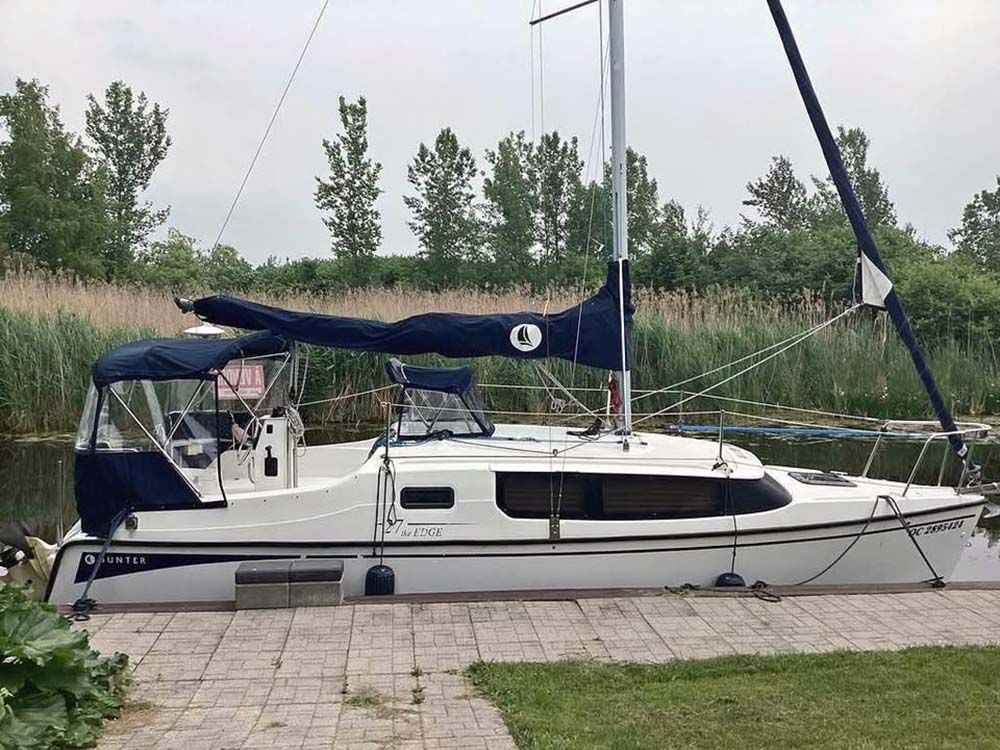
The Hunter 27 Edge is a compact, trailerable motorsailer that deliberately blurs the line between a practical daysailer, a small coastal cruiser and a planing runabout. Designed by the Hunter design team and marketed as “TheEDGE,” it first appeared in the mid-2000s and was built by Hunter Marine (later Marlow-Hunter) for a brief run—production examples date from about 2008 through the early 2010s—positioning the boat as an easy-to-tow, family-friendly platform that can also be driven hard under power. The concept was aimed at owners who wanted the flexibility to trailer, power at planing speeds for day trips, and still keep a genuine sailing rig and usable below-decks accommodation for weekends; that hybrid remit means the Edge has found most of its buyers among weekenders, trailer sailors and owners who value versatility more than pure offshore capability. On the used market it tends to trade in the same buyer pool as other trailerable motor-sailers (and competes for attention with MacGregor-line boats), so demand is steady but specialized—strongest where trailerability and easy ramp access matter.
Design and Construction
The Edge is built around a lightweight fiberglass hull with a retractable centerboard and an integrated water-ballast tank that converts a light, trailerable hull into a reasonably stiff sailing platform once filled. That combination—light empty displacement, large water ballast (around 1,600 lb) and a centerboard—keeps road weight low for towing while giving the boat respectable stability under sail; draining the ballast for trailering restores the low curb weight that makes over-the-road transport practical. Structurally the boat follows modern production practice: hand-laid or chopper-gun fiberglass hull, a molded deck, and production-level fitout. The rig is a fractional B&R sloop, chosen for a low, easy-handled sailplan and reliance on swept back spreaders rather than backstays—again a choice that favors simplicity for trailer/single-handed use. From a long-term ownership perspective these design choices create tradeoffs: the water-ballast plumbing, centerboard trunk and transom/outboard well require periodic inspection and service (more than a fixed-keel cruiser would), but the basic GRP construction and conventional fittings make hull repairs and common upgrades straightforward and well supported by yards.

Performance
On the water the Edge behaves like what it is: a hybrid. In displacement mode under sail its calculated hull speed is in the mid-6-knot range and owners report predictable, forgiving handling in coastal conditions; the fractional B&R rig and modest sail area make the boat easy to reef and short-hand. Where the design stands out is under power—fitted with a large outboard and with ballast drained, the Edge will plane and can hit double-digit speeds and, in factory marketing and owner experience, run into the high teens or low-20s under ideal conditions—something a conventional 27-ft keelboat won’t do. That performance under power makes the boat uniquely useful for mixed use (quick hops, watersports, rapid repositioning) but it also means fuel and engine considerations matter: owners tuning the Edge for serious sailing often keep ballast in place and fit a modest outboard, while those who favor motoring will accept the compromises in sail performance. Compared with strictly-sailing 27-ft cruisers (traditional Hunter 27s, Catalina 27s), the Edge sacrifices some pointing performance and light-air grunt but wins on versatility and ramp-to-water convenience.
Comfort and Accommodations
Belowdecks the Edge is compact but cleverly arranged: cabins fore and aft (or a forward V-berth and convertible saloon depending on fit), a small galley and an enclosed head give the feel of a weekend cruiser rather than a daysailer. Because the hull is relatively beamy for its length and the coachroof is raised compared with traditional trailer sailors, headroom and usable locker space are better than many competing trailerable designs—owners commonly praise the interior volume for overnighting. At the same time there are obvious limits: freshwater capacity and tankage are modest in factory spec (some published specs list very small water tanks in dealer brochures), and galley and tankage options are intentionally lightweight to preserve towable mass. For couples or a small family the Edge is perfectly serviceable for weekends and short coastal cruises; for long-term liveaboard cruising it feels cramped and the small water/fuel capacities usually require aftermarket upgrades to be practical.
Safety and Practicality
Deck ergonomics favor easy launching, boarding and single-person handling: the walk-through transom, planing-capable hull and outboard well make the Edge extremely practical for ramp use, swift beaching and water-side activities. The flip side is that the boat’s safety envelope while motoring at planing speed differs from conventional displacement sailing—heavy, sustained planing runs expose the outboard and transom to different loads and require careful fuel, engine and sea-state management. As a sailing platform the retractable centerboard and water ballast give shallow-water access and good trailering practicality, but they add service points (ballast valves, pumps, board pivot bearings, trunk seals) that must be inspected during surveys. Overall the Edge is best treated as a coastal and inshore boat that doubles as a fast motorboat; for true offshore or heavy weather sailing an owner should plan for equipment upgrades (higher capacity tanks, stronger ground-tackle, heavier sails) and accept that the basic systems were optimized for trailer/coastal use rather than transoceanic voyaging.
Known Issues with the Hunter 27 Edge
Owner reports and forum threads show a pattern of recurring maintenance topics rather than one single catastrophic failure mode. The most frequently mentioned items are: water-ballast plumbing and valves that need attention (pumps, hoses, tank fittings), centerboard trunk wear or binding, and the usual checklist around transom and outboard well fittings for corrosion or leaks—problems that are direct consequences of the trailerable/motorsailer design. Some owners also note that steering feel (wheel versus tiller dynamics) can feel heavy or sluggish at low speed, and expect routine outboard-related service (mount, tilt mechanism, controls) that differs from inboard-engine boats. Common, practical upgrades recommended by experienced owners include fresh water capacity increases (larger portable tanks or additional jerries), upgrading the outboard controls and fuel system if you intend sustained planing use, and regular inspection/servicing of the ballast system and centerboard bearings during haul-outs. None of these are unusual for a hybrid trailerable boat, but because they’re integral to the Edge’s appeal they should be high on a buyer’s pre-purchase checklist.
Market Availability and Pricing in the U.S.
The Edge is out of production and primarily available on the used market; U.S. listings tend to cluster in coastal states where trailer launching is common (Florida, Gulf states, parts of the Southeast and some Great Lakes areas). Recent sold and asking prices for Edge examples and comparable trailerable motorsailers show a broad band depending on year, equipment and condition—examples and broker listings from 2008–2012 model years typically trade in the range of roughly $15,000–$40,000 in the U.S., with cleaner, fully-equipped boats toward the upper end. That spread reflects real-world variables: upgraded outboards, good trailer packages, electronics and fresh bottom jobs lift asking price, while mechanical or ballast/centerboard issues depress it. Compared with strictly-sailing 27-ft cruisers the Edge can command a premium if the buyer values the power/planing capability and factory trailer, but it will be a smaller, more specialized market than mainstream keelboat models—resale liquidity is good within the trailer/motorsailer niche but longer to sell outside it.
Below is a comparison with similar sailboats from the same era:
| Model | LOA | Approx. years | Typical used price (US) | Main differences |
|---|---|---|---|---|
| Hunter 27 Edge | ~26.3 ft | 2008–2012 | $15,000–$40,000 | Trailerable motorsailer: water ballast + centerboard; planing under outboard power; compact cruising interior. |
| MacGregor 26M | ~25.8 ft | 2003–2013 | $10,000–$30,000 | Pure trailerable motor/sail focus; very common on US used market; typically simpler interiors and huge buyer base for trailer sailors. |
| Hunter 27 (classic / 27 series) | ~27.2 ft | 1974–2006 (various 27 variants) | $4,000–$30,000 (wide variation by age/condition) | Conventional fixed-keel cruisers across multiple generations; heavier, more sea-kindly under sail, broad parts/support network. |
| Catalina 27 | ~27.0 ft | 1974–1990s (widely produced) | $3,000–$20,000 (depending on year/condition) | Classic American 27-ft cruiser; proven, simple, often cheaper to buy and maintain but not trailerable or planing focused. |
Hunter 27 Edge vs MacGregor 26M

The Edge and the MacGregor 26M share the same market niche—trailerable boats that can motor quickly and still be sailed—but they take slightly different approaches to the compromise. The MacGregor emphasizes the pure trailerable planing experience (long production run, very large owner base, extreme focus on value and ease of trailering), while the Edge was built with a stronger emphasis on weekend comfort and a more finished interior, plus a centerboard and transom design intended to feel a bit more like a conventional boat when sailing.
In practical ownership terms that means MacGregor models typically cost less and are easier to resell among trailer sailors, but they often have simpler fit and finish; the Edge will often fetch a premium for the added interior comfort, better fit-out and Hunter dealer pedigree, while requiring the same attention to ballast plumbing, outboard maintenance and trailer upkeep.
► Learn more about de MacGregor 26M
Hunter 27 Edge vs Hunter 27 (Classic)

Compared to the older, fixed-keel Hunter 27 family, the Edge is a design that trades traditional displacement sailing characteristics for versatility: lighter trailering weight, water-ballast stiffness when launched and the ability to plane under outboard power. The classic Hunter 27s (Cherubini designs and subsequent variants) are heavier, generally carry more permanent ballast, and feel more like conventional seaworthy small cruisers—better suited for sailors prioritizing pure sailing comfort and offshore confidence.
For buyers this boils down to intended use: choose the classic Hunter 27 if you want a simple, heavy-keel sailing experience with a large parts/owner community and easier systems, or pick the Edge if trailerability, ramp access and the mixed motor-and-sail lifestyle are the priority.
► Learn more about de Hunter 27
Hunter 27 Edge vs Catalina 27

The Edge and the Catalina 27 address similar owner sizes (couple/family weekenders) but from different philosophies: Catalina 27s are mainstream, displacement-oriented keelboats with deep U.S. market penetration and generally cheaper entry prices, while the Edge is niche, trailerable, and built to offer powerboat-like mobility alongside sailing capability. Consequently, the Catalina tends to be simpler to maintain for owners who want purely sailing-focused use and who value an extensive U.S. dealer/owner base; the Edge wins when the buyer values ramp convenience, the ability to motor briskly between spots and a more modern, compact interior layout.
From a maintenance/ownership standpoint Catalinas are often cheaper to keep in long-term sailing use (less ballast plumbing, no centerboard trunk service), whereas the Edge can bring extra service items but returns versatility that some owners find worth the trade.
► Learn more about de Catalina 27
Maintenance Costs of a Hunter 27 Edge in the U.S.
Below are the typical recurring and periodic costs you should budget for; ranges are U.S.-oriented and vary widely by region (New England/California at the high end; Southeast/Gulf states at the lower end). Rule-of-thumb: for a 26–27-ft trailerable motorsailer expect low to moderate fixed costs but add specialized line items for the water-ballast and trailer systems.
- Mooring / Slip / Storage: trailer sailors often pay less for marina slips if they trailer out regularly, but winter storage, yard haul/launch and trailer storage add up. Budget $500–$6,000/year depending on region and whether you use a seasonal rack, slip, or off-site storage.
- Insurance: small coastal cruisers and trailer boats often see premiums $300–$1,200/year for standard liability and hull coverage; higher in hurricane zones or for charter/paid use.
- Engine / Outboard servicing & fuel: regular outboard maintenance (annual tune, lower unit, prop, fuel system) $300–$1,200/year depending on hours and professional vs DIY; fuel costs rise quickly if you regularly plane the boat.
- Antifouling / haul-out / bottom paint: even trailerable boats need occasional hull care—expect $200–$1,500 for periodic bottom maintenance if you keep the boat in the water part-time; full professional haul/paint higher.
- Water-ballast & centerboard systems: pump replacement, hose and valve service, or centerboard bearing work are specialty items—budget $200–$2,000 spread over several years depending on condition and use.
- Standing & running rigging: inspections yearly; partial running-rigging refresh is inexpensive, a full standing-rig replacement (rare on a newer 27) could be $1,000–$4,000.
- Sails: mains and working headsails for a small fractional rig are typically $1,500–$6,000 for full replacements depending on materials and loft; light-air or specialty sails extra.
- Trailer upkeep: brakes, bearings, lights and tires—plan $200–$1,200/year amortized, higher if trailer needs axle or brake work.
- Electronics / batteries: modest systems and periodic battery replacement—$300–$3,000 depending on whether you upgrade to chartplotter/AIS, solar, etc.
Significant one-time events to plan for: major ballast-tank/centerboard trunk repair or full rig replacement (can be several thousand dollars), a new outboard (many owners spend $5k–$12k for a modern mid-range outboard), and major trailer refurbishments. Many owners can handle a large share of routine maintenance (trailering, cleaning, oil changes, simple electronics swaps), but water-ballast plumbing, centerboard structural work and professional outboard servicing usually need specialists—factor in labor rates for marine yards in your area. Overall, maintenance and operating costs for the Edge are medium for its size: not as cheap as the simplest fixed-keel 27s (which lack the ballast/trailer complexity), but generally lower than larger keelboats and entirely affordable if you’re comfortable with periodic specialist service
Conclusion
The Hunter 27 Edge is a clear niche proposition: a trailerable, planing-capable motorsailer with reasonable weekend-cruising accommodations. Its strengths are practical and immediate—easy ramp access and trailering, rapid powered repositioning, a forgiving fractional rig and a surprisingly roomy interior for the class. Its compromises are no surprise: extra service items tied to the water-ballast and centerboard systems, limited factory tankage (unless upgraded) and a sailing performance profile that prioritizes versatility over pure upwind speed or offshore endurance. For a buyer who values launch-and-go flexibility, wants to mix watersports or speedy day runs with occasional overnight cruising, and prefers a boat that can live on a trailer, the Edge is a fine fit and can be good value on the used market; for someone focused on long-distance sailing or simple, lowest-maintenance ownership, a conventional fixed-keel 27-ft cruiser (Catalina/Hunter classic variants) will often be the better choice. In short: look for the Edge if trailerability and mixed power/sail capability are priorities—inspect ballast and centerboard systems closely at survey, budget for a sensible outboard and fresh water upgrades if you plan multi-day trips, and you’ll find a versatile little boat with an honest, usable package and a stable niche in the resale market.
Specifications
| Hull Type | Keel/Centerboard |
| Rigging Type | Fractional Sloop |
| LOA | 26.35 ft / 8.03 m |
| LWL | 24.18 ft / 7.37 m |
| S.A. (reported) | 288.00 ft² / 26.76 m² |
| Beam | 8.33 ft / 2.54 m |
| Displacement | 3,450 lb / 1,565 kg |
| Max Draft | 4.92 ft / 1.50 m |
| Min Draft | 1.57 ft / 0.48 m |
| Construction | Fiberglass (FG) |
| Ballast Type | Water |
| First Built | 2006 |
| Builder | Hunter Marine (USA) |
| Designer | Hunter Design Team |
| Auxiliary Power | Outboard |
| Fuel Capacity | 6 gal / 23 L |
| Water Capacity | 10 gal / 38 L |
| S.A./Displ. | 20.24 |
| Disp./Len. | 108.94 |
| Comfort Ratio | 12.75 |
| Capsize Screening Formula | 2.21 |
| S# | 4.57 |
| Hull Speed | 6.59 kn |
| Pounds/Inch Immersion | 719.69 lb/inch |
| Rig Dimensions (I / J / P / E) |
I: 23.67 ft / 7.21 m J: 11.48 ft / 3.50 m P: 24.83 ft / 7.57 m E: 12.25 ft / 3.73 m |
| Sail Areas |
Fore: 135.87 ft² / 12.62 m² Main: 152.08 ft² / 14.13 m² Total (100% Fore + Main): 287.95 ft² / 26.75 m² |
| S.A./Displ. (calc.) | 20.23 |
| Est. Forestay Length | 26.31 ft / 8.02 m |
Disclaimer
The considerations and analyses presented regarding the Hunter 27 Edge sailboat are of a general nature and are based on the available information and technical data on this model, interpreted to the best of our knowledge and understanding. It is important to note that the specific characteristics of any particular sailboat may vary due to custom modifications, maintenance performed, and conditions of use over time, among other factors. Therefore, the details and performance of the boat you are considering may not exactly match the information provided here.
We strongly recommend that, before making any purchasing or usage decisions, you conduct a detailed inspection of the boat in question, consult with nautical professionals and other sailors, and consider your personal needs, expectations, and capabilities. Each sailboat may have unique particularities that affect its performance and suitability for different types of sailing and sailors.
The information contained in this analysis should be used as a general guide and not as a definitive reference. Professional evaluation and personal inspection are essential to ensure that the boat meets your specific requirements and expectations.