



The Hunter 31 is a compact cruiser designed in the early 1980s by Cortland Steck and built by Hunter Marine in the United States beginning in 1983. It was conceived as a family-oriented coastal cruiser with sporting lines and simple, user-friendly systems: an easy-to-handle masthead sloop intended to be single-handed or short-crew friendly rather than a serious offshore passagemaker. Over the years the name has been recycled for later Hunter and Marlow-Hunter designs (often confusing buyers), but the original 1983–1987 Steck design remains common on the used-boat market because it offers a lot of interior volume and straightforward sailing manners for its size. Today you’ll mostly see these older hulls on the second-hand market and they appeal to budget-conscious cruisers, club sailors and buyers looking for a roomy weekend boat rather than to charter companies or professional schools.
Design and Construction
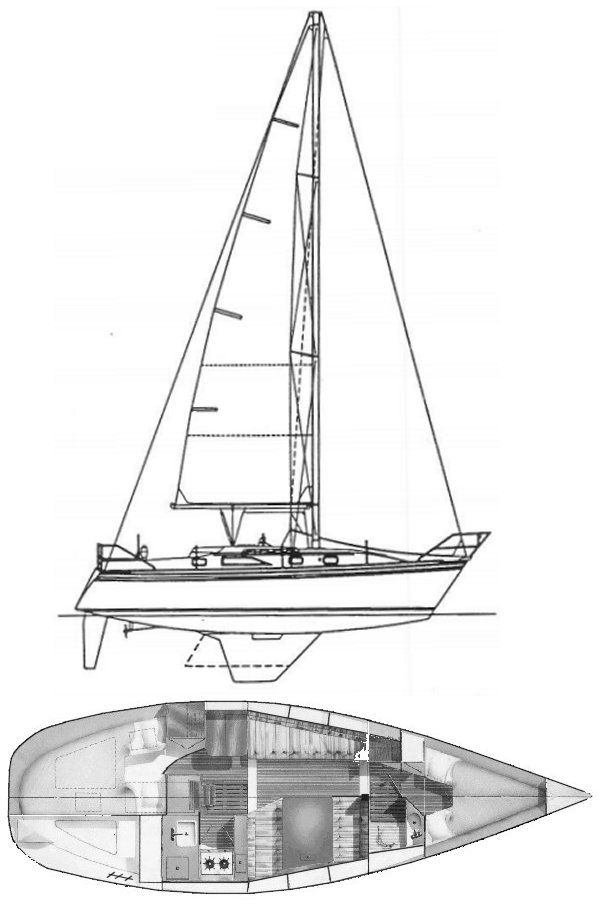
The Hunter 31 is a fiberglass (GRP) production boat with a fin keel and an internally-mounted spade rudder, and it uses Hunter’s B&R style rigging with swept spreaders. That package—moderate beam for the era (about 10′11″), a relatively long waterline, and a ballast/displacement ratio in the low-40% range—gives the boat a balance between initial stiffness and moderate displacement behavior: enough ballast to stand up in a breeze, with a hull form that favors interior volume and comfortable motion for coastal work. The builder used hand-laid fiberglass with internal stringers and frames bonded to the hull to improve stiffness without excessive weight, a typical production-boat approach that simplifies repairs (laminate repairs are straightforward) but means attention to deck core areas, fittings and chainplates is essential over time.
From a maintenance and resale perspective those decisions are a mixed bag. The fiberglass hull itself tends to be durable and easily repaired, but the balsa-cored deck sections (common on many Hunters of that era) and cast-iron keel-to-hull joints are two areas where deferred maintenance shows up and can affect value. Architecturally, the design maximizes interior room within a 31-foot LOA envelope (wider beam and a plumb transom compared with older classic sloops), which buyers appreciate for liveability but which also means more topside area exposed to wind and spray—something to consider for owners who prize blue-water seakeeping over comfort at anchor.
Performance
On paper the Hunter 31’s hull speed is about 6.8–6.9 knots and the boat sits in the “coastal cruiser” performance band—SA/D and comfort ratios indicate a boat designed to be lively in moderate airs but not a racer. In light air she will be conservative compared with modern light-displacement designs, but in 8–15 knots she points reasonably well and tracks with a neutral helm: forgiving rather than sporty. Owners commonly report the boat can feel a little tender in sudden gusts (typical of a boat with generous topsides and a relatively high sail area for displacement), so reef early above 18–20 knots to keep the motion comfortable; the B&R rig and swept spreaders can limit how deeply you trim an overlapping genoa downwind, which leads many owners to prefer combinations of headsail and a light asymmetric when reaching.
Compared to contemporaries, the Hunter 31 sits comfortably between the heavier, more conservative 1970s cruisers and the later, wider-beamed 1990s cruisers: better day-sailing pace than a heavy full-keel boat and easier to single-hand than many more performance-oriented designs of similar length.
Comfort and Accommodations
Below deck the Hunter 31 was laid out to feel larger than its length suggests: a sociable saloon, a practical U-shaped galley, a dedicated nav station and a roomy aft cabin give the boat real family-cruiser credentials. Headroom in the saloon is generous for a 31-footer (owners typically report about 6′3″ in the main saloon), and molded tanks and lockers are placed to maximize usable space. Storage is decent for weekending and short-term liveaboard use, but long-term liveaboard comfort depends on how aggressively you’ll stow gear—larger families may find the V-berth cramped for two adults on extended trips.
Practical considerations—ventilation through multiple ports and hatches, a functional galley with room for a two-burner or three-burner stove, and a head with shower—make the boat easy for couples or small families to cruise for extended weekends. Many Hunter 31 interiors have aged with teak veneer and joinery that, while warm, often gets refitted or refreshed by new owners; it’s common to see modest cosmetic refits (new upholstery, electronics) that dramatically increase perceived comfort and resale appeal.
Safety and Practicality
On deck the boat’s generous freeboard and relatively high cockpit coamings give a secure feel at anchor and in chop, but the T-shaped cockpit can be a little crowded when fully crewed because of the pedestal wheel and controls. Lifelines and pulpits are conventional for the era; deck gutters and non-skid areas are basic but practical. Access to the water is straightforward via the transom and a boarding ladder, but if you plan frequent heavy weather or offshore passages you’ll want to consider strengthening deck fittings and checking chainplate load paths as part of any pre-purchase survey.
Systems on the 31 are generally accessible: the modest Yanmar auxiliary is easy to work on and panels open well, but owners should expect to upgrade electronics, replace old hoses and check the fuel tank condition in older boats. For most buyers the boat is best seen as a coastal cruiser—good for extended weekend passages and coastal hopping—with blue-water capability only after structural and systems upgrades.
Known Issues with the Hunter 31
Owners and surveyors commonly report a handful of recurring problems that are worth checking on any candidate:
- Delamination beneath the mast step and compression post areas, often from water ingress or poor earlier repairs.
- Balsa-cored deck soft spots or core rot around leaky deck fittings and hatches.
- Cast-iron keel corrosion (rust staining where keel meets hull), which requires careful inspection of keel bolts and flange areas.
- Undersized or tired deck hardware (winches, travelers) and dated fuel tank installations in some early hulls.
- Bilge and shower sump designs that can trap water and encourage rot to the cabin sole if not maintained.
Many of these are age-related or maintenance-driven rather than fatal design flaws. Practical buyer upgrades include replacing rotted core sections and rebedding fittings, switching to a modern fuel tank if the original is failing, fitting larger winches and a stronger mainsheet traveler, and installing modern electronics and sailing instruments. A careful survey will reveal which of these recommended fixes are cosmetic and which are structural, and the latter should be treated as negotiation points in purchase.
Market Availability and Pricing in the U.S.
This original Hunter 31 is no longer in production; what you find today is strictly a used-boat market made up of hulls built between 1983 and 1987. Listings are frequent enough that you can usually find examples in most U.S. boating regions—Florida, the Gulf Coast, the Chesapeake and New England tend to have the largest pools of older production boats, while California listings appear periodically for well-kept West Coast examples. Condition varies from project boats to well-refitted cruisers; many are sold by private owners who upgraded electronics and sails, but you can also find hulls that have been lightly neglected. Recent listing aggregators show examples at both the low end and mid-range of the used market, so expect prices to reflect condition and refit history.
For a practical buying benchmark, typical asking prices in the U.S. currently fall roughly in the range $9,000–$56,000 depending on year, equipment and condition (projects at the low end, turnkey boats at the high end). That spread makes the Hunter 31 an economical entry into a roomy coastal cruiser if you are willing to do some mechanical or cosmetic work; at the same time, the large supply of similar boats means resale value is modest and you should buy with the expectation of doing selective upgrades rather than banking on strong appreciation.
Below is a comparison with similar sailboats from the same era:
| Model | LOA | Years (approx.) | Typical U.S. used price | Principal differences |
|---|---|---|---|---|
| Catalina 30 | ~29.9 ft | 1977–2008 (various marks) | $12,000–$35,000 | Proven long production run, conservative hull, easy systems and large owner community. |
| Marlow-Hunter 31 (later model) | ~31 ft | 2006–2015 (and later Marlow variants) | $35,000–$80,000+ | More modern layout, larger interior volume and updated systems; typically newer and pricier. |
| Beneteau First 31.7 | ~31.7 ft | 1990s–2000s | $40,000–$65,000 | Tends to be more performance-oriented with sleeker hull and race/cruise compromises. |
Hunter 31 vs Catalina 30

The Westsail 28 is heavier and fuller-hulled, with a long-keel, cutter-oriented design that prioritizes seakindliness and reserve buoyancy; by contrast, the Cape Dory 28 (an Alberg-inspired design) is narrower, lighter and often feels more sprightly to windward. For a buyer this translates into the Westsail offering a calmer motion and superior directional stability in confused seas, while the Cape Dory typically points higher and accelerates more readily—advantages if your sailing is largely coastal and you care about passage time.
Maintenance differs in emphasis: the Westsail’s solid hull and heavy joinery mean more focus on engine, shaft and deck-core inspections, while the Cape Dory’s simpler systems and slightly more modern layouts often make upgrades and parts replacement cheaper and more straightforward. If resale liquidity and interior volume matter, the Cape Dory has the edge; if offshore confidence and classic, heavy-duty construction are your priority, the Westsail wins out.
► Learn more about de Catalina 30
Hunter 31 vs Marlow-Hunter 31

The original Hunter 31 (1983) is a product of its era—solid hull, more basic systems—and the Marlow-Hunter 31 is a later evolution with more modern production techniques, updated deck layouts and often a focus on convenience features (arches, molded cockpit furniture, modern furling systems). That translates into a different ownership profile: the Marlow-Hunter typically requires less immediate upgrading and is better suited to buyers wanting turn-key capability.
Performance and handling differences are subtle: the Marlow-Hunter benefits from contemporary hull shaping and rigging choices that often improve light-air performance and deck ergonomics, while the older Hunter 31 remains competitive in moderate winds and gives a slightly more tactile feel to experienced skippers. If low purchase price and a project-friendly platform matter, the older Hunter is compelling; if you prefer newer systems and higher initial comfort, spending more on a Marlow-Hunter often makes sense.
► Learn more about de Marlow-Hunter 31
Hunter 31 vs Beneteau First 31.7

Compared with a Beneteau First 31.7 or similar performance-leaning 31-footers, the Hunter 31 favors comfort and straightforward handling over outright speed. The Beneteau variants usually have a more performance-oriented hull and rig, which result in a higher SA/D and crisper behavior to windward; they’re attractive to buyers who want club racing potential plus cruising ability.
From a practical ownership standpoint the Beneteau’s sleeker lines and lighter build can mean more attention to sail inventory and tuning to get the best performance, while the Hunter’s broader interior and robust layout make it easier to live aboard or take families cruising with less focus on sail trim. Maintenance expectations differ accordingly: performance boats often demand newer sails and tighter rig checks, while the Hunter’s likely bills center on deck and systems refurbishment
► Learn more about de Beneteau First 31.7
Maintenance Costs of an Hunter 31 in the U.S.
Typical annual and periodic costs for a 31-foot production cruiser like the Hunter 31 will vary by region and owner choices. Below is a commented list of the common cost items you should budget for (each item in bold followed by a short note):
- Mooring/Slip or Storage: Depending on region, expect $1,200–$8,000+ per year (inland lakes and small marinas at the low end; high-demand coastal slips, especially in the Northeast and California, at the top).
- Insurance: Roughly $300–$1,200 annually for a used Hunter 31 depending on vessel value, cruising area and coverage limits; coastal cruising and charter use raise premiums.
- Engine servicing & fuel: Annual service, oil, impeller and filters $300–$900; more if injectors or transmission work is needed. Older Yanmar 13–16 hp installations are inexpensive to service but parts/labor add up.
- Antifouling & haul-out: Plan on $600–$2,000 per year (haul, bottom prep and paint), more at big-yard locations or for extensive fairing.
- Standing rigging inspection / replacement: Inspection annually; replacement every 10–15 years—budget $1,500–$5,000 for a full rigging replacement depending on options.
- Running rigging & sails: Minor running rigging replacements and repairs $100–$800 per year; new mainsail or furling genoa is a significant one-time cost ($2,000–$6,000+ depending on cloth and supplier).
- Winterization / shrinkwrap or summer commissioning: $200–$1,000 per season depending on services chosen.
- Electronics & small systems: Upgrades (chartplotter, AIS, instruments) commonly $1,000–$7,000 if you modernize; incremental replacements are cheaper.
- Survey / repairs / refit: Expect periodic one-off bills—surveys typically $400–$1,000; small refits $2,000–$10,000; major refits (deck core, keel work, engine replacement) can exceed $20,000.
Regional differences: haul-out and slip fees are the largest variable—Florida and the Southeast can be cheaper for wintering than New England or California, where yard and marina rates are higher. Many owners can handle routine maintenance themselves (bottom painting, oil changes, basic rigging swaps) and thus keep annual costs lower; structural work, complex electrical or composite repairs usually require professional help and therefore raise total cost of ownership.
Overall cost classification: for a 31-ft production cruiser, expect medium ongoing costs—higher than a basic daysailer but lower than a larger, more complex yacht. Because the Hunter 31 typically sells for modest sums, plan for periodic investments to keep systems current; sensible upgrades (sails, electronics, re-bedded deck gear) improve safety and resale prospects.
Conclusion
The Hunter 31 is a pragmatic, roomy and approachable coastal cruiser that has a lot to offer buyers who want comfortable accommodations, simple systems and forgiving sailing manners at a modest price. Its strengths are interior volume, ease of single-handing, and a hull that performs well in realistic coastal conditions; its weaknesses are age-related items that frequently surface in surveys—deck core issues, keel flange corrosion and some undersized original hardware—so a thorough pre-purchase inspection is essential.
For buyers seeking an affordable, family-friendly 31-footer to use for weekend cruising and occasional longer coastal hops, the Hunter 31 is worth serious consideration provided you budget for targeted upgrades. It is not the best starting point if your priority is offshore passagemaking right out of the gate, but for coastal cruising its cost-to-value proposition is attractive. Resale value is modest and tied closely to condition and upgrades; buy with realistic expectations, prioritize a good survey and the boat will repay you with roomy comfort and straightforward sailing.
Specifications
| General Specifications | |
|---|---|
| Hull Type | Fin w/spade rudder |
| Rigging Type | B&R |
| LOA | 31.33 ft / 9.55 m |
| LWL | 26.25 ft / 8.00 m |
| Beam | 10.92 ft / 3.33 m |
| Displacement | 9,700 lb / 4,400 kg |
| Ballast | 4,000 lb / 1,814 kg |
| Max Draft | 5.30 ft / 1.62 m |
| Construction | Fiberglass (FG) |
| First Built | 1983 |
| Last Built | 1987 |
| Builder | Hunter Marine (USA) |
| Designer | Cortland Steck |
Auxiliary Power / Tanks | |
| Make | Yanmar |
| Type | Diesel |
| Horsepower | 16 HP |
| Fuel Capacity | 18 gals / 68 L |
| Water Capacity | 33 gals / 125 L |
Sailboat Calculations | |
| S.A. (reported) | 458.00 ft² / 42.55 m² |
| S.A. / Displ. | 16.17 |
| Bal. / Displ. | 41.24 |
| Disp. / Len. | 239.41 |
| Comfort Ratio | 22.36 |
| Capsize Screening Formula | 2.05 |
| S# | 2.19 |
| Hull Speed | 6.87 kn |
| Pounds/Inch Immersion | 1,024.23 lb/in |
Rig and Sail Particulars | |
| I | 42.00 ft / 12.80 m |
| J | 12.00 ft / 3.66 m |
| P | 37.42 ft / 11.41 m |
| E | 11.00 ft / 3.35 m |
| S.A. Fore | 252.00 ft² / 23.41 m² |
| S.A. Main | 205.81 ft² / 19.12 m² |
| S.A. Total (100% Fore + Main) | 457.81 ft² / 42.53 m² |
| S.A. / Displ. (calc.) | 16.16 |
| Est. Forestay Length | 43.68 ft / 13.31 m |
| Mast Height from DWL | 47.33 ft / 14.43 m |
Disclaimer
The considerations and analyses presented regarding the Hunter 31 sailboat are of a general nature and are based on the available information and technical data on this model, interpreted to the best of our knowledge and understanding. It is important to note that the specific characteristics of any particular sailboat may vary due to custom modifications, maintenance performed, and conditions of use over time, among other factors. Therefore, the details and performance of the boat you are considering may not exactly match the information provided here.
We strongly recommend that, before making any purchasing or usage decisions, you conduct a detailed inspection of the boat in question, consult with nautical professionals and other sailors, and consider your personal needs, expectations, and capabilities. Each sailboat may have unique particularities that affect its performance and suitability for different types of sailing and sailors.
The information contained in this analysis should be used as a general guide and not as a definitive reference. Professional evaluation and personal inspection are essential to ensure that the boat meets your specific requirements and expectations.