



The Marlow-Hunter 31 is a modern, compact cruiser introduced by Hunter (under the Marlow-Hunter brand) in the mid-2010s as a family-oriented coastal cruiser that trades big-boat conveniences for manageable size and ease of handling. Designed by Glenn Henderson with input from David Marlow, the 31 was marketed as a comfortable, well-built pocket cruiser intended primarily for couples or small families who value interior volume and simple systems over racing performance; it arrived at a time when many owners were asking for more liveable space in the 30–33-foot class. The model was produced in the United States from around 2015 through the late 2010s and has found a steady place on the used market: buyers tend to be coastal cruisers, yacht-club weekend sailors and owners who want an easy-to-handle two-cabin layout rather than charter companies or heavy offshore passagemakers.
Design and Construction
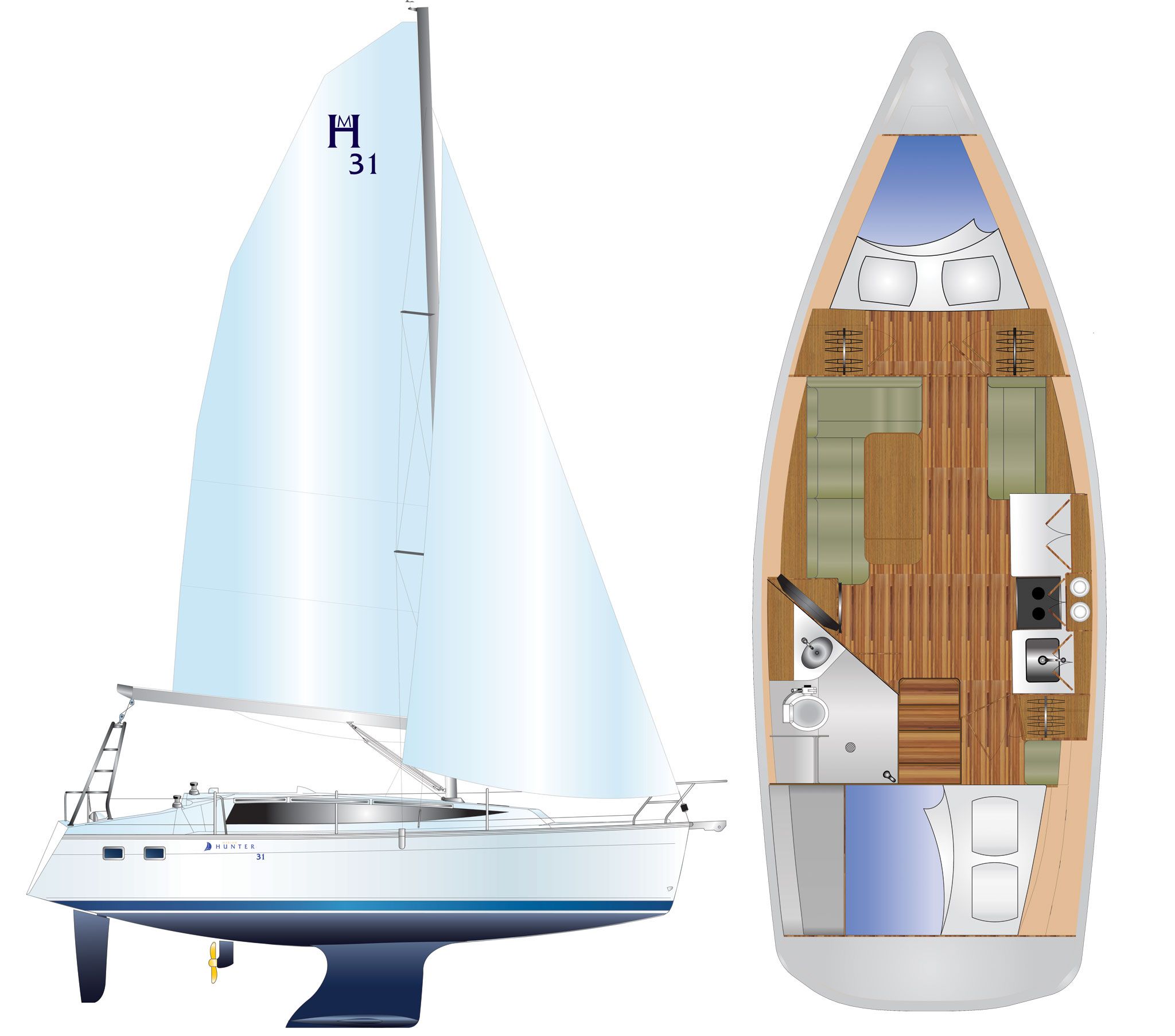
The Marlow-Hunter 31 uses a modern, relatively beamy hull with a plumb bow and modest overhangs to maximize waterline length and interior room; she comes with either a deeper fin keel or a shoal option, and an internally mounted spade rudder. The rig is a fractional B&R sloop with swept spreaders and a stainless-arch mainsheet traveler — a Hunter hallmark that keeps cockpit lines tidy and reduces cockpit clutter. Construction is polyester/vinylester fiberglass with Nida-core reinforcement in deck areas and Kevlar reinforcement forward; the builder emphasized collision protection up front and a laminated structure aimed at stiffness and longevity. Those choices make the boat relatively light and roomy for its length while keeping production and repair straightforward: a solid fiberglass hull with localized core and reinforcement is easier for typical yards to repair than exotic composites, and replacement parts (blocks, deck hardware, rudder components) remain widely available. (sailboatdata)
From an architectural standpoint the 31 sits in a design sweet spot: moderate ballast ratio and a relatively low center of gravity give enough initial stability for cruising comfort, while a moderate displacement/length and a healthy sail area/displacement ratio preserve lively performance in light to moderate airs. The trade-offs to note for a buyer are simple: wide beam for interior volume increases form stability (comfortable at anchor and in a reach) but can make motion in confused short seas a bit snappier; the spade rudder and lighter overall displacement favor responsiveness but make grounding and structural impacts something to inspect carefully.
Performance
On the water the Marlow-Hunter 31 generally behaves like a modern cruising 31: she accelerates readily in moderate breeze, points reasonably well for a beamy hull, and delivers comfortable off-wind performance thanks to the generous beam and sail plan. Magazine tests and owner reports put typical cruising speeds in the high-4 to mid-6-knot range on a beat in 10–15 knots of breeze, with higher burst speeds on a reach; sustained figures above hull-speed are uncommon except surfing down waves. The fractional B&R rig simplifies mainsail control (no backstay) and helps keep the rig balanced, but shorthanded helmsmen should pay attention to headsail trim since much of the drive comes from the foresail in lighter winds.
Compared with older, narrower 30-footers the 31 feels more stable and roomy; compared with performance-oriented 32–34-footers it is not a race winner but is easier to handle for a short-handed couple. In confused seas the broad hull can make the motion quicker than in a narrower cruiser, but the trade is an interior and cockpit that feel much larger than many older designs in the same length bracket. Owner forums report consistent praise for handling and predictability, though claimed top speeds are often optimistic when cited without context.
Comfort and Accommodations
Interior packaging is one of the 31’s strongest selling points. The wide beam and careful layout deliver a full-size V-berth or forward cabin, a convertible saloon settee, and a private aft cabin (two-cabin layouts are common), plus a surprisingly complete galley and a single head with reasonably generous volume for a 31-footer. Natural light and ventilation are above average for the class, and storage is designed to support weekend cruising or short-term liveaboard use. The stainless arch and tidy cockpit arrangement create a protected social space that’s easy to use under sail or at rest.
For prospective buyers this layout makes the boat ideal for a couple who want overnighting and coastal cruising comfort, or a small family where the aft cabin serves as a private sleeping area. For full-time liveaboard use the 50-gallon fresh water capacity and two-cabin arrangement are helpful, but long-term cruisers should evaluate galley refrigeration capacity, storage for spares and heating/ventilation upgrades. Interiors on these boats often age well because of quality finishes, though many second-hand examples show light modernization (upgraded electronics, new upholstery) which is typical and not a sign of hidden problems.
Safety and Practicality
Deck layout and deck hardware emphasize straightforward, low-fatigue sailing. The arch with mainsheet traveler moves crucial control lines away from the cockpit, reducing tripping hazards and lowering risk of accidental jibes. Wide side decks and well-placed grabrails help in rougher conditions, and the fold-down swim platform improves boarding and man-overboard recovery in calm conditions. Accessibility to through-hull fittings, the engine compartment and key systems is generally good—an important practical advantage for routine maintenance and emergency access.
That said, owners aiming to use the 31 for offshore passages should be realistic: the boat is a coastal cruiser at heart. With careful upgrades (e.g., additional handholds, stronger jacklines, upgraded navigation and communications, reinforced seacocks) it is capable of sensible offshore legs, but original-equipment configurations are optimized for coastal and near-coastal cruising rather than extended bluewater passages. Systems accessibility and a generally conservative electrical layout make the 31 an owner-serviceable platform for those comfortable with routine mechanical and electrical maintenance.
Known Issues with the Marlow-Hunter 31
Owners’ threads and service bulletins for Hunter-derived models reveal a few recurring themes that a buyer should inspect carefully at survey:
• Window and deck-seal leaks: older Hunters sometimes show leaking around deck-to-hull joints or cabin-top fittings if seals have not been refreshed; these are repairable but can hide water damage if neglected.
• Fuel tank concerns: some reports cite owner replacements of an early OEM tank or preference for steel/aluminum replacements for longevity—an item to verify on any survey.
• Electronics and sail inventory: many used boats show deferred upgrades—electronics (chartplotter, AIS, radar) or worn sails—and buyers often budget for replacements or upgrades shortly after purchase.
Common, practical improvements recommended by owners include changing to a more efficient propeller for better light-air performance, updating the navigation stack to a modern integrated unit, and checking the keel bolts and rudder bearings for play as part of any pre-purchase survey. These are predictable, practical items rather than structural red flags for a well-maintained hull.
Market Availability and Pricing in the U.S.
The Marlow-Hunter 31 is no longer in continuous production under that exact name (production ran roughly 2015–2019), so the market today is used-boat driven. Listings in the U.S. show examples typically offered in the $80,000–$140,000 range depending on year, condition, location and options (a 2016 example listed near California appears around $99,000 while recent listings in the Pacific Northwest have been in the $115k–$139k band). Examples are most commonly found along the U.S. coasts where owner interest in comfortable coastal cruisers is strongest: California and the Pacific Northwest, the Chesapeake and Mid-Atlantic, and sporadically in Florida listings. Many boats appear as well-kept owner cruisers; fewer are ex-charter vessels compared with larger production yachts, though condition varies widely.
Comparing price and value: at the upper end the 31 competes with Catalina’s 315 and mid-size Jeanneau/Beneteau models that emphasize interior volume; at the lower end it overlaps older Beneteau Oceanis 31 and Dufour 310 examples. Its strengths—modern access, roomy interior, and tidy deck ergonomics—give it a competitive resale position if maintained, but like all production boats its value depends heavily on documented maintenance, upgrades, and region.
Below is a comparison with similar sailboats from the same era:
| Model | LOA | Approx. Years Built | Typical U.S. Used Price | Main Differences / Notes |
|---|---|---|---|---|
| Marlow-Hunter 31 | 32.3 ft | 2015–2019 | $80,000–$140,000 | Roomy interior for its length, B&R rig, stainless arch, coastal cruiser focus. |
| Catalina 315 | ~31.5 ft | 2013–2020 | $100,000–$180,000 | Proven U.S. builder, conservative design, strong dealer support and resale in U.S. marinas. |
| Beneteau Oceanis 31 | 31.7 ft | 2006–2014 (and later variants) | $60,000–$100,000 | European design emphasis, lighter displacement, often more performance-oriented in sail plan. |
| Dufour 310 Grand Large | ~31 ft | 2014–2018 | $80,000–$130,000 | Modern European hull and interior style, emphasis on balance of performance and comfort. |
Marlow-Hunter 31 vs Catalina 315

The Marlow-Hunter 31 and the Catalina 315 aim at similar buyers but take different approaches: the Marlow-Hunter emphasizes the tidy, modern cockpit with a stainless arch and an interior that maximizes usable cabin volume per foot, while the Catalina focuses on tried-and-true U.S. production layout and dealer support. That means the 31 often feels more contemporary in ergonomics and cockpit cleanliness, whereas the 315 may offer broader dealer parts support and a more conservative motion under sail.
From a sailing and ownership perspective, the Catalina’s conservative hull and systems make it a safe, familiar purchase for someone who values a large owner network and resale ease; the Marlow-Hunter rewards owners who prioritize a modern layout and slightly sportier light-air response. Maintenance needs are comparable, but the Catalina’s long track record in U.S. marinas can simplify service and parts sourcing.
► Learn more about de Catalina 315
Marlow-Hunter 31 vs Beneteau Oceanis 31
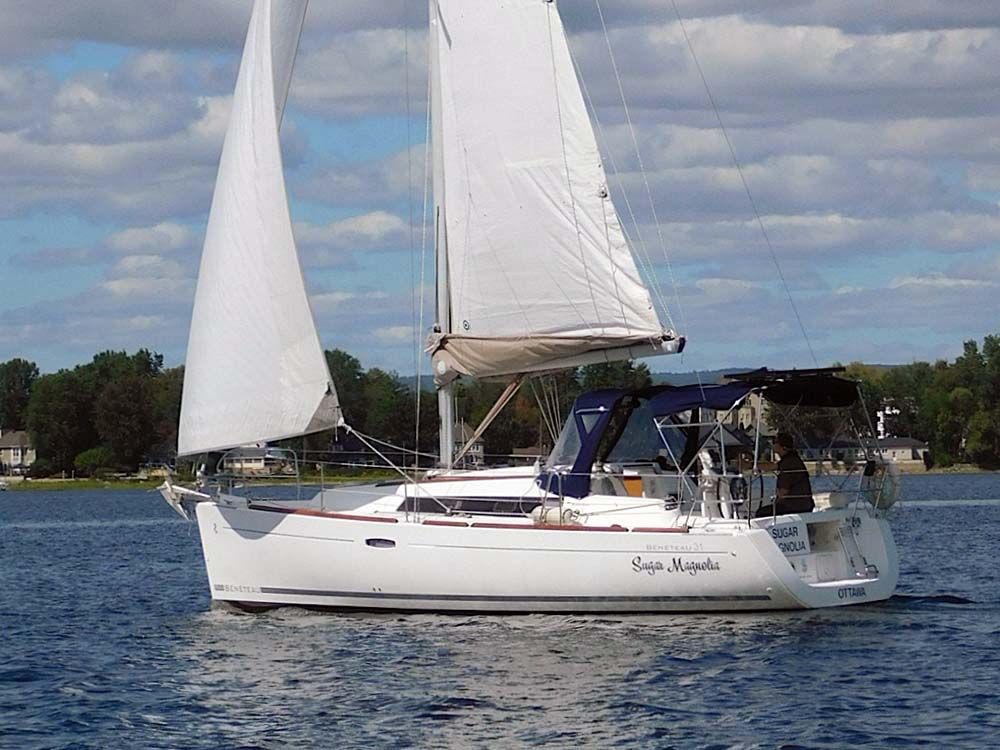
Compared with the Oceanis 31, the Marlow-Hunter 31 offers a more “Americanized” interior—wider berths, more emphasis on cockpit usability and comforts—while the Oceanis tends to be lighter, with a slightly more performance-lean hull form from a European design lineage. In practice that translates into the Oceanis feeling a touch livelier to sailors chasing windward performance, and the Marlow-Hunter feeling roomier and friendlier for non-racing couples.
Buyers who cruise mostly coastal U.S. waters and want easy serviceability may prefer the Marlow-Hunter’s pragmatic choices; those focused on light-air performance and a firmer heel when heeled downwind may value the Oceanis layout and European rigging approach. The swap-out costs (sails, electronics) are similar, but the Oceanis sometimes commands a different market segment in resale depending on region.
► Learn more about de Beneteau Oceanis 31
Marlow-Hunter 31 vs Dufour 310 Grand Large

The Dufour 310 Grand Large is a European competitor that leans toward performance-oriented cruising with an interior that highlights contemporary styling and efficient hull lines; the Marlow-Hunter trades some of that edge for robust U.S.-style comforts like the arched traveler and a layout optimized for simple single- or double-handed sailing. In day-to-day handling the Dufour can feel sharper on the helm and a bit more performance-biased, while the Marlow-Hunter offers easier cockpit cleanliness and a slightly more forgiving motion at anchor.
For ownership considerations, Dufour owners often accept a slightly more spartan dealer footprint in exchange for the European style and sailing feel; Marlow-Hunter buyers are choosing convenience, tested American-market features and straightforward owner maintenance. Both boats require similar investment in sails and electronics to modernize, but the Dufour can occasionally demand higher refit costs depending on European spec levels.
► Learn more about de Beneteau First 31.7
Maintenance Costs of an Marlow-Hunter 31 in the U.S.
Below is a practical, commented bulleted list of typical annual ownership costs and significant one-time items a buyer should budget for. Each item is shown with a realistic U.S. range and a short note.
- Mooring / Slip fees: $3,000–$12,000 per year — wide regional variance (inexpensive moorings in smaller marinas vs. premium slips in big coastal cities).
- Insurance: $500–$1,500 per year — typically ~1%–2% of insured value; factors include cruising area and owner experience.
- Engine servicing and routine mechanicals: $300–$1,200 per year — oil, filters, winterization and small repairs; more if injector or transmission work is needed.
- Antifouling / haul-out and bottom paint: $600–$2,500 every 1–3 years — dependant on region (muddy/slimy harbors require more frequent cleaning).
- Standing and running rigging inspections: $200–$800 per year (inspection) and $2,000–$6,000 for replacement as a one-time cost every 10–20 years depending on wear.
- Sails (maintenance / replacement): $200–$1,000 annual for repairs; a new main or genoa can be $3,000–$8,000 each depending on cloth and cut.
- Electronics and navigation upgrades: $0–$6,000 (one-time) — many used boats benefit from new chartplotters, AIS and autopilots to modernize safety and convenience.
- Annual miscellaneous (zincs, anodes, small plumbing/electrical): $300–$1,200 per year.
Region matters: marina and haul costs are highest in California and the Northeast, midrange in the Mid-Atlantic and Gulf, and lowest in many inland/less trafficked regions. Significant one-time investments that commonly appear within the first 3–5 years of ownership are sail replacement, a battery bank replacement (or upgrade to lithium), and a mid-life engine service or replacement if hours are high. BoatTrader and Practical Sailor guidelines typically estimate annual running costs for a boat this size in the $3,000–$7,000 band (exclusive of slip fees), with total ownership costs rising substantially if you choose paid haul, storage, or professional maintenance frequently. Budgeting conservatively—particularly for systems and sails—keeps surprises small.
Most owners can perform routine maintenance (zincs, oil changes, basic sail repair) themselves, but jobs like rigging replacement, major sailmaking, or complex electrical refits generally require professionals. The balance between owner-maintainable tasks and paid services will therefore directly determine whether annual costs stay low-to-medium or push higher. Overall, for a well-maintained Marlow-Hunter 31 the cost profile is medium for its size and use: more than a stripped-down trailer-sailer, but lower than larger semi-displacement or luxury yachts, and reasonable relative to the comfort and systems it provides.
Conclusion
The Marlow-Hunter 31 is a thoughtful modern coastal cruiser: roomy for its length, easy to handle single- or short-handed, and built with practical materials that favor repairability and owner servicing. Its design philosophy trades outright racing edge for interior comfort, low-clutter deck ergonomics (the arch and furling options), and intuitive systems—attributes that make it an appealing choice for couples or small families focused on weekend cruising and seasonal coastal passages. When maintained and updated (sails, electronics, routine seal and tank checks), it holds resale value well within its market segment.
For buyers seeking a manageable, comfortable 31-foot cruising platform that is easy to live with and relatively straightforward to maintain, the Marlow-Hunter 31 is worth considering and often represents good value compared with older 30-foot designs. For those whose priorities are club racing or long offshore passages, other contemporaries with narrower hulls and performance-biased rigs will be more appropriate. In short: for coastal cruising and comfortable weekend family sailing, the Marlow-Hunter 31 is a solid, pragmatic choice with a resale profile that rewards documented care and sensible upgrades.
Specifications
| Hull Type | Fin w/ bulb & spade rudder |
| Rigging Type | B&R Fractional |
| LOA | 32.35 ft / 9.86 m |
| LWL | 29.66 ft / 9.04 m |
| S.A. (reported) | 581.00 ft² / 53.98 m² |
| Beam | 11.84 ft / 3.61 m |
| Displacement | 11,854 lb / 5,377 kg |
| Ballast | 3,380 lb / 1,533 kg |
| Max Draft | 5.41 ft / 1.65 m |
| Construction | Fiberglass (FG) |
| First Built | 2015 |
| Builder | Marlow Hunter (USA) |
| Designer | Glenn Henderson |
| Auxiliary Power (Type) | Diesel |
| Auxiliary Power (HP) | 20 |
| Fuel Capacity | 21 gals / 79 L |
| Water Capacity | 50 gals / 189 L |
| S.A./Displ. | 17.94 |
| Bal./Displ. | 28.51 |
| Disp./Len. | 202.82 |
| Comfort Ratio | 22.36 |
| Capsize Screening Formula | 2.08 |
| Hull Speed | 7.30 kn |
| Pounds/Inch Immersion | 1,254.78 lbs/inch |
| I | 35.76 ft / 10.90 m |
| J | 11.25 ft / 3.43 m |
| P | 3.64 ft / 1.11 m |
| E | 36.45 ft / 11.11 m |
| SPL/TPS | 46.55 ft / 14.19 m |
| S.A. Fore | 201.15 ft² / 18.69 m² |
| S.A. Main | 66.34 ft² / 6.16 m² |
| S.A. Total (100% Fore + Main Triangles) | 267.49 ft² / 24.85 m² |
| S.A./Displ. (calculated) | 8.26 |
| Est. Forestay Length | 37.49 ft / 11.43 m |
Disclaimer
The considerations and analyses presented regarding the Marlow-Hunter 31 sailboat are of a general nature and are based on the available information and technical data on this model, interpreted to the best of our knowledge and understanding. It is important to note that the specific characteristics of any particular sailboat may vary due to custom modifications, maintenance performed, and conditions of use over time, among other factors. Therefore, the details and performance of the boat you are considering may not exactly match the information provided here.
We strongly recommend that, before making any purchasing or usage decisions, you conduct a detailed inspection of the boat in question, consult with nautical professionals and other sailors, and consider your personal needs, expectations, and capabilities. Each sailboat may have unique particularities that affect its performance and suitability for different types of sailing and sailors.
The information contained in this analysis should be used as a general guide and not as a definitive reference. Professional evaluation and personal inspection are essential to ensure that the boat meets your specific requirements and expectations.