



The Island Packet 35 is a late-1980s/early-1990s American cruising classic from Island Packet Yachts, designed by company founder Robert (Bob) Johnson. Conceived first and foremost as a blue-water capable coastal/offshore cruiser for a couple (with room for family or guests), it blends traditional long-keel manners with thoughtful systems and a conservative cutter rig. Between 1988 and 1994 roughly 178 hulls were built, and the model is long out of production, which keeps demand focused on the U.S. brokerage market—especially among cruising couples targeting the Bahamas/Florida, the Chesapeake, and New England. Reviews from the period and today consistently position it as a comfort- and capability-oriented boat rather than a performance racer, which is exactly what many second-owners are seeking.
Design and Construction
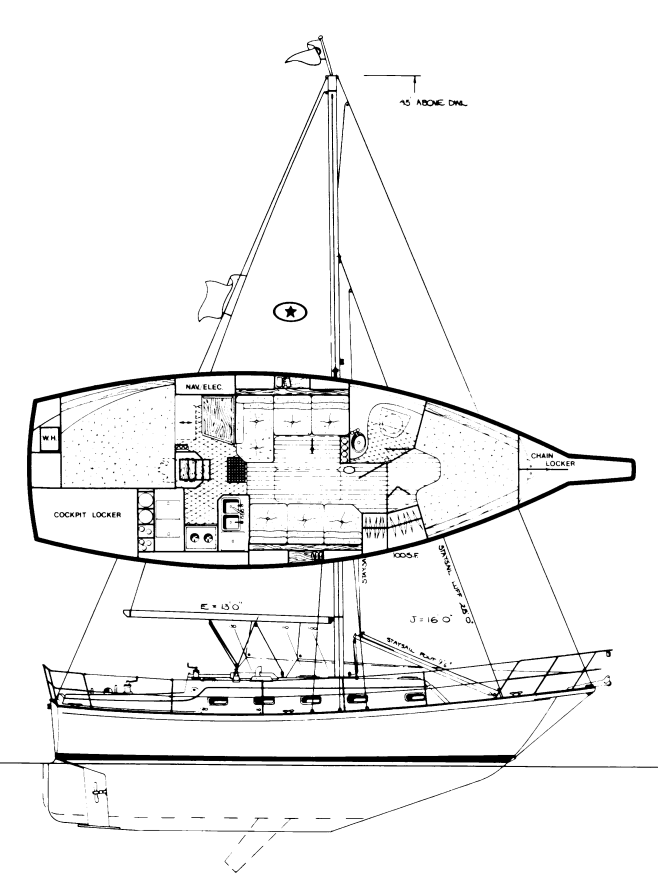
Johnson’s hallmark “full-foil” long keel integrates ballast, running gear protection, and directional stability into one structure. The rudder is keel-mounted and well-shielded; the prop sits in the keel aperture—excellent for snag resistance and shoal cruising. The boat is a true cutter: a foretriangle sized for a working headsail plus a self-tacking staysail keeps sail area low and balanced when the breeze pipes up, yet offers flexible combinations in light air. The hull is solid fiberglass with heavy laminate typical of the era; the deck is cored for stiffness; spars are anodized aluminum with a keel-stepped mast. This package emphasizes seakindliness, forgiveness and durability over minimal weight. From a naval-architecture perspective, the long lateral plane and moderate D/L (mid-200s) yield high course stability and a gentle motion at the expense of raw upwind speed—traits many passagemakers prize because they reduce steering input and crew fatigue. Factory documentation confirms the keel-stepped mast and through-deck arrangement, a detail owners appreciate for strength and serviceability.
Performance
Under sail, the Island Packet 35 is happiest reaching and running, where its long waterline for length and balanced cutter plan produce steady 6–7-knot passages near hull speed in moderate air. In choppy head seas it is unflappable and tracks like a train, though it won’t point as high or accelerate as quickly as fin-keel contemporaries. A widely read Perry review sums up the boat’s temperament: contemporary hull form with the “forgiveness of a long keel,” easy on the helm and on the crew. Compared to peers, a Catalina 36 or Hunter 35.5 will typically be quicker in sub-12-knot breezes and higher-pointing upwind; a Pacific Seacraft 34 is closer philosophically—seakindly, stout, and reassuring—but usually a touch livelier to weather thanks to its cutaway-forefoot/long-fin underbody. If your real-world brief is making miles comfortably with a short-handed crew—e.g., Florida–Bahamas seasonal cruising—the Island Packet 35’s reputation for “get-there” reliability is well-earned.
Comfort and Accommodations
The interior is one of the model’s greatest strengths for a 35-footer. The layout places a V-berth forward, a proper head just aft, opposing salon settees (with a folding table), an aft-facing nav station, a large starboard U-galley, and a private aft cabin with a double berth. The 12-foot beam and high volume let storage push outboard without feeling cramped; ventilation is generous via multiple opening ports and hatches; handholds abound. Liveaboard couples like the separation between cabins and the sea-galley’s security at heel, while families appreciate that you can sleep two cabins plus convertible berths in the salon. Many examples show tasteful refits (soft goods, lighting, refrigeration, electronics) because the platform rewards modernization without losing its warm teak character.
Safety and Practicality
On deck you get wide bulwarks, stout stanchions, double lifelines, a bowsprit platform that simplifies anchoring, and shroud bases placed inboard enough for secure movement forward. The cockpit is deep with good coamings and clear sightlines; the long keel protects rudder and prop when (not if) you bump the bottom in skinny water. The cutter rig shines for short-handed sailing: roll away the yankee, keep the staysail and a reefed main, and the boat settles into an easy, balanced groove. Systems access is generally good, though some structural items (e.g., chainplates hidden behind cabinetry) can be more involved. As delivered, the boat is well-suited for coastal and near-offshore work; for blue-water ambitions owners typically add modern electronics, storm sails, and house-power upgrades.
Known Issues with the Island Packet 35
After three-plus decades, patterns have emerged:
- Chainplates and bedding: Like many boats of the era—especially those with partially hidden or encapsulated plates—crevice corrosion and leaks at chainplates are the number-one watch item. Inspect for weeping below cabinetry and around the caprail; replacement is a known, solvable project on older IPs.
- Rudder moisture/delamination: Some Island Packets (and other cruisers) have seen moisture ingress at the rudder seam leading to soft spots or delam; surveyors often recommend dropping and repairing/sealing during a refit.
- Aluminum tanks: Original aluminum fuel/water tanks can pit if bedded in foam or sitting in a damp bilge. Budget for inspection and, if necessary, replacement on boats that haven’t been addressed.
- Mast/deck seal and wiring pass-throughs: The keel-stepped mast uses a deck collar and boot; leaks are not endemic but are worth checking whenever you see staining at the mast partners. Factory guidance covers proper sealing.
None of these are deal-breakers on a well-maintained example; they are age-appropriate items that separate the truly sorted boats from the merely “for sale.”
Market Availability and Pricing in the U.S.
The model is only available used. Listings tend to cluster on the East and Gulf Coasts—Florida (Bahamas-bound favorites), the Carolinas, the Chesapeake (Annapolis and surrounding creeks), plus a sprinkling on the West Coast. As of mid-2025, clean Island Packet 35s commonly ask in the $70,000–$120,000 range, with outliers below for project boats and above for exceptionally upgraded examples; recent public listings show multiple boats in the high-$60s to high-$90s and an occasional six-figure asking price for standout refits. Relative to peers, the IP35 holds value well thanks to brand reputation and a clear buyer profile.
Below is a comparison with similar sailboats:
| Model | LOA | Approx. build years | Typical U.S. used price | Notable differences |
|---|---|---|---|---|
| Island Packet 35 | 35 ft | 1988–1994 | $70k–$120k | Full-length keel, cutter, seakindly & shallow draft (~4.5′). |
| Pacific Seacraft 34 | 34 ft | 1987–1998 | $50k–$140k | Cutaway forefoot/long-fin + skeg; a bit quicker upwind; similar blue-water ethos. |
| Catalina 36 (Mk I/II) | 36 ft | 1983–2002 | $30k–$100k | Fin keel/spade rudder sloop; faster in light air; less underbody protection. |
| Hunter 35.5 Legend | 35.5 ft | 1988–1995 | $35k–$45k | Performance-oriented fin/spade sloop; bigger cockpit, lighter displacement. |
| Pearson 365 | 36 ft | 1976–1982 | $22k–$45k | Older ketch/sloop options; heavier, slower; good value entry cruiser. |
Maintenance Costs of a Island Packet 35 in the USA
For a 35-footer of this type, a realistic annual budget (without major refits) usually falls between $6,000–$15,000, depending on location and how much work you do yourself.
- Dockage and haul-out: $2,500–$8,000/year on the East Coast (Chesapeake and Southeast on the lower end; South Florida/SoCal, $5,000–$10,000).
- Insurance: $700–$2,200/year (influenced by ownership history, insured value, and hurricane zones).
- Engine (Yanmar 3-cyl ~27–35 hp): annual service $300–$800 DIY; $800–$1,500 with a yard. Includes impellers, belts, and filters.
- Antifouling and bottom work: $1,500–$4,000 every 12–24 months depending on paint type and region; add $300–$700 for hull polishing.
- Rigging and sails: standing rigging every 10–15 years $6,000–$12,000; a mainsail-yankee-staysail package $7,000–$12,000 depending on fabric and build.
- Systems and consumables: AGM/LFP batteries $800–$4,000; head, pumps, and pressurized water maintenance $200–$600/year.
- Electronics (occasional): replacement of autopilot, plotter, AIS, and sensors $5,000–$15,000.
- Typical jobs on this model: preventive replacement and re-bedding of chainplates ($4,000–$10,000 depending on scope), rudder inspection/re-sealing ($1,000–$4,000 if dropped at a yard), inspection/replacement of aluminum tanks in case of corrosion ($3,000–$8,000).
Much of the routine upkeep is manageable by the owner (oil, impellers, filters, running rigging, basic electronics). The items that drive costs up are specialized yard projects (standing rigging, tanks, rudder, interior carpentry to access fittings). Overall, the cost of ownership is medium-high for a 35-footer, but the resilient resale value of the brand offsets it if you buy a well-maintained, well-documented example.
Conclusion
The Island Packet 35 is a purpose-built cruising boat that trades raw speed for composure, protection, and human-scale systems. Strengths include its seakindly long-keel underbody, versatile cutter rig, liveaboard-friendly interior, and shallow working draft that opens up the ICW and Bahamas. Weaknesses are predictable for the genre: modest light-air performance and some age-related projects (chainplates, tanks, rudder). For a short-handed cruising couple who values security, stowage and comfort over VMG to windward, it’s an excellent candidate—widely available, well-documented, and with steady resale. If your sailing plans read more like “reliable miles in comfort” than “club-line trophies,” it remains a quietly smart buy in its class.
Specifications
| Hull Type | Long Keel |
| Rigging Type | Cutter |
| LOA | 35.33 ft / 10.77 m |
| LWL | 30.00 ft / 9.14 m |
| S.A. (reported) | 640.00 ft² / 59.46 m² |
| Beam | 12.00 ft / 3.66 m |
| Displacement | 17,500.00 lb / 7,938 kg |
| Ballast | 8,000.00 lb / 3,629 kg |
| Max Draft | 4.50 ft / 1.37 m |
| Construction | FG (Fiberglass) |
| First Built | 1988 |
| Last Built | 1994 |
| # Built | 178 |
| Builder | Island Packet Yachts (USA) |
| Designer | Bob Johnson |
Auxiliary Power / Tanks (orig. equip.) | |
|---|---|
| Make | Yanmar |
| Type | Diesel |
| HP | 35 / 38 hp |
| Fuel | 48 gals / 182 L |
Accommodations | |
| Water | 90 gals / 341 L |
Sailboat Calculations | |
| S.A. / Displ. | 15.25 |
| Bal. / Displ. | 45.71 |
| Disp. / Len. | 289.35 |
| Comfort Ratio | 31.27 |
| Capsize Screening Formula | 1.85 |
| S# | 1.68 |
| Hull Speed | 7.34 kn |
| Pounds/Inch Immersion | 1,286.32 pounds/inch |
Rig and Sail Particulars | |
| I | 44.33 ft / 13.51 m |
| J | 17.00 ft / 5.18 m |
| P | 37.50 ft / 11.43 m |
| E | 14.00 ft / 4.27 m |
| S.A. Fore | 376.81 ft² / 35.01 m² |
| S.A. Main | 262.50 ft² / 24.39 m² |
| S.A. Total (100% Fore + Main Triangles) | 639.31 ft² / 59.39 m² |
| S.A./Displ. (calc.) | 15.23 |
| Est. Forestay Length | 47.48 ft / 14.47 m |
Disclaimer
The considerations and analyses presented regarding the Island Packet 35 sailboat are of a general nature and are based on the available information and technical data on this model, interpreted to the best of our knowledge and understanding. It is important to note that the specific characteristics of any particular sailboat may vary due to custom modifications, maintenance performed, and conditions of use over time, among other factors. Therefore, the details and performance of the boat you are considering may not exactly match the information provided here.
We strongly recommend that, before making any purchasing or usage decisions, you conduct a detailed inspection of the boat in question, consult with nautical professionals and other sailors, and consider your personal needs, expectations, and capabilities. Each sailboat may have unique particularities that affect its performance and suitability for different types of sailing and sailors.
The information contained in this analysis should be used as a general guide and not as a definitive reference. Professional evaluation and personal inspection are essential to ensure that the boat meets your specific requirements and expectations.