


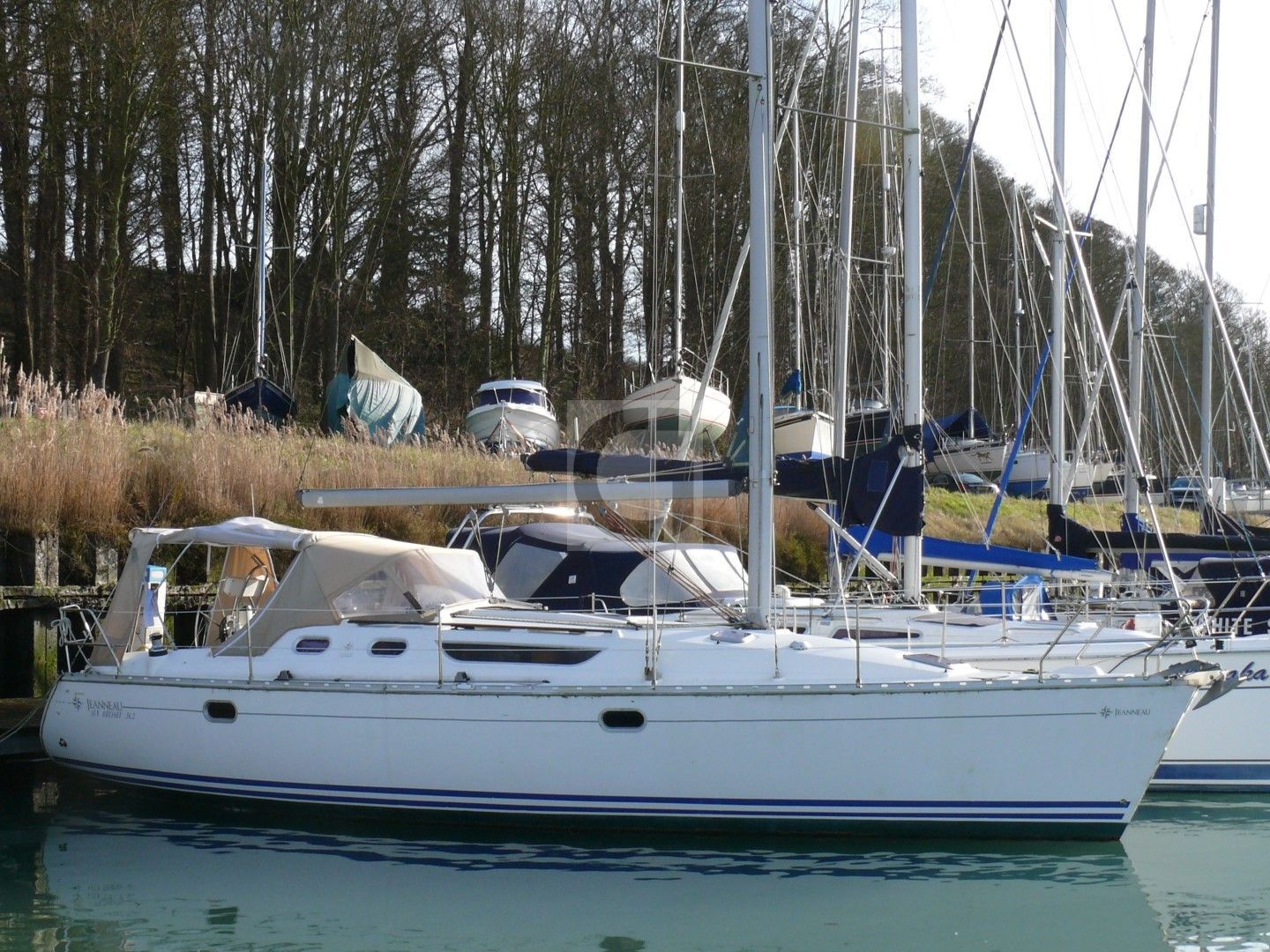
The Jeanneau Sun Odyssey 36.2 arrived in the late 1990s as a purpose-built cruiser that blended comfortable onboard living with straightforward sail handling. Designed by Jacques Fauroux and built by Jeanneau at a time when European production boats were pushing for more voluminous interiors and easier deck ergonomics, the 36.2 was aimed at small families, couples and charter operators who wanted a solid coastal-to-offshore platform without the complexity or cost of a pure racer-cruiser. The hull and deck proportions, two- and three-cabin layout choices and relatively modest sail area positioned it squarely as a cruising boat rather than a performance-first design, which explains why many examples found second lives in the used market as private family boats and charter yachts.
Design and Construction
The Sun Odyssey 36.2 uses a fin keel and spade rudder on a moderately beamy hull; the basic planform favors interior volume and form stability over a narrow, easily-driven performance hull. It is rigged as a masthead sloop, a conservative choice that keeps sail handling predictable and allows a large genoa to produce drive in moderate airs. Construction is fiberglass (hand-laid GRP for these builds) with cored deck structures and bonded bulkheads typical of production boats of the era; Jeanneau’s factory data show LOA around 36’1″, beam near 12’3″, displacement roughly 12,345 lb and a draft in the 6′ range for the standard keel, which supports a comfortable load-carrying capability and sensible tankage for extended weekends. These construction choices translate into a boat that is straightforward to repair (common repair yards are familiar with the layup and hardware), while deck-core penetrations and the mast step area merit inspection when buying used because those are known service items on many Sun Odyssey models.
Performance
The 36.2 is not a club-racer; in light air it can feel underpowered compared with modern, light-displacement designs, and many owners report that the genoa carries most of the driving force, so reefing strategy typically begins with reducing headsail area. In moderate to fresh conditions its balanced hull and moderate ballast give predictable behaviour: it tracks well off the wind, is steady on a reach and will hold a close reach with reasonable pointing for a cruiser of its vintage. Practical-Sailor and owner reports emphasize that the boat can feel “solid” but will slam in a short, choppy upwind seaway—an important buyer note if you expect to frequently navigate confused coastal seas. Compared with newer 36-foot cruisers it will usually be a knot or two slower in light airs but remain competitive in hands-on, short-handed cruising conditions where comfort and range matter more than racing performance.
Comfort and Accommodations
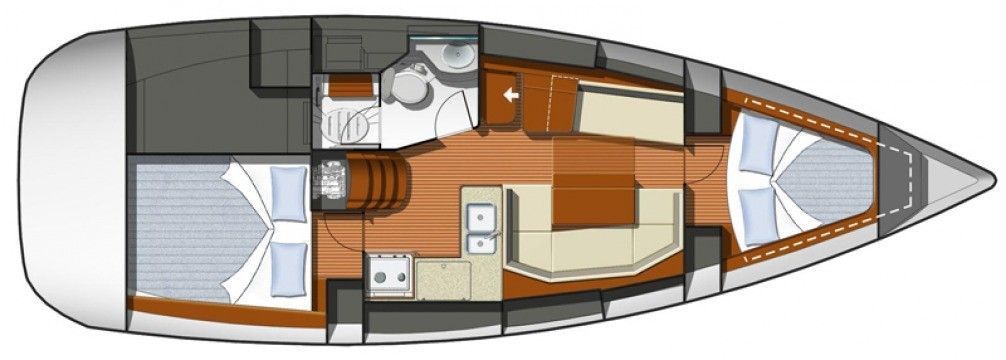
Below, the 36.2 prioritizes usable volume: layouts with two aft cabins provide a roomy owner’s cabin and generous storage, while three-cabin, charter-style interiors show how the hull was configured to maximize berths. The galley-to-companionway relationship is practical for short-handed sailing, and the saloon is typically bright and sociable—qualities that make the boat a strong candidate for couples who cruise long weekends or small families doing coastal passages. Ventilation is reasonable for its era but not as abundant as on later models with larger deck hatches, so buyers considering liveaboard use in warm climates often retrofit additional vents or fans. In practice the boat lives well for extended weekends and coastal cruising; continuous liveaboard for long seasons is possible but will usually require attention to storage optimization and modernizing systems (refrigeration, insulation, and water systems) to match current expectations.
Safety and Practicality
On deck the cockpit layout is oriented toward comfortable cruising: a deep cockpit for security, reachable winches from the helm for easy short-handed sailing, and a transom that facilitates boarding and water access. The spade rudder and fin keel give positive helm feel, which aids confident handling in tight situations and when single- or double-handing. Access to core systems—engine, steering, and through-hull fittings—is generally good for the age-class, but stringer and mast-step areas are recognized points to inspect; ensuring the integrity of deck seals and core in the mast step region is a practical pre-purchase step that directly affects long-term cost of ownership. With modest upgrades (reliable navigation electronics, attention to seacocks and rig checks) the boat is suitable for coastal and offshore passages; owners who intend blue-water voyaging often reinforce systems and carry conservative redundancy, but no major structural overhaul is typically required for competent offshore use.
Known Issues with the Jeanneau Sun Odyssey 36.2
Owners’ forums and owner-network writeups identify a handful of recurring themes rather than a single catastrophic design flaw. Water ingress at the mast step and soft deck-core under the compression post or step has been reported and is a documented repair on several Sun Odysseys—attention here preserves structural integrity and avoids expensive future repairs. Bilge and plumbing routing in some early builds can create awkward access and occasional wet spots if fittings or hoses are poorly routed or maintained. Engine service issues are usually age-related rather than model-specific (many boats left the yard with Volvo units of modest horsepower), so expect typical diesel-age maintenance items on older engines. Commonly recommended upgrades from experienced owners include replacing or modernizing standing/running rigging as a preventative measure, upgrading older electronics for reliability, and fitting a more efficient propeller or sail inventory to suit the owner’s preferred wind range.
Market Availability and Pricing in the U.S.
The Sun Odyssey 36.2 is out of production and circulates exclusively on the used market; in the U.S. it appears with reasonable frequency in brokerage listings and dealer inventories, with concentrations in traditional cruising hubs such as Florida and parts of the West Coast, though listings can be found nationwide. Current used-listing snapshots show asking prices clustered in the $55,000–$80,000 range depending on year, equipment and condition, with averages reported near the high-$60k mark in major U.S. marketplaces. This middle tier pricing puts the 36.2 competitively against similar-era cruisers: it is often better equipped for liveaboard comfort than some older, lighter boats at the same price, but buyers should expect to budget for common updates. Overall it remains a model with steady appeal to coastal cruisers and owners upgrading from 30-foot boats because it balances space and manageability without the premium of a modern yacht.
Here’s a comparison with similar models:
| Model | LOA | Typical build years | Typical US used price | Main differences |
|---|---|---|---|---|
| Jeanneau Sun Odyssey 36.2 | ~36’1″ | mid-1990s – early-2000s | $55k–$80k | Emphasis on interior volume, cruising comfort; moderate performance; solidly-built production European boat. |
| Catalina 36 (Mk I/II) | ~36′ | 1985–2005 (varies by mark) | $30k–$90k | Classic American cruiser with a very large resale pool and simple systems; often cheaper to maintain but older styling and systems. |
| Hunter 356 | ~35.5′ | early-2000s | $45k–$75k | Roomy, easy-handling deck layout with emphasize on family cruising; often has modern conveniences but lighter construction in places. |
| Beneteau Oceanis 361 | ~36.1′ | late-1990s – 2000s | $65k–$100k | European cruiser with similar volume to Jeanneau but often slightly newer systems and different hull tuning; comparable resale bracket. |
Jeanneau Sun Odyssey 36.2 vs Catalina 36

The 36.2 tends to offer a more modern European deck line and interior use of volume than many Catalina 36 variants, which were designed earlier with a different aesthetic and slightly simpler systems. In practical ownership terms that often means the Jeanneau feels more “yacht-like” below and will have features buyers appreciate for extended cruising, while the Catalina can be easier and cheaper to maintain due to its ubiquity and simpler plumbing/electrical layouts.
If your priority is a comfortable, contemporary interior and a hull tuned for cruising balance, the 36.2 has the edge; if you prioritize the lowest ongoing maintenance cost and the largest used-parts market, a Catalina 36 may be the more pragmatic choice.
► Learn more about the Catalina 36
Jeanneau Sun Odyssey 36.2 vs Hunter 356

Both boats target family cruising, but the Hunter 356 pushes easier short-handed deck ergonomics and sometimes more modern factory amenities (like in-mast furling options), whereas the 36.2 leans slightly toward traditional sailplan choices and a stiffer, heavier feel that some owners prefer offshore. Buyers looking for a forgiving, family-oriented deck and simple handling might opt for the Hunter, while those who value interior volume and a more conservative, solid construction approach will find the Jeanneau aligns better with those priorities.
In resale and maintenance terms the Hunter can be economical for weekend sailors; the Jeanneau often returns better perceived value to buyers who prioritize cruising comfort and a slightly more substantial build.
► Learn more about the Hunter 356
Jeanneau Sun Odyssey 36.2 vs Beneteau Oceanis 361

The Oceanis 361 is a close contemporary and competitor: both emphasize cruising comfort, but Beneteau variants sometimes include newer layout tweaks or slightly different hull tuning that favors softer motion in a seaway. The 36.2’s design often feels a touch more robust in construction details of the period, whereas the Oceanis can offer incremental improvements in deck hardware layout or factory systems depending on the year.
For a buyer choosing between them, the decision commonly comes down to specific boat condition, equipment and personal taste in interior joinery—both will serve well as coastal/family cruisers, but the Jeanneau can be a better value if you prioritize a stiffer feel and slightly heavier displacement for load-carrying.
► Learn more about the Beneteau Oceanis 361
Maintenance Costs of a Jeanneau Sun Odyssey 36.2 in the U.S.
- Mooring/Slip: $2,500–$10,000 per year — (varies widely: inland/mid-Atlantic marinas are cheaper; prime Florida or West Coast slips are at the high end).
- Insurance: $700–$2,500 per year — (depends on value, cruising area, and owner experience).
- Engine servicing: $400–$1,200 per year routine; $3,000–$8,000 for major re-power or major gearbox work if needed.
- Antifouling (haul, prep, paint): $600–$2,500 every 1–3 years, depending on yard rates and region.
- Standing and running rigging: $0–$300/yr if maintained; expect $3,000–$7,000 as a periodic replacement cycle (~10–15 years).
- Sails: $0–$500/yr with good care; replacement mains/genoa or a new cruising sail inventory $3,000–$12,000 as a one-time large cost.
- Miscellaneous systems (electronics, watermaker, refrigeration): budget $500–$3,000/yr for parts/repairs; electronics refit $4k–$12k if modernizing.
Many owners can perform routine maintenance and preventive care themselves (oil changes, through-hull checks, bottom paint prep) which reduces cost; however, structural repairs, rigging replacement, and major electrical or engine work usually require professional services. Region matters: haulout and yard labor rates are higher in popular wintering hotspots, so ownership in Florida or California will push the annual bill upward. For a well-maintained 36-foot cruiser, expect overall ownership costs to be medium within its size range—not as cheap as a 30-footer but significantly less than larger offshore yachts—and the boat’s reasonable resale market typically offsets moderate investment in sensible maintenance and system upgrades.
Conclusion
The Jeanneau Sun Odyssey 36.2 is a pragmatic cruiser that rewards owners who value interior comfort, sensible deck ergonomics and a hull designed for stable, predictable cruising rather than racing. Its strengths are real usable volume, a straightforward sloop rig that a small crew can handle, and a broad second-hand market that keeps liquidity reasonable for sellers. Weaknesses to watch for are age-related systems (engine, rigging, deck-core around the mast step) and a hull tuning that can be a bit lively in short, choppy seas—issues that are usually detectable at survey and repairable without structural replacement. For couples or small families seeking a capable coastal cruiser with occasional offshore aspirations, the 36.2 is worth seeking out; it represents a balanced investment for coastal cruising with resale that remains steady when the boat has been conscientiously maintained.
Specifications
| Hull Type | Fin w/spade rudder |
| Rigging Type | Masthead Sloop |
| LOA | 36.08 ft / 11.00 m |
| LWL | 30.50 ft / 9.30 m |
| S.A. (reported) | 410.00 ft² / 38.09 m² |
| Beam | 12.25 ft / 3.73 m |
| Displacement | 12,345.00 lb / 5,600 kg |
| Ballast | 3,417.00 lb / 1,550 kg |
| Max Draft | 6.16 ft / 1.88 m |
| Construction | FG |
| First Built | 1998 |
| Builder | Jeanneau |
| Designer | Jacques Fauroux |
| Auxiliary Power (orig. equip.) | Volvo Diesel, 27 HP |
| S.A. / Displ. | 12.32 |
| Bal. / Displ. | 27.68 |
| Disp. / Len. | 194.24 |
| Comfort Ratio | 21.08 |
| Capsize Screening Formula | 2.12 |
| Hull Speed | 7.40 kn |
| Pounds/Inch Immersion | 1,335.00 pounds/inch |
Disclaimer
The considerations and analyses presented regarding the Jeanneau Sun Odyssey 36.2 sailboat are of a general nature and are based on the available information and technical data on this model, interpreted to the best of our knowledge and understanding. It is important to note that the specific characteristics of any particular sailboat may vary due to custom modifications, maintenance performed, and conditions of use over time, among other factors. Therefore, the details and performance of the boat you are considering may not exactly match the information provided here.
We strongly recommend that, before making any purchasing or usage decisions, you conduct a detailed inspection of the boat in question, consult with nautical professionals and other sailors, and consider your personal needs, expectations, and capabilities. Each sailboat may have unique particularities that affect its performance and suitability for different types of sailing and sailors.
The information contained in this analysis should be used as a general guide and not as a definitive reference. Professional evaluation and personal inspection are essential to ensure that the boat meets your specific requirements and expectations.