



The Leopard 39 is a compact, owner-friendly cruising catamaran designed to deliver the balance most cruising couples want: lively sailing performance without sacrificing comfortable living space. Launched in the early 2010s by Leopard Catamarans / Robertson & Caine and penned with input from Morelli & Melvin, the model is effectively a re-worked successor to the Leopard 38 with a continuous hardtop, raised helm and interior refinements aimed at both private owners and charter operators. Its brief was straightforward — produce a 38–40′ platform that sails well, is easy to handle short-handed, and offers the kind of interior ergonomics that appeal to couples and small families. The boat found a steady following on the used market almost immediately and remains popular with private cruisers and owners who prize a compact, fast cat that is still manageable in marinas and for seasonal maintenance.
Design and Construction
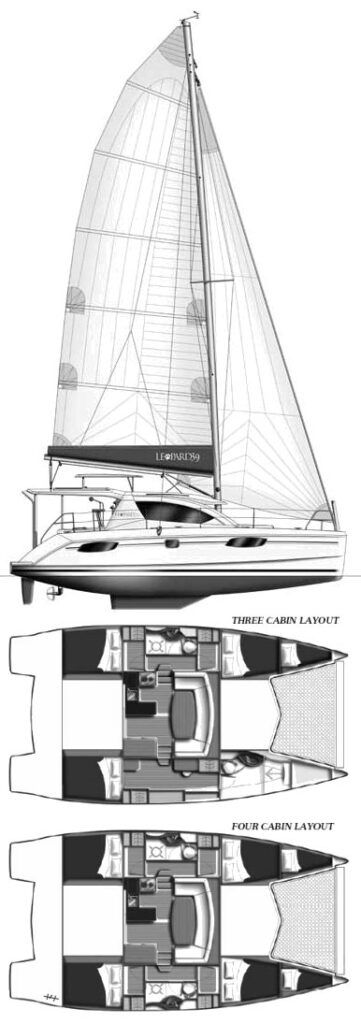
Leopard kept the hull/deck molds close to its predecessor but incorporated several practical changes: a continuous hardtop over the cockpit, a raised and protected helm, and careful internal arrangement that places an owner’s suite to starboard with guest accommodation to port in the owner’s-layout variants. The hulls are relatively fine in the entries and use short fixed mini-keels rather than daggerboards — a design choice that simplifies maintenance and improves cruising reliability at the cost of some ultimate windward pointing compared with performance daggerboard cats. Structurally, Robertson & Caine’s production approach has historically used GRP with sandwich cores (balsa in many builds) and hand-layup techniques; that construction yields a stiff, light and warm-feeling interior when properly built and maintained, but it also means buyers should be attentive to core integrity around fittings and penetrations.
From an architectural perspective the Leopard 39 trades absolute internal volume for better-prioritized living spaces and cleaner underwater lines — a naval-architecture choice that enhances acceleration and passage-making without the handling quirks of very beamy volume-first cats. For a prospective owner that translates into generally lower windage, a more responsive helm feel under sail, and a construction regime that balances weight savings with routine repairability; however, any owner contemplating significant structural changes should be prepared to engage composite specialists for core repairs or major refits.
Performance
On the water the Leopard 39 has a reputation for being quicker and more responsive than many earlier generation 38–40′ cruising cats. Published test reports and owner feedback place typical cruising speeds in the high-6 to mid-8 knot range in 10–15 knots of true wind, with higher bursts possible on favorable points of sail — test runs have shown the boat accelerating into the high 8’s and touching near-double-digit speeds in stronger winds and surf. The relatively fine hull entries and an efficient sailplan (large main, moderate jib, sturdy spars) give the boat good acceleration and a comfortable helm balance that is forgiving for short-handed crews.
Where Leopard chose mini-keels over daggerboards, the practical tradeoff shows: the 39 points well for a cruising cat but won’t outpoint lighter daggerboard multihulls. In rougher seas the bridgedeck design and hull flare generally moderate slamming and produce a predictable motion that many cruisers describe as confidence-inspiring, rather than sporty and twitchy; the result is a boat that rewards confident cruising without demanding a professional crew.
Comfort and Accommodations
Despite being compact for the 40′ category, the Leopard 39 is notable for the livable salon (headroom often quoted at about 6’5″) and generous natural light through its forward-facing windows. The owner’s-suite layout (starboard hull) is a sensible move for couples who plan extended trips — it gives separation between guest and owner spaces while concentrating services (heads, storage) logically. Galley ergonomics and salon sightlines were improved over past models, and ventilation through large hatches and windows keeps the interior comfortable in warm climates.
For a family or a couple planning long-term liveaboard life, the layout is workable but not cavernous; practical owners typically add custom storage solutions and upgrade refrigeration or electrical systems during refits. Overall the interior ages well if teak/ply and joinery are maintained; it’s also common to see modest modernizations (upgraded navigation electronics, new upholstery, LED lighting) in resale boats rather than major structural remodelling.
Safety and Practicality
Deck ergonomics were clearly a priority: a protected helm with excellent sightlines, tidy control leads to the cockpit, and walk-around decks that make moving forward or tending sheets safer in a seaway. The shallowish draft and fixed mini-keels make the 39 practical for coastal cruising, ICW transits and protected anchorages — a real practical benefit for owners in places like the Southeast U.S. and the Caribbean. Systems access is generally good; engines and saildrives sit in accessible trunks and service points are straightforward, although integrated sandwich construction means major plumbing or electrical rework is best done carefully to avoid core exposure.
For planned ocean passages the 39 is fundamentally capable as a short-offshore cruiser, especially when owners add prudent redundancies (storm anchors, emergency steering plan, upgraded electronics). Buyers intending serious blue-water work should validate chainplates, through-hull seals and lightning protection during survey and consider modest reinforcements recommended by long-distance cruising refit specialists.
Known Issues with the Leopard 39
Owners and surveyors commonly flag a few recurring items that prospective buyers should check closely. Because Robertson & Caine has used balsa core in some laminates, water intrusion around fittings and poorly sealed hardware can lead to localized core rot — a problem that is avoidable with careful maintenance but expensive if left untreated. Regular inspection and prompt resealing of deck penetrations, dorade boxes and portlights is a sensible preventive strategy.
Other frequently noted items are the usual suspects for any production twin-engine cat: saildrive wear or corrosion where service history is thin, aging electrical panels and navigation electronics on older boats, and normal rigging fatigue on hulls with heavy use or charter history. Practical, commonly recommended upgrades include fresh sail inventories, saildrive inspection/overhaul, and preventive resealing of deck hardware; buyers should budget for these items and treat a clean service record as a meaningful value indicator.
Market Availability and Pricing in the U.S.
The Leopard 39 is no longer a current production model (its principal production run and market push centered in the early 2010s), so examples are only available on the second-hand market. In the U.S. you see most activity through Florida brokers and in the Caribbean, with occasional East Coast and Chesapeake listings — boats used privately or lightly in owner configuration are common, and charter returns appear less frequently for this particular model than for larger Leopard models. Based on representative U.S. listings and broker samples, a practical used market range for Leopard 39s today is roughly $220,000–$360,000, depending on year, equipment and refit history.
Below is an HTML comparison table (headers and all cells left-aligned so you can copy the code directly) juxtaposing the Leopard 39 with three comparable cats buyers typically consider. The table shows model, LOA, approximate build years, typical used price in the U.S. market, and the principal differences that matter to buyers.
Here is a comparison with three similar catamarans of comparable size and era:
| Model | LOA | Typical build years | Typical used price in U.S. market | Main differences |
|---|---|---|---|---|
| Leopard 39 | ~37’6″ (11.43 m) | ~2011–2014 | **$220,000–$360,000** | Compact, well-balanced cruising cat with raised helm and hardtop; favorable sailing manners for its size and owner-layout focus. |
| Lagoon 380 | ~38′ (11.5 m) | 2000s–2010s | $170,000–$300,000 | Volume-first design, heavy charter presence and broad resale market; more interior space but generally slower in light air. |
| Nautitech 40 | ~39’–39.7″ | Early 2000s / later ‘Open’ versions | $140,000–$500,000 | Performance-leaning hulls and Open variants favor sailing responsiveness and cockpit integration; lighter-displacement bias. |
| Fountaine Pajot Lavezzi 40 | ~39’1″ | 2002–2009 | $140,000–$380,000 | Balanced cruising performance with a roomy bridgedeck salon; some early hulls reported osmosis issues—solid coastal cruiser appeal. |
Leopard 39 vs Lagoon 380

The Leopard 39 was engineered as a more sailing-centric compact cat compared with the Lagoon 380’s volume-first charter pedigree. In everyday use that means the Leopard usually accelerates and points a little better, and the helm feedback tends to be firmer and more engaging for owners who enjoy passage-making; the Lagoon, meanwhile, converts beam into interior volume, which is a practical benefit for charter operations or owners who prioritize social interior space over sailing finesse.
From a maintenance and resale perspective, Lagoons often trade more fluidly in charter-heavy markets (more units, more aftermarket support), while Leopard 39 owners often find a premium among buyers seeking a smaller, better-sailing live-aboard cat — a niche market but a loyal one.
► Learn more about de Lagoon 380
Leopard 39 vs Nautitech 40

Compared with Nautitech 40 models (especially the later Open variants), the Leopard 39 is marginally more conservative in hull form but still prioritizes usable comfort and helm protection. Nautitech tends to reward owners who prioritize light-air performance and cockpit/saloon integration; Leopard’s package trades a touch of outright sportiness for a slightly more conventional, robust interior and greater owner-suite privacy.
Practically, Nautitech ownership can involve more attention to keeping a lighter displacement package tuned and in optimal condition (sails, rigging, weight control), whereas the Leopard’s build and systems often emphasize straightforward maintenance and comfortable cruising at modest speeds.
► Learn more about de Nautitech 40
Leopard 39 vs Fountaine Pajot Lavezzi 40

Both boats aim at comfortable coastal cruising on a ~39–40′ platform, but the Lavezzi tends toward a slightly roomier bridgedeck salon and a gentler motion, while the Leopard favors a tighter, slightly more performance-oriented package with a raised, protected helm. Buyers choosing between them should think about priorities: choose Leopard for a more engaging helm, easier ICW/shallower-water access and an owner-oriented layout; choose Lavezzi for maximum bridgedeck living volume and a marginally softer, more lounging-focused interior feel.
Maintenance-wise, older Lavezzis have a history of some osmosis reports on early hulls (something buyers watched closely), while Leopards demand the usual vigilance around core penetrations and saildrives but generally enjoy a solid reputation among owner-operators who maintain them well.
► Learn more about de Fountaine Pajot Lavezzi 40
Maintenance Costs of a Leopard 39 in the U.S.
Regional variation is meaningful: Florida and Southeast yards typically have lower labour rates but higher storm-prep and insurance costs; New England and California show higher haulout and storage fees. Significant one-time costs for Leopard 39 buyers often include sail inventory replacement, saildrive overhauls, generator or A/C service/replacement, and potential barrier-coat/core-related works if surveyors find evidence of water intrusion.
A mechanically competent owner can reasonably perform routine work (oil changes, anodes, antifoul prep, small plumbing/electrical fixes), but any structural core repairs, major saildrive jobs, or comprehensive electrical rewire will generally require professional services. For a 38–39′ production cat the Leopard 39 sits in the medium maintenance-cost band: higher than a same-length simple monohull because of twin systems, but usually lower than larger production cats. Well-maintained Leopards tend to hold resale value within their niche, so sensible preventive spending often pays back at sale.
Conclusion
The Leopard 39 is a strong candidate for buyers who want a compact cruiser that actually sails like a boat — responsive, reasonably quick and straightforward to handle short-handed — while still offering a comfortable, well-appointed living environment for a couple or small family. Its strengths are clean underwater lines, a protective helm/hardtop arrangement, and an owner-focused interior layout that makes extended weekends and coastal passages pleasant and practical. (Boats)
Weaknesses are modest and familiar: the need to monitor core integrity and deck penetrations, routine saildrive attention, and the twin-engine maintenance economics that come with multihulls. For a buyer who values sailing performance plus owner-friendly accommodations in the 38–40′ range, the Leopard 39 is worth actively seeking; it represents a sensible investment for coastal cruising with reasonable resale prospects in markets where buyers prize a smaller, nimble cruising cat.
Specifications
| Hull Type | Catamaran Twin Keel |
|---|---|
| Rigging Type | Frac. Sloop (Rotating Spar) |
| LOA | 37.50 ft / 11.43 m |
| LWL | 36.00 ft / 10.97 m |
| S.A. (reported) | 991.00 ft² / 92.07 m² |
| Beam | 19.75 ft / 6.02 m |
| Displacement | 20,120.00 lb / 9,126 kg |
| Max Draft | 3.42 ft / 1.04 m |
| Construction | FG |
| First Built | 2011 |
| Last Built | 2014 |
| Builder | Robertson and Caine |
| Designer | Morelli & Melvin |
| Auxiliary Power | Yanmar, Diesel x 2, 42 HP |
| Fuel | 92 gals / 348 L |
| Water | 206 gals / 780 L |
| S.A. / Displ. | 21.52 |
| Disp. / Len. | 192.52 |
| KSP | 0.67 |
| Mast Height from DWL | 62.67 ft / 19.10 m |
Disclaimer
The considerations and analyses presented regarding the Leopard 39 catamaran are of a general nature and are based on the available information and technical data on this model, interpreted to the best of our knowledge and understanding. It is important to note that the specific characteristics of any particular sailboat may vary due to custom modifications, maintenance performed, and conditions of use over time, among other factors. Therefore, the details and performance of the boat you are considering may not exactly match the information provided here.
We strongly recommend that, before making any purchasing or usage decisions, you conduct a detailed inspection of the boat in question, consult with nautical professionals and other sailors, and consider your personal needs, expectations, and capabilities. Each sailboat may have unique particularities that affect its performance and suitability for different types of sailing and sailors.
The information contained in this analysis should be used as a general guide and not as a definitive reference. Professional evaluation and personal inspection are essential to ensure that the boat meets your specific requirements and expectations.