


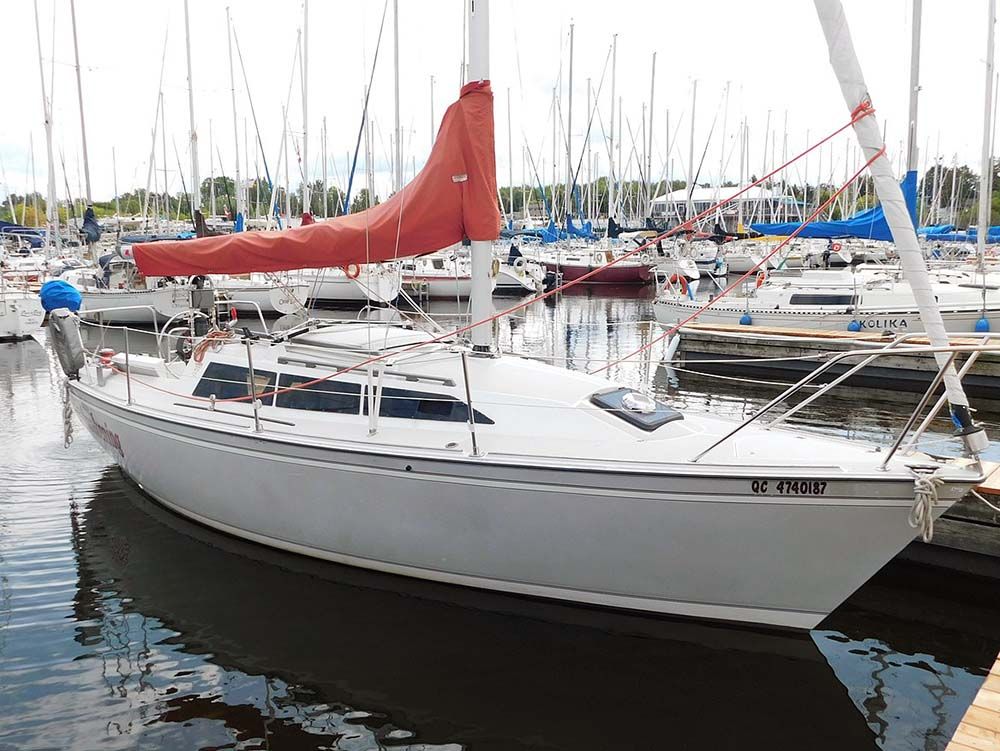
The O’Day 27 is a classic, compact coastal cruiser produced in the 1970s that was aimed squarely at families and weekend sailors who wanted a forgiving, inexpensive keelboat with sensible accommodations and simple systems. Designed by Alan P. Gurney and built by O’Day Corp. between the early and late 1970s, the 27 was part of the era when fiberglass production boats made small-boat cruising broadly accessible; roughly seven hundred plus hulls were completed during the model run, which helped the design become a familiar sight in marinas and inland lakes. Today the model survives almost entirely on the used market and tends to attract private buyers looking for an affordable starter cruiser, DIY renovators, and owners who want a manageable club- or coastal-cruiser rather than a modern, high-performance passagemaker.
Design and Construction
The O’Day 27 is a straightforward masthead sloop with a fin keel and a rudder supported by a skeg as part of a conservative hull form that favors directional stability over sporty agility. Construction is solid fiberglass with molded liners and modest use of cored structures where needed—an approach that produced durable hulls but also creates obvious inspection points (deck core and chainplate areas) for buyers of decades-old examples. Deck hardware and fittings on original boats were simple and robust; production-era details (teak trim, molded-in features) make for a pleasant interior without exotic materials that can complicate repairs. These construction choices mean routine structural repairs and cosmetic renewals are readily handled by most yards: a solid glass hull is easier to patch or fair than sandwich composites, while deck-core repairs require a careful survey to rule out soft spots.
From a naval-architecture perspective the O’Day 27 sits toward the heavier side of the small cruiser spectrum for its length, yielding good initial stability and predictable behavior in a blow but limiting top-end speed. The relatively deep keel and lead ballast (for many examples) give self-righting tendencies and a reassuring feel under sail, which is part of why the type was popular for family use and teaching. That conservatism also helps the boat retain practical resale value in the budget end of the market: buyers pay for sound structure and simplicity, not cutting-edge performance.

Performance
The O’Day 27 is not designed to win club races but to deliver comfortable, predictable passages in coastal and sheltered-water conditions. Hull-speed for the design sits around the mid-six-knot range, and in 8–15 knots of true wind most examples will cruise in the 5–6 knot band under a properly trimmed main and headsail; seakeeping is steady thanks to the heavier displacement and skeg-hung rudder, which increase directional control in confused seas. In light airs the boat can feel sluggish compared with lighter European designs, but the trade is a forgiving motion and a boat that is easy to single-hand or manage with a small crew. Owner reports and retrospective reviews praise the boat’s ability to carry canvas in stronger conditions without becoming twitchy—qualities that matter more to coastal cruisers than to racers.
Compared with contemporaries like the Catalina 27 or Pearson 27, the O’Day typically feels a touch heavier and steadier; compared with later, lighter 27–30 foot designs it will be slower in light air but easier to handle for novices. That places it squarely as a dependable pocket cruiser: not fast, but honest and competent where many buyers need it to be.
Comfort and Accommodations
For a 27-foot hull the O’Day’s interior is practical and comfortably arranged: a forward V-berth, a small convertible settee in the main cabin, a compact galley and a modest enclosed head give reasonable liveaboard capability for a couple or a young family on short cruises. Molded liners and decorator trim from the production era create a durable, serviceable interior that tends to age well if the boat has been kept dry and ventilated—many boats have received cosmetic updates (reupholstery, fresh decking, new cabinetry) without major layout changes because the basic plan works. Storage and tankage are modest, so while the boat can support week-long cruises with careful provisioning, owners planning true liveaboard use typically upgrade refrigeration, battery capacity, and freshwater storage. Reviews and owner feedback emphasize that the ergonomics favor practical use: everything is within reach, and systems are intentionally simple.
Safety and Practicality
Deck geometry and the skeg-supported rudder give the O’Day 27 a secure feel while working around the boat: handholds, modest cockpit depth, and a conservative rig make movement easier in a blow than on many smaller, more performance-oriented hulls. Accessibility to common systems—engine space, rudder attachments, through-hulls—is generally straightforward on these boats, an important advantage when routine checks or winterization are due. That said, the design is best suited to coastal passages, lakes and protected offshore legs; long bluewater cruising would require significant upgrades (rigging renewal, communications, water and fuel capacity increases) to be comfortably safe. The practical reality for most buyers is that this is a low-complexity, owner-serviceable platform well matched to weekend cruising and club sailing.
Known Issues with the O’Day 27
Because most O’Day 27s are now forty-plus years old, the issues you’ll most frequently encounter are age-related rather than unique to the original design. Common inspection findings include chainplate leaks and associated deck/core softening where fittings were not re-bed periodically, worn standing rigging that dates back many decades, and tired engines—early inboard models sometimes carried gasoline Atomic 4 engines that many owners have since replaced or repowered with small diesels or outboards. Surveyors also point to keel-bolt checks and potential blistering on older hulls as routine items to verify.
Practical buyer upgrades typically recommended by experienced owners are: re-bed deck hardware and replace suspect chainplates, replace standing rigging if age or wear is evident, refurbish or repower the engine if it shows signs of neglect, and refresh sails and electronics to modern standards. These improvements are familiar and usually affordable for a small-boat budget, making the O’Day 27 a reasonable restoration candidate—provided the survey finds no hidden structural damage.
Market Availability and Pricing in the U.S.
The O’Day 27 is out of production and is available only on the used market; because about 720 were built and many remain in service, there is a steady supply of listings from private sellers and brokers. Asking prices vary widely with condition, equipment and region: bargain examples where hulls or systems need work are often listed in the low thousands, while well-refurbished, repowered boats can reach the mid-five-figures. A realistic current used range in the U.S. is $3,000–$15,000, with most sale prices clustering under $12,000 unless the boat has been comprehensively restored. Boats of this class appear frequently in New England, the Mid-Atlantic/Chesapeake, the Great Lakes and around Florida, reflecting both original distribution and owner preference for coastal-cruiser platforms.
Below is a comparison with similar sailboats from the same era:
| Model | LOA | Approx. Years Built | Typical U.S. Used Price | Main Differences / Notes |
|---|---|---|---|---|
| O’Day 27 | 27.0 ft | 1972–1979 | $3,000–$15,000 | Heavier, conservative cruiser: solid fiberglass construction, skeg-hung rudder, family-friendly layout. |
| Catalina 27 | 26.8–27.0 ft | 1971–1991 (various marks) | $4,000–$12,000 | Very common, extensive owner support, broad parts market; conservative motion and easy resale. |
| Hunter 27 | ~27.0 ft | 1970s–2000s (various models) | $5,000–$25,000 | Multiple variants across eras (different keels/rigs); generally modern features on later models and varied pricing. |
| Pearson 27 | ~27.0 ft | 1970s–1990s (variants) | $6,000–$19,000 | Sturdy cruiser with several iterations; often slightly lighter or more performance-oriented than O’Day, depending on model. |
O’Day 27 vs Catalina 27

The O’Day 27 and Catalina 27 occupy much of the same buyer territory—affordable family coastal cruising and first serious boats—but they arrive from slightly different philosophies. The O’Day leans toward a heavier, conservative hull and a skeg-supported rudder that provide steady tracking and comfort in a breeze, while the Catalina typically emphasizes broad market appeal, dealer support and a very large follow-on owner community that simplifies parts and service.
For the buyer this means the Catalina may be easier to resell and to find replacement parts for, while the O’Day can reward a hands-on owner with a slightly more rugged early construction and a boat that often needs fewer cosmetic upgrades. Both are similar in accommodation intent, but the Catalina’s ubiquity makes it an easy, practical choice for a worry-free purchase.
► Learn more about the Catalina 27
O’Day 27 vs Hunter 27

Comparing the O’Day 27 to various Hunter 27 iterations highlights differences in period and product evolution: early Hunters share the O’Day’s mission of family cruising but later Hunter variants added more modern conveniences and sometimes different keel/rig options that alter handling. The O’Day generally feels more traditional—heavier and simpler—whereas later Hunters (and some Hunter models from the 1990s–2000s) can offer more up-to-date deck ergonomics and, occasionally, lighter displacement for livelier light-air performance.
Practically, a buyer who prioritizes simplicity and a no-frills platform will appreciate the O’Day’s straightforward systems, while someone wanting later-model comforts or a newer hull form might prefer a Hunter—accepting potentially higher asking prices and a wider variation in maintenance histories.
► Learn more about the Hunter 27
O’Day 27 vs Pearson 27

The Pearson 27 often presents as a near contemporary alternative: depending on the Pearson variant, buyers may find a hull form that is somewhat lighter or tuned toward modest performance, with similar build-era features and a comparable accommodation plan. The O’Day’s strengths are its predictable, steady motion and broad spare-parts familiarity among classic-boat owners, whereas a Pearson can sometimes feel a touch sprightlier and may come with different interior styling that appeals to certain owners.
From a maintenance and ownership point of view, both boats demand vigilance on the usual suspects—deck cores, rigging, engines—but pricing and availability can tilt the decision: low-budget buyers find bargains in both markets, while those wanting less hands-on restoration often target the best-maintained examples regardless of builder.
► Learn more about de Pearson 27
Maintenance Costs of a O’Day 27 in the U.S.
Below is a practical, annotated list of typical annual ownership costs and significant one-time items to budget for. Each line starts with the cost category (bold) followed by a realistic U.S. range and a short explanatory note.
- Mooring / Slip fees: $1,200–$8,000 per year — highly dependent on region (inland lakes and small marinas are inexpensive; high-demand coastal slips are costly).
- Insurance: $300–$1,200 per year — smaller, older boats can often be insured inexpensively, but rates depend on cruising area and declared value.
- Engine servicing and routine mechanicals: $200–$1,000 per year — includes seasonal tuneups, small repairs; repowering is a major one-time expense ($3,000–$12,000+ depending on engine choice).
- Antifouling / haul-out and bottom paint: $400–$2,000 every 1–3 years — region and frequency matter; freshwater use reduces frequency.
- Standing and running rigging inspections / replacements: $100–$500 per year for inspections; replacement $1,500–$4,000 as a multi-year capital expense depending on rig and complexity.
- Sails (maintenance / replacement): $100–$800 yearly for repairs; expect $1,500–$4,000 for new mainsail or headsail depending on cloth and whether custom work is needed.
- Electronics and navigation upgrades: $0–$4,000 (one-time) — many older boats benefit from a modern chartplotter, VHF/AIS and better battery systems.
- Annual misc. (zincs, anodes, small plumbing/electrical): $200–$1,000 per year.
Regional differences are important: ownership in New England or California will push haul, dock and service costs to the high end; inland lakes or smaller Gulf marinas are far cheaper. Significant one-time costs for an O’Day 27 are typically repowering, a major rig refit, or an extensive deck/core repair; these can each run several thousand dollars and are the most common budget surprises on older production boats. Many routine tasks (zincs, basic engine maintenance, small gelcoat repairs) can be owner-performed, but rig replacement, major engine work and heavy fiberglass or core repairs usually require professionals. Overall the ownership cost for an O’Day 27 is low-to-medium for its size class—more than a trailerable daysailer but substantially less than larger fiberglass cruisers—provided the new owner buys wisely and budgets for the expected mid-life projects.
Conclusion
The O’Day 27 is a pragmatic, well-understood small cruiser that rewards owners who value simplicity, affordability and straightforward systems over speed or luxe amenities. Its conservative hull and robust production-era construction provide steady handling and a friendly platform for families, weekenders and those learning to maintain a keelboat. The negatives are predictable: aging systems, potential deck/core attention and the need to refresh sails and electronics on many examples—but these are commonly encountered and, when addressed, leave an honest, usable cruiser.
For a buyer seeking an inexpensive, usable coastal cruiser that can be upgraded incrementally and made reliably seaworthy for day sailing and coastal cruising, the O’Day 27 is worth strong consideration. It is rarely an investment play for rapid appreciation, but for low-cost entry into keelboat ownership it offers dependable performance, straightforward maintenance and a broad enough market to make resale practicable when the time comes.
Specifications
| Hull Type | Fin with rudder on skeg |
| Rigging Type | Masthead Sloop |
| LOA | 27.00 ft / 8.23 m |
| LWL | 22.75 ft / 6.93 m |
| S.A. (reported) | 340.00 ft² / 31.59 m² |
| Beam | 9.00 ft / 2.74 m |
| Displacement | 6,700.00 lb / 3,039 kg |
| Ballast | 2,230.00 lb / 1,012 kg |
| Max Draft | 4.00 ft / 1.22 m |
| Construction | Fiberglass (FG) |
| Ballast Type | Lead |
| First Built | 1972 |
| Last Built | 1979 |
| # Built | 720 |
| Builder | O’Day Corp. (USA) |
| Designer | Alan P. Gurney |
Sailboat Calculations / Definitions | |
| S.A. / Displ. | 15.35 |
| Bal. / Displ. | 33.28 |
| Disp. / Len. | 254.03 |
| Comfort Ratio | 23.09 |
| Capsize Screening Formula | 1.91 |
| S# | 1.98 |
| Hull Speed | 6.39 kn |
| Pounds/Inch Immersion | 731.59 pounds/inch |
Rig and Sail Particulars | |
| I | 35.00 ft / 10.67 m |
| J | 11.66 ft / 3.55 m |
| P | 29.50 ft / 8.99 m |
| E | 9.25 ft / 2.82 m |
| S.A. Fore | 204.05 ft² / 18.96 m² |
| S.A. Main | 136.44 ft² / 12.68 m² |
| S.A. Total (100% Fore + Main Triangles) | 340.49 ft² / 31.63 m² |
| S.A./Displ. (calc.) | 15.38 |
| Est. Forestay Length | 36.89 ft / 11.24 m |
| Mast Height from DWL | 38.50 ft / 11.73 m |
Disclaimer
The considerations and analyses presented regarding the O’Day 27 sailboat are of a general nature and are based on the available information and technical data on this model, interpreted to the best of our knowledge and understanding. It is important to note that the specific characteristics of any particular sailboat may vary due to custom modifications, maintenance performed, and conditions of use over time, among other factors. Therefore, the details and performance of the boat you are considering may not exactly match the information provided here.
We strongly recommend that, before making any purchasing or usage decisions, you conduct a detailed inspection of the boat in question, consult with nautical professionals and other sailors, and consider your personal needs, expectations, and capabilities. Each sailboat may have unique particularities that affect its performance and suitability for different types of sailing and sailors.
The information contained in this analysis should be used as a general guide and not as a definitive reference. Professional evaluation and personal inspection are essential to ensure that the boat meets your specific requirements and expectations.