


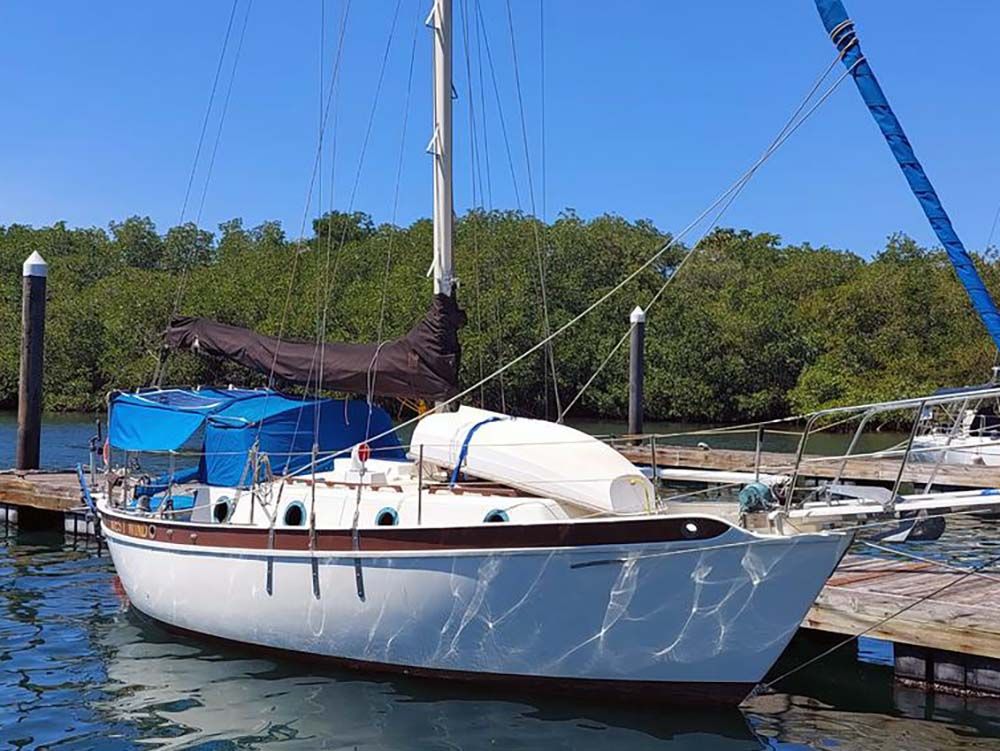
The Westsail 28 is a compact, heavy-displacement cutter conceived in the mid-1970s as a short-keel, blue-water pocket cruiser rather than a club racer or volume-maximizing family boat. Designed by Herb David and produced by Westsail Corporation between roughly 1975 and 1979, the 28 was intended for owners who prized seakindly motion, robust construction and offshore confidence on a modestly sized hull; only a small run of hulls was built, and the model has remained a niche classic rather than a mass-market bestseller. Today the Westsail 28 attracts a particular buyer profile: sailors who want a stout, seaworthy little cutter for serious coastal voyaging or for restoration/owner-refit projects, and a steady trickle of sales appears on broker sites and owner forums rather than on charter lists.
Design and Construction
The hull is a conservative long-keel form with a transom-hung rudder and a relatively full, beamy midsection that contributes to reserve buoyancy and a comfortable motion in confused seas. Most examples left the factory with a cutter rig (often described as a masthead cutter) and a hand-laid solid fiberglass hull with a plywood or sandwich-cored deck depending on the build run; the heavy lead ballast and substantial displacement make the boat feel very planted, but they also limit acceleration and pointing when compared with modern fin-keel boats. These construction choices — solid laminate below and a more traditional joinery-heavy interior — mean that structural repairs are conventional (glasswork, core repairs, reinforcing of mast supports) and that much of the value sits in the hull integrity and joinery rather than in equipment. From a naval-architecture standpoint the Westsail 28 trades agility for seakindliness: long keel and weight low in the hull reduce hobby-horsing and make long watches less fatiguing, but buyers should expect slower tacks and more helm to change course quickly.

Performance
On the water the Westsail 28 behaves like a true traditional cruiser: steady, predictable and a little pokey. With a displacement in the neighborhood of 13,500 lb and a modest sail area for that weight, practical cruising speeds are in the mid-to-high 4-knot range in average conditions and the theoretical hull speed sits in the low-6-knot band; she will push through short, confused seas with less hobby-horsing than many lighter boats, which owners appreciate on longer passages. The long keel provides excellent directional stability and simplifies autopilot or tiller-watch duties, but the tradeoff is reduced pointing ability and slower acceleration out of tacks — sailors who value time-to-destination or club-race performance will find faster boats for the same LOA. Among contemporaries the Westsail 28’s reputation is firmly that of a safe, comfortable seagoer rather than a nimble coastal flyer.
Comfort and Accommodations
Inside, the Westsail 28 is a compact but robustly finished space: joinery tends toward traditional hardwoods, with a compact galley, an enclosed head and practical berths designed for seafaring rather than large-party entertaining. Headroom and usable volume are modest by modern standards, so the boat best suits a couple or a small family who prioritize offshore capability over spacious living arrangements; many owners have upgraded lighting, ventilation and the galley to modern standards to make week-long cruises more comfortable. Storage is surprisingly generous for the hull length because the designers squeezed lockers into the full-keel package, but taller crews should expect to compromise on standing headroom. Overall, the interior ages attractively when cared for, and it’s common to find well-executed owner refits that preserve the boat’s classic character while improving livability.
Safety and Practicality
Safety on deck is one of the Westsail 28’s strong points: robust toerails, big cleats and heavy-duty hardware reflect a design brief that emphasized offshore security. The cutter rig is inherently versatile for heavy weather—small inner foresails and reefing the main let you balance the sailplan easily—and the long keel gives a forgiving motion that reduces crew fatigue on overnight passages. For short-handed sailing, upgrades such as a roller-furling headsail, self-tailing winches and a reliable reefing system strongly improve practicality; without them, sheet-handling and sail changes are more work than on modern, cockpit-focused designs. Systems accessibility is generally reasonable (engines are accessible beneath removable cockpit soles in many examples), but because these boats are decades old, plumbing, wiring and through-hull fittings merit careful inspection and are common maintenance items.
Known Issues with the Westsail 28
Most of the documented problems with Westsail 28s are age-related and tied to the realities of a high-humidity, plywood/cored-deck era: deck-core compression or soft spots around chainplates and other penetrations, and cabin-top or sole sag where the mast support or partners haven’t been adequately reinforced. Owner forums and surveys commonly flag the mast-support area under the cabin sole as a location to inspect closely; if neglected, it can lead to localized deck deformation and more costly structural repairs. Older inboard diesel engines, propeller shafts, cutlass bearings and seacocks are typical survey items too, and many purchasers budget to renew standing rigging, update electronics, and check/renew shaft/packing arrangements. Practical, commonly recommended upgrades include reinforcing the mast support and chainplate foundations, replacing dated standing rigging on a schedule, upgrading navigation electronics and refreshing sails to match the owner’s cruising ambitions.
Market Availability and Pricing in the U.S.
The Westsail 28 is out of production and appears only on the used market; listings are intermittent but persistent, mostly driven by private sellers and smaller brokers. Current asking prices for clean, ready-to-go examples tend to cluster in the mid-five-figure range, while project boats can be found in the low five figures; recent broker listings and aggregated sales suggest a practical market band of $10,000–$35,000, with many boats offered around $15k–$25k depending on location and refit level. You’ll see Westsail 28s turn up most often where classic-boat communities and bluewater shippers are active: New England, the Pacific Northwest, parts of the mid-Atlantic and occasionally Florida, plus listings that surface from Mexico and Central America as owners move boats south. The model has a defined but narrow buyer pool—enthusiasts who value traditional heavy-displacement cruisers—so resale can be steady if the boat is well documented and refitted, but liquidity is lower than for mainstream family cruisers.
Below is a comparison with similar sailboats from the same era:
| Model | LOA | Years (approx.) | Typical used price (U.S.) | Main differences |
|---|---|---|---|---|
| Cape Dory 28 | ~28 ft | 1974–1988 | $8,000–$40,000 | Narrower, classic Alberg lines with long-keel feel but lighter displacement; more “classic pocket cruiser” than heavy-tanker feel. |
| Albin Vega 27 | ~27 ft | Late 1960s–1980s | $3,000–$15,000 | Lighter, narrower hull with a strong offshore reputation for its size; less interior volume and slower speeds but excellent for solo or small-crew voyaging. |
| Catalina 30 | ~30 ft | 1978–1994 (various marks) | $9,000–$30,000 | Much larger interior volume, more mainstream owner market and parts support; better resale liquidity and family-cruiser ergonomics than the Westsail 28. |
Westsail 28 vs Cape Dory 28

The Westsail 28 is heavier and fuller-hulled, with a long-keel, cutter-oriented design that prioritizes seakindliness and reserve buoyancy; by contrast, the Cape Dory 28 (an Alberg-inspired design) is narrower, lighter and often feels more sprightly to windward. For a buyer this translates into the Westsail offering a calmer motion and superior directional stability in confused seas, while the Cape Dory typically points higher and accelerates more readily—advantages if your sailing is largely coastal and you care about passage time.
Maintenance differs in emphasis: the Westsail’s solid hull and heavy joinery mean more focus on engine, shaft and deck-core inspections, while the Cape Dory’s simpler systems and slightly more modern layouts often make upgrades and parts replacement cheaper and more straightforward. If resale liquidity and interior volume matter, the Cape Dory has the edge; if offshore confidence and classic, heavy-duty construction are your priority, the Westsail wins out.
► Learn more about de Cape Dory 28
Westsail 28 vs Albin Vega 27
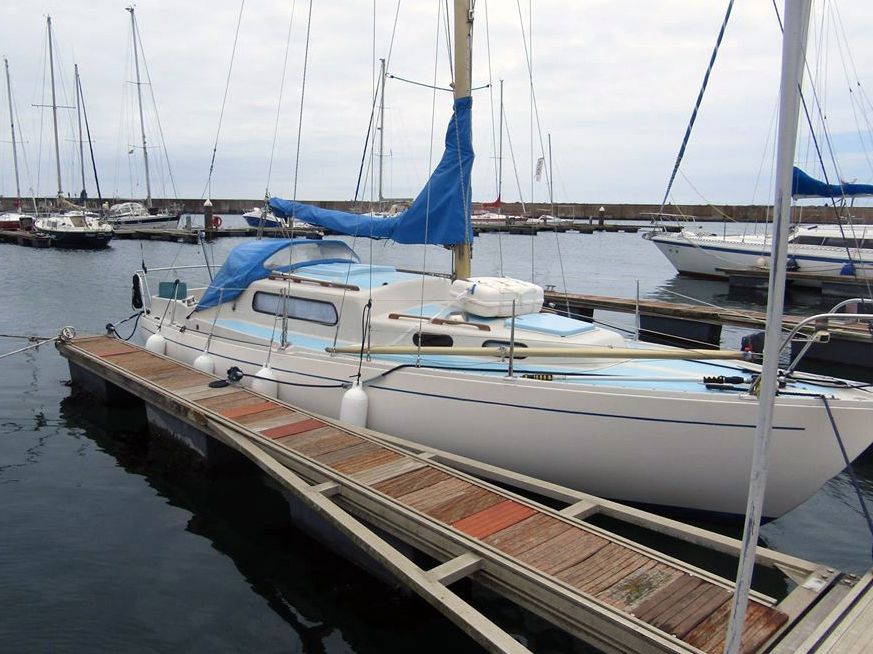
Both designs enjoy bluewater reputations, but they arrive at seaworthiness differently: the Vega is a light, nimbler pocket cruiser that performs respectably for its size, while the Westsail 28 achieves seaworthiness through mass, ballast and a long keel. Buyers who single-hand or expect to race club events occasionally will likely prefer the Vega’s responsiveness and lower maintenance profile; owners planning exposed offshore passages in uncertain weather will value the Westsail’s motion comfort and redundancy.
Interior and habitability contrast sharply: the Vega is compact and spare, optimized for minimal-crew voyaging, whereas the Westsail 28 packs in heavier joinery, more lockers and a sensation of solidity that feels reassuring offshore but occupies more of the boat’s displacement budget. Maintenance on the Vega is often simpler and less costly in dollar terms, but the Westsail’s structural robustness can make it a longer-lived platform if core issues are addressed early and documented.
► Learn more about de Albin Vega 27
Westsail 28 vs Catalina 30

The Catalina 30 is a mainstream family cruiser that favors interior volume, ease of handling and resale liquidity; the Westsail 28 offers a very different proposition of heavy-displacement seakeeping and classic lines. Practical ownership considerations point toward the Catalina if you want weekend comfort, easy upgrades and a broad parts/support network; choose the Westsail if your priority is a small boat that behaves like a larger yacht in a blow and you accept slower passage times.
On maintenance and upgrades the Catalina typically benefits from abundant aftermarket parts and local technicians familiar with the platform, which can lower long-term costs and speed refits. The Westsail’s systems are straightforward but older and require more careful structural inspection (mast support, deck areas); in return you get a hull and motion character that many traditional bluewater sailors prize.
► Learn more about de Catalina 30
Maintenance Costs of an Westsail 28 in the U.S.
- Mooring/Slip or Storage — annual marina slip fees vary widely: $1,200–$7,000+ depending on region (New England and California at the high end); off-season haul and winter storage add to this.
- Insurance — a classic 28-ft offshore cruiser typically runs $400–$1,500/year depending on cruising area, coverage and owner experience.
- Engine servicing — routine annual service, filters and belts: $300–$1,000; full overhauls on older diesels (Westerbeke, Yanmar, etc.) can be several thousand.
- Bottom paint / anti-fouling — plan $300–$1,500 every 1–3 years depending on yard rates and frequency of hauling.
- Standing rigging replacement — expect $1,500–$4,500 on a 10–15 year cycle, depending on complexity and labor.
- Running rigging & sails — a new mainsail and working headsail will often cost $1,500–$6,000+; smaller routine replacements and line renewals are modest by comparison.
- Structural repairs (mast support, chainplate/core work) — localized core or mast-support repairs can range $1,000–$10,000 depending on severity and whether interior joinery must be removed.
- Prop shaft, cutlass bearing, packing/PSS — these items are common one-off costs and can run $500–$2,500 depending on whether the shaft is pulled and bearings/seals replaced.
Region affects these ranges strongly: yards in the Northeast and West Coast generally charge more for labor and haul, while Gulf and some inland yards are cheaper. Significant one-time costs to budget for include standing-rigging replacement, a new suit of sails and any deck/core or structural reinforcement discovered in a survey. An owner with mechanical aptitude can DIY many routine tasks (engine oil, basic electrical work, varnish), which materially reduces annual outlay; however, major structural, rigging and engine overhauls usually require professionals. Overall, cost of ownership for the Westsail 28 is medium to high for its size when you factor in periodic structural work and the premium of specialized repairs, but thoughtful, documented maintenance tends to preserve resale value in the small but dedicated market niche.
Conclusion
The Westsail 28’s strengths are clear: a stout, traditionally built hull, excellent motion in a seaway, a cutter rig that adapts well to heavy weather and a personality that appeals to sailors who prize seaworthiness over speed or interior volume. Its weaknesses are equally practical — modest interior space, comparatively slow passages and the need to watch for age-related structural issues (mast support, deck penetrations and older systems). For a buyer who wants a compact boat that behaves like a larger, sea-kindly cruiser and is prepared to invest in careful surveying and occasional refits, the Westsail 28 is a very honest and rewarding platform. It is best suited to an owner who values offshore confidence and classic lines and who either does much of the work themselves or budgets for professional maintenance; for that owner the Westsail 28 can be a worthwhile find with a stable, if specialized, resale segment.
Specifications
| Hull Type | Long keel with transom-hung rudder |
| Rigging Type | Cutter |
| LOA | 28.25 ft / 8.61 m |
| LWL | 23.50 ft / 7.16 m |
| Beam | 9.58 ft / 2.92 m |
| Displacement | 13,500 lb / 6,123 kg |
| Ballast | 4,200 lb / 1,905 kg |
| Max Draft | 4.33 ft / 1.32 m |
| Construction | Fiberglass solid hull / plywood sandwich deck |
| Years Built | 1975–1979 |
| Number Built | 78 |
| Builder | Westsail Corp. (USA) |
| Designer | Herb David |
| Auxiliary Power | Volvo MD11HD, 13 HP diesel |
| Fuel Capacity | 36 gals / 136 L |
| Water Capacity | 79 gals / 299 L |
| Sail Area (reported) | 475 ft² / 44.13 m² |
| Comfort Ratio | 41.26 |
| Capsize Screening | 1.61 |
| Hull Speed | 6.50 kn |
| Rig Dimensions | I: 35.00 ft, J: 17.00 ft, P: 31.50 ft, E: 11.30 ft |
| Sail Areas | Fore: 297.5 ft², Main: 178 ft², Total: 475.5 ft² |
Disclaimer
The considerations and analyses presented regarding the Westsail 28 sailboat are of a general nature and are based on the available information and technical data on this model, interpreted to the best of our knowledge and understanding. It is important to note that the specific characteristics of any particular sailboat may vary due to custom modifications, maintenance performed, and conditions of use over time, among other factors. Therefore, the details and performance of the boat you are considering may not exactly match the information provided here.
We strongly recommend that, before making any purchasing or usage decisions, you conduct a detailed inspection of the boat in question, consult with nautical professionals and other sailors, and consider your personal needs, expectations, and capabilities. Each sailboat may have unique particularities that affect its performance and suitability for different types of sailing and sailors.
The information contained in this analysis should be used as a general guide and not as a definitive reference. Professional evaluation and personal inspection are essential to ensure that the boat meets your specific requirements and expectations.