



The Beneteau Oceanis 45 is a modern cruising sailboat designed to blend performance, comfort, and practicality for coastal and offshore sailing. Introduced in 2012 by the renowned French shipyard Beneteau, this model was penned by naval architect Finot-Conq and interior designer Nauta Design, both well known for their focus on liveability and sea-kindliness. The Oceanis 45 was created with the cruising family or sailing couple in mind—those looking for a yacht that’s easy to handle, capable of long passages, and comfortable enough for extended life aboard.
Over the years, it has become a favorite in the brokerage and charter markets. Its spacious layout, clean lines, and solid sailing credentials have attracted private owners and charter fleets alike, particularly in North America and the Mediterranean. Today, demand remains high among cruising enthusiasts seeking a versatile and proven platform.
Design and Construction
The Oceanis 45 features a beamy, chined hull—a hallmark of modern cruising yachts—that increases both interior volume and form stability. Its hull is constructed in fiberglass (GRP) with an injection-molded deck, which helps reduce weight while maintaining strength. The boat is typically equipped with a cast iron fin keel (standard or shoal draft), a balanced spade rudder, and dual helms, promoting control and access at anchor.
It is rigged as a masthead sloop with a furling genoa and in-mast or traditional mainsail options. The rig is designed for simplicity and easy reefing, making it a good fit for short-handed crews. These construction decisions—chine for stability, twin wheels for control, and a wide beam carried aft—enhance both sailing performance and interior habitability. Owners appreciate the durability of the materials and straightforward construction, which translates to manageable maintenance and good long-term resale value.

Performance
Under sail, the Oceanis 45 delivers solid performance across a range of conditions. With a generous sail area (over 100 m² with standard sails) and a relatively light displacement for its size, the boat performs well in light air and remains composed in heavier seas. Thanks to its chine and wide stern, it offers excellent downwind speed and a comfortable ride on a reach.
Upwind, it points reasonably well for a cruiser, though performance purists might find the deep-draft version more satisfying. Compared to similar models like the Jeanneau Sun Odyssey 439 or Hunter 45 DS, the Oceanis 45 is often praised for its balanced helm and ease of handling, especially when fitted with bow thrusters and electric winches. It’s not a racer, but it’s an efficient, stable cruiser that can log long daily distances in comfort.
Comfort and Accommodations
The interior of the Oceanis 45 is where it shines. Available in 2 to 4 cabin configurations, the layout is spacious and flooded with natural light, thanks to large hull and deck windows. The salon feels open and inviting, with clean Italian styling, quality finishes, and an efficient galley to port.
Cabins offer generous headroom, wide berths, and ample storage, making it suitable for families or groups planning extended stays aboard. Ventilation is excellent, with opening hatches and ports throughout. In charter versions, you’ll often find four cabins and four heads, while owner versions favor a larger master stateroom forward.
For coastal cruising or full-time living aboard, the Oceanis 45 offers one of the most comfortable interiors in its class. The modular furniture holds up well over time, though charter boats may show wear unless refurbished.
Safety and Practicality
From a safety perspective, the Oceanis 45 is well equipped for coastal and moderate offshore use. The wide cockpit and flush decks offer good mobility, and lifelines are appropriately high. The dual helms improve visibility and make docking simpler, while the electric transom folds into a swim platform, adding convenience at anchor.
The boat can be managed easily by two people, especially with furling sails and optional autopilot. Engine access is decent, and most systems are logically arranged, making routine maintenance relatively painless. Owners will want to monitor the condition of the thru-hulls and deck fittings over time, but nothing in the systems is particularly complex or proprietary.
Known Issues with the Beneteau Oceanis 45
Like many production cruisers, the Oceanis 45 has a few recurring concerns. Some owners report flexing in the deck near the chainplates or cockpit sole, especially in heavily chartered boats. Hardware like hatches and hinges may show early signs of wear if exposed to tropical sun.
The in-mast furling mainsail, while convenient, can jam if not maintained or used correctly. The electric swim platform motor is another common point of failure but is easily replaced. Electronics, particularly B&G systems installed in early models, may require updates.
Many owners opt to upgrade the propeller (folding or feathering) to improve motoring performance. Reinforcing the anchor locker, upgrading the house battery bank, and refreshing the upholstery are also popular post-purchase improvements., wind generators, and in some cases, lithium battery systems and bow thrusters for easier docking.ing design, adding solar panels, increasing battery bank capacity, and modernizing navigation systems.
Market Availability and Pricing in the U.S.
The Oceanis 45 is no longer in production (replaced by the Oceanis 46.1), but it remains widely available on the secondhand market, especially in Florida, California, and New England. Prices in the U.S. typically range from $180,000 to $280,000, depending on year, condition, and equipment. Ex-charter models are usually less expensive but may require refits.
Well-kept private-owner versions, especially those with upgraded navigation systems and bow thrusters, tend to sell quickly. Compared to similar boats, the Oceanis 45 represents a strong value, with a healthy balance between performance, comfort, and price.
Below is a comparison with other cruising sailboats of similar size, age, and purpose:
| Model | LOA | Year | Used Price (USD) | Main Differences |
|---|---|---|---|---|
| Beneteau Oceanis 45 | 45.6 ft | 2012–2018 | $180,000–$280,000 | Spacious, dual helm, modern design, excellent liveaboard |
| Jeanneau Sun Odyssey 439 | 43.9 ft | 2011–2015 | $170,000–$240,000 | Similar performance, lighter interior, less beam aft |
| Catalina 445 | 44.5 ft | 2010–2020 | $210,000–$290,000 | More traditional interior, robust build, centerline berth |
| Hunter 45 DS | 45.0 ft | 2006–2014 | $160,000–$220,000 | Deck saloon, large windows, less agile under sail |
Beneteau Oceanis 45 vs Jeanneau Sun Odyssey 439
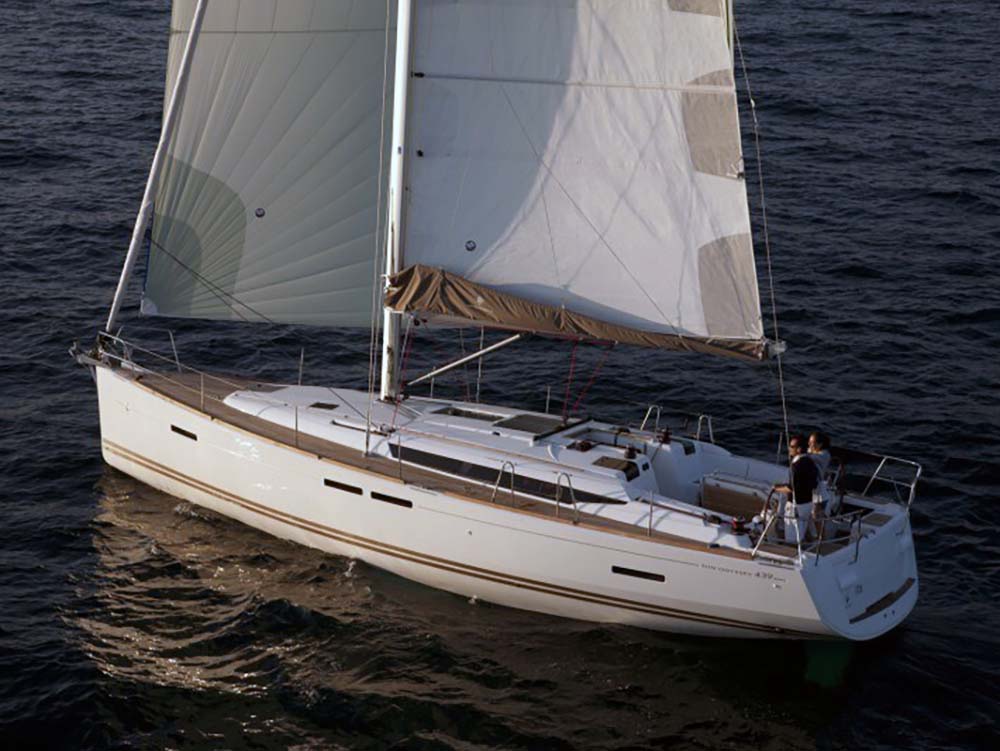
The Beneteau Oceanis 45 and the Jeanneau Sun Odyssey 439 share a modern, performance-cruiser philosophy, but the Oceanis leans slightly more toward comfort and stability, while the Jeanneau offers a livelier helm and marginally better upwind performance. The Oceanis’s broader beam carried aft provides a larger cockpit and twin-rudder configuration that enhances control under heel, ideal for family cruising. In contrast, the Sun Odyssey’s lighter displacement and single rudder give it a sportier feel preferred by sailors who enjoy active trimming. Interior-wise, the Oceanis delivers a more spacious, apartment-like saloon and larger cabins, appealing to those prioritizing liveaboard comfort over pure sailing efficiency. For coastal or extended cruising, the Oceanis feels more forgiving and luxurious; the Jeanneau suits owners who favor hands-on sailing with a bit more performance flair.
► Learn more about de Jeanneau Sun Odyssey 439
Beneteau Oceanis 45 vs Catalina 445

Compared with the Catalina 445, the Beneteau Oceanis 45 feels more European in design and finish, emphasizing open interiors and sleek styling, whereas the Catalina offers a more traditional American layout with robust systems and practical ergonomics. The Catalina’s heavier build and moderate beam give it a slightly steadier motion in rough seas, while the Oceanis provides better cockpit space and easier deck movement. Sailing performance favors the Oceanis in light to moderate conditions, thanks to its efficient hull form and balanced rig, but the Catalina stands out for durability and straightforward maintenance, appealing to owners planning long-term ownership. The Oceanis caters to those seeking a modern, comfortable cruiser with contemporary flair, while the Catalina attracts sailors valuing ruggedness, simplicity, and familiarity.
► Learn more about de Catalina 445
Beneteau Oceanis 45 vs Hunter 45 DS (Deck Salon)

The Oceanis 45 and Hunter 45 Deck Salon both emphasize comfort, but they approach it differently: the Oceanis through sleek design and balanced sailing performance, the Hunter through maximum interior volume and visibility. The Hunter’s higher topsides and raised saloon create exceptional headroom and light, but at the cost of higher windage and slightly less elegant motion under sail. The Oceanis, by contrast, feels more refined and better balanced, with twin wheels and a deeper keel option improving control and pointing ability. Maintenance is typically easier on the Oceanis, given its more conventional systems and deck layout, while the Hunter’s integrated systems require more specialized care. For buyers seeking a comfortable family cruiser that still sails well, the Oceanis strikes a better balance between luxury and performance; the Hunter favors those prioritizing interior living space above all else.
► Learn more about de Hunter 45 DS (Deck Salon)
Maintenance Costs of a Beneteau Oceanis 45 in the USA
Typical annual maintenance expenses for a Beneteau Oceanis 45 range from $12,000 to $20,000 USD, depending on location, usage, and whether the owner performs some of the work personally.
- Mooring or slip fees: $4,000–$9,000 annually, varying widely between regions (lower in the Gulf Coast, highest in the Northeast or California).
- Insurance: $1,500–$3,000 per year, depending on coverage level and cruising area.
- Engine servicing: Around $600–$1,000 for annual maintenance; major overhauls every 5–7 years can reach $3,000–$5,000.
- Antifouling paint and haul-out: $1,500–$3,000 annually, influenced by water salinity and fouling rates.
- Standing and running rigging inspection/replacement: $500–$1,000 yearly for inspection; full replacement every 8–10 years can cost $8,000–$10,000.
- Sails: Routine cleaning and repair at $300–$700 annually; full sail replacement typically $10,000–$15,000 depending on material and sailmaker.
Significant one-time costs may include electronics upgrades ($5,000–$10,000), deck refits, or interior refurbishments, particularly on older vessels. The Oceanis 45 can be partially owner-maintained—tasks like cleaning, minor engine work, and electronics upkeep are manageable—but rigging, antifouling, and major systems generally require professional services, increasing the total cost of ownership. Overall, maintenance costs are medium to high for its class and size, typical of 45-foot cruisers with modern systems. However, its strong resale value and broad market demand often offset long-term expenses, making it a solid investment for sailors prioritizing comfort, capability, and contemporary design.
Conclusion
The Beneteau Oceanis 45 strikes an appealing balance between modern design, sailing performance, and long-term liveability. Its strengths lie in its roomy and well-lit interior, smart deck layout, and ease of handling, especially for couples or small crews. While charter versions may require extra care when buying used, private-owner examples are often well maintained and loaded with options.
For sailors seeking a capable, comfortable cruiser that’s modern without being overcomplicated, the Oceanis 45 is well worth considering. It holds its value respectably and competes strongly against other cruisers in the 43–46 ft range. Whether you’re planning seasonal coastal adventures or extended voyages, it’s a sound investment with enduring appeal.
Specifications
| Hull Type | Fin w/bulb & spade rudder |
| Rigging Type | Fractional Sloop |
| LOA | 45.42 ft / 13.84 m |
| LWL | 42.00 ft / 12.80 m |
| Beam | 14.75 ft / 4.50 m |
| Max Draft | 7.08 ft / 2.16 m |
| Displacement | 21,048 lb / 9,547 kg |
| Construction | Fiberglass (FG) |
| First Built | 2013 |
| Builder | Beneteau (France) |
| Designer | Finot-Conq / Nauta Design |
| Auxiliary Power | Diesel, 54 HP |
| Fuel Capacity | 50 gals / 189 L |
| Water Capacity | 151 gals / 572 L |
| Sail Area (Reported) | 1,076.00 ft² / 99.96 m² |
| I / J / P / E | I: 57.16 ft | J: 18.50 ft | P: 53.67 ft | E: 17.83 ft |
| S.A. Fore | 528.73 ft² / 49.12 m² |
| S.A. Main | 478.47 ft² / 44.45 m² |
| S.A. Total (100% Triangles) | 1,007.20 ft² / 93.57 m² |
| S.A. / Displ. (Reported) | 22.67 |
| S.A. / Displ. (Calculated) | 21.22 |
| Displacement / Length | 126.83 |
| Comfort Ratio | 20.99 |
| Capsize Screening Formula | 2.14 |
| Hull Speed | 8.68 knots |
| Pounds/Inch Immersion | 2,213.54 lb/inch |
| Mast Height from DWL | 66.42 ft / 20.24 m |
| Estimated Forestay Length | 60.08 ft / 18.31 m |
| S# (Sail Area to Displacement Ratio) | 4.37 |
Disclaimer
The considerations and analyses presented regarding the Beneteau Oceanis 45 sailboat are of a general nature and are based on the available information and technical data on this model, interpreted to the best of our knowledge and understanding. It is important to note that the specific characteristics of any particular sailboat may vary due to custom modifications, maintenance performed, and conditions of use over time, among other factors. Therefore, the details and performance of the boat you are considering may not exactly match the information provided here.
We strongly recommend that, before making any purchasing or usage decisions, you conduct a detailed inspection of the boat in question, consult with nautical professionals and other sailors, and consider your personal needs, expectations, and capabilities. Each sailboat may have unique particularities that affect its performance and suitability for different types of sailing and sailors.
The information contained in this analysis should be used as a general guide and not as a definitive reference. Professional evaluation and personal inspection are essential to ensure that the boat meets your specific requirements and expectations.