



The C&C 35 Mk III is a classic early-1980s racer-cruiser from C&C Yachts that was conceived to blend club-level performance with comfortable cruising accommodations. Designed by Robert W. (Rob) Ball and introduced as a clean, modern redesign of the earlier C&C 35 line, the Mk III was built between the early-to-mid 1980s and marketed to sailors who wanted a sporty boat that still worked well for weekend and coastal cruising. Its character sits squarely between a serious club racer and a capable family cruiser: owners prize it for pointing ability, speed in a breeze and a hull form that rewards good sail trim. Today the Mk III remains firmly a used-boat market item — not a mainstream charter or school boat — and it draws demand from buyers who want a performance edge in a comfortable 35-foot package, often in regions with active club racing and coastal cruising scenes.
Design and Construction
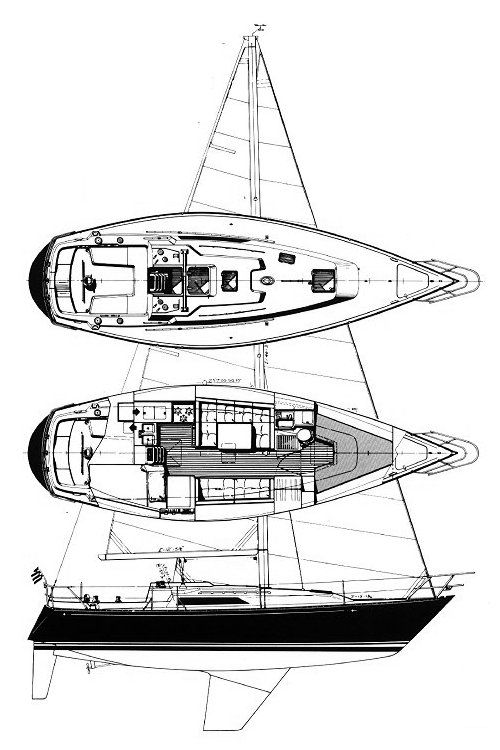
The Mk III is a purpose-built fin-keel, spade-rudder monohull with a masthead sloop rig — a configuration chosen to deliver pointing ability and manoeuvrability without excessive complexity. Construction is conventional fiberglass (solid hull with production-era deck construction), with a deep fin keel as standard and a centerboard/keel option on some examples that trades draft for shoal-water access; the standard Mk III numbers put displacement in the 10,800–11,000 lb neighborhood with ballast around 4,500 lb, giving a ballast/displacement ratio in the low-40s and a relatively stiff, powerful feel. Those naval-architecture choices — moderate displacement, fairly high ballast ratio and a relatively generous sail area — explain why the boat accelerates quickly and carries sail well in breeze while remaining controllable for an experienced short-handed crew. From an owner’s perspective this is good news: the solid fiberglass structure is repairable with standard techniques (laminate repair, deck-fitting reinforcement), and the straightforward rigging layout keeps long-term maintenance accessible and predictable.
Performance
On the water the Mk III is widely regarded as a performance-leaning cruiser: hull speed sits around 7.1 knots (calculated from the waterline length) and the maker’s and community numbers produce an SA/D in the high-teens, which is consistent with a boat that’s lively in a range of wind strengths. Owners and forum discussions routinely praise the model for good upwind ability and quick acceleration — it will outpace many contemporary production cruisers in 12–20+ knot conditions and holds a tighter pointing angle, which makes passages shorter and more enjoyable when you’re on a schedule. That performance comes with expectations: the deeper fin keel (and the optional centerboard versions’ complexity) make the Mk III less forgiving in shoal-only waters than a shoal-draft cruiser, and it rewards attention to sail trim and rig tuning if you want the best speed and handling. Overall it sits toward the “racer-cruiser” end of the spectrum among 34–36 foot boats: faster and more weatherly than pure coastal cruisers, but not as maintenance-intensive as an all-out race boat.
Comfort and Accommodations
The interior of the Mk III balances performance priorities with the habitability families want for weekends and longer trips: the layout typically includes a large V-berth forward, a usable saloon with a dinette that converts to berth space, a practical galley and a properly sized head — in many listings owners report headroom and a liveable layout that make multi-day cruises comfortable for a couple or a small family. Tankage is conservative but adequate for coastal work (fuel and water capacities in the modest range), and finish quality from the factory was competitive for the era — attractive joinery that, when well maintained, still presents nicely. That said, long-term liveaboard cruisers frequently upgrade systems (watermakers, refrigeration, solar, larger tanks) to match extended cruising ambitions; as a result, you’ll often see Mk IIIs on the market with a mix of original woodwork and sensible modern refits. For buyers who want a boat that’s both fun to sail and honest to live aboard for weekends and week-long passages, the Mk III represents a strong compromise.
Safety and Practicality
Deck ergonomics and systems layout reflect the boat’s dual role: the cockpit is sized for active sailing while still offering handholds and practical access for family use, and many owners lead primary control lines aft for safer short-handed operation. The standard deep fin keel gives good righting moment and upwind control, which is reassuring in mixed weather offshore; the centerboard variant lowers draft for shoaler anchorages but adds mechanical complexity and a different inspection/maintenance regime. Practical safety checks for any buyer should focus on keel bolts and sump areas, mast step condition, chainplate backing and through-hull fittings — items that, while not unique to the Mk III, are where age-related failures can create big bills. In short: the boat is perfectly capable of coastal and limited offshore work as built, but prudent surveys and conservative system upgrades are essential before committing to extended passages.
Known Issues with the C&C 35 Mk III
Forum and survey discussions highlight several recurring areas to inspect on Mk III examples. Notable items commonly reported by owners and surveyors include stress or wear around the mast step and chainplate/deck-fitting areas, attention required to the keel-sump glass in some early hulls (thin laminate reported at the keel leading edge), and the usual lifecycle replacements — standing rigging nearing service life, cutlass bearing and shaft alignment, and corroded or aged hardware. Keel-bolt torque and inspection are also mentioned repeatedly as prudent maintenance tasks on older C&C keels. These issues are typically repairable (and many owners proactively fibreglass-reinforce the keel sump, renew deck cores around fittings, or replace rigging) but they materially affect survey outcomes and negotiation leverage for buyers. Common, practical upgrades sellers often perform or buyers budget for include renewals of standing rigging, a refitted shaft/prop/dripless seal, upgraded electronics/autopilot and targeted hull or deck rework where fittings have been changed over time.
Market Availability and Pricing in the U.S.
The Mk III is out of production and appears only on the used market. Listings over recent years show a broad spread of condition and asking prices: project boats or bargain finds in the low-teens can appear, while well-equipped, freshly refitted examples commonly list in the mid-to-high-three-figures (USD). A practical, current market range for U.S. buyers would be approximately $12,000–$45,000 depending on year, equipment, refit level and location; strong boats with regatta packs and professional refits sit at the upper end, while older, survey-required hulls occupy the lower end of the scale. You’ll see Mk IIIs with the greatest frequency where active club racing and C&C owner communities are concentrated — New England, the Mid-Atlantic and parts of the Great Lakes — though they also turn up on both U.S. coasts and in the eastern Canadian listings. In buyer terms: this is a model with attractive performance-for-price and a willing niche market (sailors who value speed and handling), but resale depends strongly on documented upgrades and survey history rather than brand-new desirability.
Below is a comparison with similar sailboats from the same era:
| Model | LOA | Approx. Years Built | Typical Used Price (U.S.) | Main Differences |
|---|---|---|---|---|
| C&C 35 Mk III | ~34.7 ft | 1982–1987 | $12,000–$45,000 | Racer-cruiser balance, deep fin keel (or CB option), lively SA/D and good upwind performance. |
| Catalina 36 | ~36.3 ft | 1982–2005 (various marks) | $25,000–$100,000+ | Roomier cruiser focus, huge resale pool and factory options; generally more comfort-oriented than C&C performance models. |
| Hunter 35 Legend 35 | ~35.5 ft | Late 1980s–1990s (Legend series) | $25,000–$60,000 | Cruiser-oriented with emphasis on interior volume and comfort; easier systems for family cruising but less racier handling than the C&C. |
| Cal 35 | ~35.1 ft | 1973–early 1980s (various marks) | $15,000–$45,000 | Conservative cruiser with heavier displacement and sturdy construction; comfortable for offshore but generally slower than the C&C in a breeze. |
C&C 35 Mk III vs Catalina 36

The Mk III emphasizes upwind performance and a responsive helm — its fin-keel geometry and higher SA/D make it quicker to accelerate and more weatherly than a Catalina 36, which was tuned in many marks toward interior volume and cruising comfort. For a buyer who values passage time and club racing potential, the C&C’s sharper handling and lighter feel under sail translate directly to more enjoyable days on the racecourse and quicker coastal hops.
By contrast, the Catalina’s larger market presence, extensive parts network and generally friendlier interior layout make it a safer resale bet and a more comfortable liveaboard for families who prioritize creature comforts over raw performance; maintenance on a Catalina tends to be more about upkeep of comfort systems while the C&C buyer should budget for performance-oriented rig and hull care.
► Learn more about de Catalina 36
C&C 35 Mk III vs Hunter 35 Legend

Relative to the Hunter Legend series, the Mk III is more performance-biased in hull form and sail plan: Hunters often had design choices (wider stern sections, shallow or winged keels on some variants) that favor interior volume and steadier cruising behavior, while the C&C trades some interior cubic feet for a stiffer, more finely tuned sailing platform. Owners who sail short-handed and prefer simple, robust cruising systems may appreciate the Hunter’s ergonomics and factory comforts; the C&C will reward owners who maintain rig tuning and sails with noticeably better speed and pointing.
From a maintenance standpoint the Mk III can be slightly more demanding in terms of standing-rigging care and keel/structural inspections (given its performance foils and loads), whereas Hunters of similar age typically present fewer race-level wear concerns but may require more cosmetic or systems-level refits to modernize interior amenities.
► Learn more about de Hunter 35 Legend
C&C 35 Mk III vs Cal 35
Compared with the Cal 35 family — which leans toward conservative displacement and a comfortable motion at sea — the Mk III offers a noticeably livelier ride and better speed potential, particularly to windward. The Cal’s heavier displacement and sturdier feel can be preferable for bluewater temperament and forgiving motion, making it attractive to buyers whose priority is comfort in long passages rather than club performance.
Practically, a prospective owner choosing between them should weigh intended use: pick the Mk III if coastal performance, club racing and shorter passages are priority; pick the Cal if you want a more traditional, heavier-displacement cruiser that tolerates sloppy weather and deferred systems work a bit more kindly.
► Learn more about de Cal 35
Maintenance Costs of a C&C 35 Mk III in the U.S.
Below are typical annual and periodic cost items you should budget for; ranges depend heavily on region, condition and owner versus professional labor:
- Mooring / slip — wide range depending on marina: $1,500–$12,000+ / year (northern or inland areas are cheaper; high-demand marinas in New England, California and Florida trend to the top end).
- Insurance — $500–$2,000 / year depending on coverage, agreed value and cruising area.
- Engine servicing & winterization — $300–$1,200 / year for routine servicing; repowering is a significant one-time cost.
- Antifouling paint & haul-out — $600–$3,000 every 1–2 years depending on haul-out fees and paint choice.
- Standing rigging replacement (periodic) — $1,500–$6,000 every 10–15 years depending on complexity and whether chainplates/deck repairs are needed.
- Sails & running rigging — routine maintenance $500–$1,500 / year averaged; replacement of main+headsail runs $3,000–$10,000+ depending on cloth and cut.
- Electronics & autopilot upgrades (one-time) — $1,000–$8,000 depending on brand and scope.
- Structural / survey-found repairs (one-time) — could range $1,000–$30,000+ (keel sump repairs, deck core patches, major gelcoat or fiberglass work).
Regional differences are the largest single variable: haul-out and labor in southern California or popular New England marinas typically cost 2–3× what similar work costs in lower-demand areas. A good rule of thumb many brokers and owners use for planning is to budget roughly 5–10% of the boat’s insured value per year for maintenance and operating costs — a guideline borne out in industry summaries. The Mk III is approachable for an owner-mechanic willing to do mechanical, rigging and cosmetic work, but major structural, rigging and mast-work jobs usually require professional yards; how much you DIY will therefore materially change your outlays. Overall, for a 35-foot racer-cruiser of this era I’d classify annual running costs as medium (not as low as a minimalist daysailer, nor as high as larger yachts), with occasional larger refit years that should be anticipated and budgeted for.
Conclusion
The C&C 35 Mk III is a compelling choice if your priority is sharp, satisfying sailing in a 35-foot platform that still offers practical accommodations for coastal cruising. Its strengths are clear: a performance-oriented hull and rig that reward good sail trim, a relatively stiff and seaworthy form that handles varied conditions well, and a construction approach that is familiar and repairable. Weaknesses are mostly age-related and typical of performance boats from the era: attention is required on keel/keel-sump areas, mast step and chainplates, and many boats benefit from updated electronics and rigging. For buyers who want a boat that straddles club racing and capable coastal cruising, the Mk III is often worth seeking out — it offers strong sailing for the money and, when properly surveyed and refitted, holds its appeal to the performance-minded buyer; resale is solid within that niche but depends heavily on documented surveys and recent upgrades rather than brand alone.
Specifications
| Hull Type | Fin w/ spade rudder |
| Rigging Type | Masthead Sloop |
| LOA | 34.67 ft / 10.57 m |
| LWL | 28.00 ft / 8.53 m |
| Sail Area (reported) | 573.00 ft² / 53.23 m² |
| Beam | 11.17 ft / 3.40 m |
| Displacement | 10,825 lb / 4,910 kg |
| Ballast | 4,500 lb / 2,041 kg |
| Max Draft | 6.08 ft / 1.85 m |
| Construction | Fiberglass (FG) |
| Ballast Type | Lead |
| First Built | 1982 |
| Last Built | 1987 |
| Builder | C&C Yachts |
| Designer | Robert Ball |
| Engine | Yanmar 3GM30F Diesel, 20 gal fuel |
| Water Capacity | 30 gal / 114 L |
| S.A./Displ. | 18.80 |
| Bal./Displ. | 41.57 |
| Displ./Len. | 220.14 |
| Comfort Ratio | 22.41 |
| Capsize Screening | 2.02 |
| S# | 2.67 |
| Hull Speed | 7.09 kn |
| Rig Dimensions (I/J/P/E) | I: 46.30 ft, J: 13.60 ft, P: 41.30 ft, E: 12.50 ft |
| Sail Areas | Fore: 314.84 ft², Main: 258.13 ft², Total: 572.97 ft² |
| Forestay Length | 48.26 ft / 14.71 m |
| Mast Height from DWL | 50.50 ft / 15.39 m |
Disclaimer
The considerations and analyses presented regarding the C&C 35 Mk III sailboat are of a general nature and are based on the available information and technical data on this model, interpreted to the best of our knowledge and understanding. It is important to note that the specific characteristics of any particular sailboat may vary due to custom modifications, maintenance performed, and conditions of use over time, among other factors. Therefore, the details and performance of the boat you are considering may not exactly match the information provided here.
We strongly recommend that, before making any purchasing or usage decisions, you conduct a detailed inspection of the boat in question, consult with nautical professionals and other sailors, and consider your personal needs, expectations, and capabilities. Each sailboat may have unique particularities that affect its performance and suitability for different types of sailing and sailors.
The information contained in this analysis should be used as a general guide and not as a definitive reference. Professional evaluation and personal inspection are essential to ensure that the boat meets your specific requirements and expectations.