



The Dufour 445 Grand Large is a performance-oriented cruiser that was introduced to combine passage-making ability with comfortable liveaboard accommodations. Designed by Umberto Felci and built by Dufour Yachts in the early 2010s, the 445 targets couples and families who want a boat that will both cruise efficiently on long legs and still be enjoyable to handle for weekend sailing. The model occupies the “performance cruiser” niche—more sailing-focused than a pure comfort cruiser, but more livable than a racer—and it has attracted steady interest on the used market from private cruisers and charter operators seeking a modern, well-balanced hull. Dufour 445s turn up regularly on brokerage sites, and demand is strongest where owners want an agile hull with generous interior volume for cruising rather than bare-bones passagemaking.
Design and Construction
The 445’s hull reflects contemporary thinking in middling-displacement performance cruisers: a fine entry, moderate beam carried aft and a relatively deep fin keel (with shoal options available) produce an underwater profile optimized for lift and reduced drag. The standard rig is a fractional sloop with an efficient mainsail and a moderate-size foresail, giving a sail-plan that accelerates the boat in variable conditions without demanding a large crew for sail handling. Construction uses resin-infused GRP laminates with reinforced structural zones where keel loads and rig loads concentrate, a common approach that balances stiffness and repairability; these production methods mean collision or compression repairs are relatively straightforward at most yards. Naval-architecture choices—higher aspect keel and balanced rudder geometry—translate into sharper pointing, faster acceleration off the wind and more forgiving helm balance, while still retaining tankage and tank-top strength that buyers value for extended cruising and resale longevity.

Performance
Under sail the Dufour 445 feels noticeably livelier than many same-length “comfort-first” cruisers: it tends to accelerate quickly in puffs, maintains speed off the wind, and points well for a production cruiser of its era. In light airs it will generally outperform heavier designs of similar LOA, and in moderate seas its hull form offers a pleasing blend of speed and seakindly motion—enough stiffness to carry sail and a hull shape that minimizes hobby-horsing. Compared with boats like Jeanneau’s Sun Odyssey 439 or Beneteau’s Oceanis 45, the Dufour sits closer to the performance end of the spectrum: owners trade off a sliver of interior volume for better passage speeds and more rewarding helmsmanship. For buyers who plan regular passages or who enjoy trimming and sailing to windward, the 445’s sailing characteristics are a strong practical advantage.
Comfort and Accommodations
Inside, the Grand Large philosophy is evident: the 445 offers a modern, bright interior with sensible ergonomics that suit a cruising couple or small family. Layout options typically include two- or three-cabin arrangements with a well-sized saloon, commodious galley and generous stowage—enough tankage and locker room to support multi-week cruises. While the Dufour prioritizes sailing performance, the interior materials and finish are high-quality for a production yacht, and most owners find the space entirely livable for extended trips; occasional owners upgrade cushions or electronics as part of standard lifecycle refits, but major structural refits are uncommon. The net effect is a boat that feels contemporary below while encouraging actual sailing above: you get a comfortable home base without surrendering the ability to make good daily mileage.
Safety and Practicality
Deck layout on the 445 tends toward practical efficiency: clear coachroof access, well-placed winches and lines led aft enable short-handed sailing while keeping working areas uncluttered for family use. The hull and rig choices provide a predictable, balanced helm in most conditions, and the boat’s stiffer sections allow conservative reefing strategies that preserve safety and comfort for the crew. Systems are generally accessible—engine beds, seacocks and tank access follow conventional production placement—so routine maintenance and surveys are straightforward for competent owners or local yards. For true offshore conversion, buyers typically add redundancy (watermaker, backup instruments, stronger jacklines) and check chainplate and deck fitting beds during any pre-purchase survey, but out of the box the 445 is well suited to coastal and moderate offshore work while rewarding owners who enjoy performance cruising.
Known Issues with the Dufour 445 Grand Large
Owners and survey reports tend to highlight routine, age-related items rather than chronic structural defects: standing rigging age, soft bedding around deck fittings when sealants are neglected, and the common need to modernize older electronics or sails. Some examples used in charter roles show higher engine hours and accelerated interior wear, so verifying equipment hours and maintenance history is essential. Practical upgrades often recommended by experienced owners include a modern autopilot and navigation suite, propeller optimization for reduced vibration and improved fuel economy, and targeted reinforcement or re-bedding of high-load deck fittings during a refit. These are typical, manageable issues for a production cruiser and are normally caught during a thorough pre-purchase inspection.
Market Availability and Pricing in the U.S.
The Dufour 445 Grand Large was built in the early-to-mid 2010s and is primarily available on the used market; listings on major broker sites show examples across Europe and the U.S., though U.S. inventory is less abundant than for some mass-market American brands. Asking prices vary with year, outfitting and condition, but current brokerage listings and sale portals indicate a typical U.S. used-price band around $150,000–$300,000 depending on equipment level, recent refits and region. Compared with Jeanneau and Beneteau models of similar vintage the Dufour often sits competitively—sometimes lower than fully spec’d Oceanis 45s and above lighter, older Hunters—because it targets buyers who want a performance-leaning cruiser with modern systems. Availability is strongest in Mediterranean and European brokerage pools, with smaller but steady listings in Florida and other U.S. cruising hubs; well-maintained examples with updated systems sell faster than lightly equipped or high-hour charter boats.
Here’s a quick comparison with similar models:
| Model | LOA | Approx. Years Built | Typical US Used Price | Main Differences |
|---|---|---|---|---|
| Dufour 445 Grand Large | ~44.3 ft | ~2011–2014 | $150,000–$300,000 | Performance-leaning cruiser with modern hull lines and refined deck ergonomics; balances speed with livability. |
| Jeanneau Sun Odyssey 439 | 43.9 ft | ~2011–2015 | $120,000–$230,000 | European cruiser with slightly lighter displacement and emphasis on short-handed ease and cruising comfort. |
| Beneteau Oceanis 45 | 45 ft | ~2014–2018 | $170,000–$325,000 | Modern cruiser with broad aft sections for volume and a focus on cockpit ergonomics and liveaboard comfort. |
| Catalina 445 | 44.5 ft | ~2010–2016 | $265,000–$385,000 | American heavy-displacement cruiser emphasizing durability, tankage and turnkey systems for long-term cruising. |
Dufour 445 Grand Large vs Jeanneau Sun Odyssey 439
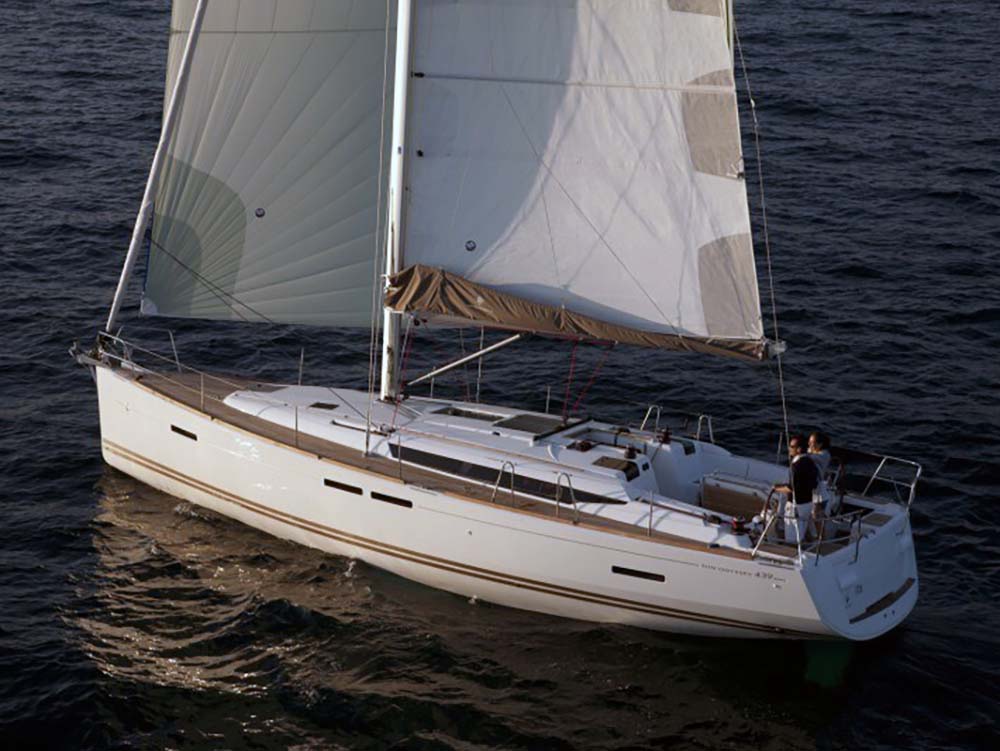
The Dufour 445 pushes further toward performance with a hull and keel arrangement that favors acceleration and pointing, delivering a firmer, more responsive helm compared with the more comfort-oriented Sun Odyssey 439. The Jeanneau trades a touch of outright speed for slightly more interior volume efficiency and an often more forgiving motion for casual family cruising; that means buyers who value passage speed and active trimming will appreciate the Dufour, while those prioritizing immediate below-decks comfort and the easiest possible singlehanding may lean Jeanneau.
In ownership terms the Jeanneau’s simpler systems and commonality of parts can mean easier local servicing in some U.S. markets, whereas the Dufour’s performance focus sometimes brings slightly higher expectations for sail and rig tuning—translating to modestly different maintenance rhythms that owners should budget for.
► Learn more about de Jeanneau Sun Odyssey 439
Dufour 445 Grand Large vs Beneteau Oceanis 45

Both boats aim to serve cruising families, but the Dufour leans toward a sportier hull form and a more performance-minded deck layout, allowing it to sustain higher average passage speeds and better light-air performance than the Oceanis 45. The Oceanis prioritizes maximum liveaboard volume—especially aft—and a very comfortable cockpit, so it will feel roomier for extended cruising and may be preferred by owners who put interior comfort first.
Practically, the Oceanis can be easier to set up as a family liveaboard with fewer immediate upgrades, while the Dufour rewards owners who will invest in sail inventory and tuning to exploit its sailing advantages, making resale and ownership costs hinge on how the boat is used and maintained.
► Learn more about de Beneteau Oceanis 45
Dufour 445 Grand Large vs Catalina 445
Comparing with the Catalina 445, the Dufour is a lighter, more performance-focused craft that delivers better light-air behavior and more engaging helm feedback, while the Catalina emphasizes conservative displacement, large tanks and a very durable systems package for extended voyaging. Buyers who plan long-range cruising with heavy provisioning and want the maximum robustness in remote locations often prefer the Catalina; those who prioritize passage speed, modern handling and a more European aesthetic will typically choose the Dufour.
From a maintenance perspective the Catalina’s simplicity and emphasis on ruggedness can lower unexpected service demands in remote cruising areas, while the Dufour’s performance edge may necessitate more frequent sail and rig attention to keep her at peak capability—so the choice reflects whether the owner values comfort-and-reliability or performance-and-efficiency.
► Learn more about de Catalina 445
Maintenance Costs of a Dufour 445 Grand Large in the USA
Typical annual maintenance for a mid-44-ft performance cruiser varies by region and usage; below are the recurring items with realistic cost guidelines:
- Mooring or slip fees: $3,000–$12,000 per year — marina rates vary dramatically by region (lower in Gulf ports, higher in New England/California).
- Insurance: $1,500–$4,000 per year — depends on agreed value, cruising area and offshore endorsements.
- Engine servicing: $600–$1,500 per year for routine maintenance; major repairs or overhauls can run $3,000–$8,000.
- Antifouling paint and haul-out: $1,200–$4,500 annually — frequency depends on water type, hull protection measures and owner willingness to DIY.
- Standing and running rigging inspection/replacement: $400–$1,200 per year for inspections and small repairs; full standing rig replacement commonly $6,000–$12,000 depending on mast type and fittings.
- Sails (maintenance and replacement): $300–$1,500 per year for repairs and servicing; a new primary sail inventory (main and a headsail or furling blade) typically ranges $8,000–$20,000 depending on cloth, cut and maker.
Regional cost differences are meaningful: yard labor and haul-out fees are noticeably higher on the Pacific Coast and in the Northeast than in many southeastern yards. Significant one-time costs buyers should plan for include electronics refits ($4,000–$15,000 for modern chartplotter, radar and AIS), major sail inventories or specialty sails (as above), and substantial composite or deck re-bedding projects if deferred maintenance is discovered.
The Dufour 445 can be partly owner-maintained—basic cleaning, routine engine checks, and cosmetic work are manageable—but professional services are usually required for rigging, composite repairs and major mechanical tasks, which increases direct ownership expenses. Overall, maintenance costs for the Dufour 445 sit in the medium range for 44–46 foot performance cruisers: higher than small cruisers but predictable for a modern production yacht. For buyers who keep systems current and choose examples with documented maintenance, resale typically compensates a fair portion of the investment because well-maintained, performance-capable boats remain marketable.
Conclusion
The Dufour 445 Grand Large is a persuasive option for buyers who want a modern performance cruiser that still offers comfortable accommodations for family cruising. Its strengths are an efficient hull and rig that produce satisfying sailing performance, paired with an interior and systems suited to multi-week cruising without extreme compromise. Weaknesses are chiefly the usual trade-offs for a performance cruiser—less absolute interior volume than the roomiest American designs and an ownership profile that rewards attention to sails and rigging. For the prospective buyer seeking a lively, capable cruiser that will make passages quickly yet remain comfortable for living aboard, the 445 is worth pursuing: when maintained and spec’d sensibly it represents a balanced investment for coastal cruising and moderate offshore work with stable resale prospects.
Specifications
| Hull Type | Fin w/bulb & spade rudder |
| Rigging Type | Fractional Sloop |
| LOA | 44.29 ft / 13.50 m |
| LWL | 39.11 ft / 11.92 m |
| Sail Area (reported) | 1,060.25 ft² / 98.50 m² |
| Beam | 14.24 ft / 4.34 m |
| Displacement | 22,324 lb / 10,126 kg |
| Ballast | 6,283 lb / 2,850 kg |
| Max Draft | 7.22 ft / 2.20 m |
| Construction | GRP |
| Ballast Type | Cast Iron |
| First Built | 2011 |
| Last Built | 2013 |
| Builder | Dufour Yachts |
| Designer | Umberto Felci |
| Auxiliary Power | Volvo Diesel (Saildrive), 55 HP |
| Fuel Capacity | 66 gals / 250 L |
| Water Capacity | 151 gals / 570 L |
| S.A. / Displ. | 21.48 |
| Bal. / Displ. | 28.14 |
| Disp. / Len. | 166.59 |
| Comfort Ratio | 24.69 |
| Capsize Screening Formula | 2.03 |
| Hull Speed | 8.38 kn |
| Pounds/Inch Immersion | 1,989.96 pounds/inch |
| I | 51.84 ft / 15.80 m |
| J | 16.40 ft / 5.00 m |
| P | 48.72 ft / 14.85 m |
| E | 16.73 ft / 5.10 m |
| S.A. Fore | 425.09 ft² / 39.49 m² |
| S.A. Main | 407.54 ft² / 37.86 m² |
| Total Sail Area (100% Fore + Main) | 832.63 ft² / 77.35 m² |
| S.A./Displ. (calculated) | 16.87 |
| Estimated Forestay Length | 54.37 ft / 16.57 m |
| Mast Height from DWL | 60.37 ft / 18.40 m |
Disclaimer
The considerations and analyses presented regarding the Dufour 445 Grand Large sailboat are of a general nature and are based on the available information and technical data on this model, interpreted to the best of our knowledge and understanding. It is important to note that the specific characteristics of any particular sailboat may vary due to custom modifications, maintenance performed, and conditions of use over time, among other factors. Therefore, the details and performance of the boat you are considering may not exactly match the information provided here.
We strongly recommend that, before making any purchasing or usage decisions, you conduct a detailed inspection of the boat in question, consult with nautical professionals and other sailors, and consider your personal needs, expectations, and capabilities. Each sailboat may have unique particularities that affect its performance and suitability for different types of sailing and sailors.
The information contained in this analysis should be used as a general guide and not as a definitive reference. Professional evaluation and personal inspection are essential to ensure that the boat meets your specific requirements and expectations.