



The Dufour 450 Grand Large was conceived as a performance-leaning cruiser that keeps comfort and practicality front-and-center — a boat for owners who want to make passages without sacrificing liveaboard comfort. Designed by Umberto Felci and launched in the early-to-mid 2010s, the 450 sits in Dufour’s Grand Large line and targets couples or small families who expect both capable passage speeds and an interior that welcomes extended cruising. It has found steady demand on the used market among private cruisers and charter operators who prize modern hull lines and efficient deck ergonomics, and U.S. listings typically reflect a market that favors well-equipped, refitted examples.
Design and Construction
Dufour set out to balance a relatively light, easily driven hull with the structural stiffness required for serious cruising: a fine entry, moderate beam carried aft, a deep fin keel with bulb, and dual rudders (on many builds) deliver lift, control and good control at higher angles of heel. The rig is a fractional sloop sized to accelerate the hull in variable conditions without imposing excessive sail-handling complexity; sheets and control lines are typically routed for easy short-handed work. Construction uses modern GRP techniques with reinforced load zones around the keel and chainplates so that the boat stays stiff under sail yet is repairable in conventional yards — a practical consideration for owners who plan long passages and want predictable maintenance. Those naval-architecture choices (lift-optimised keel, balanced rudder area and moderate displacement) give the 450 its performance edge while keeping durability and resale considerations solid for the long term.

Performance
On the water the Dufour 450 tends to feel lively and responsive: she accelerates readily in puffs, holds speed off the wind, and points well for a production cruiser of her era. In light air she will generally outpace heavier, comfort-first designs, and in a moderate seaway the hull form provides a seakindly motion with enough stiffness to carry reefed sail comfortably. Compared with contemporaries such as the Jeanneau Sun Odyssey 439 and some Oceanis variants, the 450 sits noticeably toward the performance end of the spectrum: owners who enjoy trimming and maintaining speed on passages will appreciate the reward in average daily mileage. That said, her performance is delivered with a practical tilt — systems and deck ergonomics are arranged so the boat can be sailed efficiently by a couple without constant tuning.
Comfort and Accommodations
The interior follows the “performance-cruiser” mantra: modern, bright joinery, sensible stowage and multiple layout choices (two- or three-cabin) that suit a cruising couple or a small family. Compared with heavier American designs, the Dufour sacrifices only a modest amount of tankage and locker space to gain livelier sailing, and the result is a below-decks environment that supports multi-week cruising with comfortable berths, a practical galley and decent ventilation. Materials and finishes on production examples are generally good quality; most owners find that modest cosmetic updates (cushions, electronics, soft goods) bring an older boat back to a very comfortable state without structural work. For buyers who plan a mix of coastal passages and occasional offshore legs, the 450 offers a persuasive middle ground between life-onboard comfort and meaningful passage performance.
Safety and Practicality
Deck ergonomics favor short-handed sailing: clear coachroof walkways, logically placed winches and twin wheels on many boats allow safe movement and good sightlines for helming. The hull’s righting ability and balanced rudder geometry provide predictable helm balance, making reefing decisions straightforward and decreasing crew fatigue on longer watches. Systems access is conventional — engine beds, tanks and seacocks are placed for reasonable serviceability — which reduces yard hours during scheduled maintenance. For owners intending true offshore work, prudent upgrades (redundant nav power, inspected chainplate beds, strong jacklines and an upgraded seafaring electronics package) are commonly recommended, but out of the box the 450 is well-suited to coastal work and moderate offshore passages.
Known Issues with the Dufour 450 Grand Large
Reported concerns are mainly age-and-use related rather than fundamental flaws: standing-rigging wear, deck-fitting sealant failures and the need to modernize electronics and sails are typical items on many survey reports. Charterer-used examples can show accelerated interior wear and higher engine hours, so verifying service history is essential. Buyers frequently budget for sail inventory updates, propeller/shaft inspections (to reduce vibration and improve fuel economy), and occasional re-bedding of high-load deck gear during refits. These are common, manageable items for production cruisers and generally straightforward to identify during a pre-purchase survey.
Market Availability and Pricing in the U.S.
The Dufour 450 Grand Large was built in the early-to-mid 2010s and now trades primarily on the used market; U.S. inventory is lighter than for mass-market American brands, but boats do appear in Florida and other cruising hubs. U.S. asking prices on brokerage portals and listings commonly sit in roughly the $150,000–$300,000 range, with lower-priced hulls often requiring equipment or systems refresh and higher-priced examples reflecting recent refits, upgraded electronics and low engine hours. Well-maintained, thoughtfully upgraded boats sell more quickly; boats used in charter can be bargains if their mechanical and structural condition is verified and documented.
Here’s a quick comparison with similar models:
| Model | LOA | Approx. Years Built | Typical US Used Price | Main Differences |
|---|---|---|---|---|
| Dufour 450 Grand Large | ~44.3 ft | ~2014–2016 | $150,000–$300,000 | Performance-leaning cruiser with refined underwater lines and modern deck ergonomics; balances speed with livability. |
| Jeanneau Sun Odyssey 439 | 43.9 ft | ~2011–2015 | $120,000–$230,000 | Slightly more comfort-oriented in motion; favors easy short-handing with an interior that emphasizes liveability. |
| Beneteau Oceanis 45 | 45 ft | ~2013–2018 | $170,000–$325,000 | Modern European cruiser with generous aft volume and cockpit comfort; balances cruising luxuries with decent sailing manners. |
| Catalina 445 | 44.5 ft | ~2010–2016 | $265,000–$385,000 | American heavy-displacement cruiser emphasizing tankage, simplicity and rugged systems for long-range voyaging. |
Dufour 450 Grand Large vs Jeanneau Sun Odyssey 439
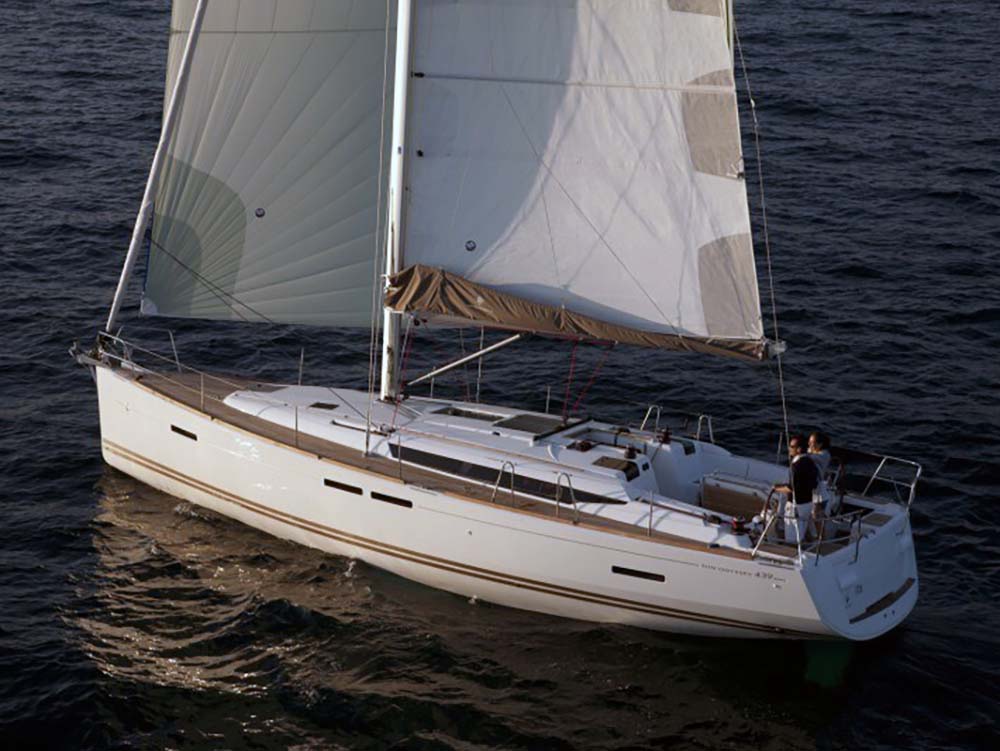
The Dufour 450 presses toward livelier passage speeds with a hull and keel profile that favor acceleration and pointing, delivering a more rewarding helm for owners who like to actively trim and maintain speed. The Sun Odyssey 439, while capable, trades a bit of outright sharpness for a slightly softer motion and interiors tuned for immediate family comfort, making it a better pick for buyers whose priority is below-decks liveability and the simplest possible short-handed handling.
From an ownership perspective the Jeanneau’s common parts and broad dealer networks in some regions can ease sourcing and service, whereas the Dufour’s performance focus often warrants a marginally higher budget for sail inventory and tuning if you want to exploit its capabilities.
► Learn more about de Jeanneau Sun Odyssey 439
Dufour 450 Grand Large vs Beneteau Oceanis 45

Both boats are modern European cruisers, but the Dufour tilts toward performance with a finer entry and more drive aft, while the Oceanis 45 pushes volume aft for maximum cockpit and cabin comfort. Buyers who prize daytime seaworthiness and passage speed will prefer the Dufour’s sharper manners; buyers who prioritize family comfort, larger social spaces and a softer motion in a seaway will often favor the Oceanis.
Practically, the Oceanis may be easier to spec as a pure liveaboard without immediate upgrades, whereas the Dufour rewards owners who will invest in sails and tuning to optimize passage performance — a trade that shows up in both operating costs and resale appeal to different buyer groups.
► Learn more about de Beneteau Oceanis 45
Dufour 450 Grand Large vs Catalina 445

Compared with the Catalina 445, the Dufour is lighter, quicker in light air and more oriented toward active sailing, while the Catalina emphasizes heavy displacement, large tanks and a build philosophy that favors robustness and simple long-range cruising. For an owner planning extensive provisioning and remote cruising, the Catalina’s tankage and conservative systems are hard to beat; for a buyer who wants to make faster passages and enjoy a more responsive helm without giving up comfortable accommodations, the Dufour is the more engaging choice.
In maintenance terms the Catalina’s conservative systems can reduce surprises in remote locations, while the Dufour’s higher performance envelope typically means slightly more attention to sail and rig condition to keep her at peak capability.
► Learn more about de Catalina 445
Maintenance Costs of a Dufour 450 Grand Large in the USA
Typical annual maintenance for a 44–46 ft performance cruiser depends on region, use and owner skill; budget realistically for the items below:
- Mooring or slip fees: $3,000–$12,000 per year — varies widely by region (Gulf/Florida often lower; New England and California higher).
- Insurance: $1,500–$4,000 per year — depends on agreed value, cruising area and whether offshore endorsements are added.
- Engine servicing: $600–$1,500 annually for routine service; major overhauls can cost $3,000–$8,000 depending on scope.
- Antifouling paint and haul-out: $1,200–$4,500 per season — frequency and cost depend on local fouling pressure and whether owners DIY.
- Standing and running rigging inspection/replacement: $400–$1,200 annually for inspection/minor work; full standing rig replacement typically $6,000–$12,000.
- Sails (maintenance and replacement): $300–$1,500 per year for repairs; full working sail inventory commonly $8,000–$20,000 depending on cloth and specialists.
Regional labor rates and yard availability materially affect these ranges: Northeast and West Coast yards usually charge more than many southeastern yards. Significant one-time costs buyers should plan for include electronics refits ($4,000–$15,000 for modern chartplotter/radar/AIS packages), major sail inventories or specialty sails, propeller/shaft work ($1,200–$6,000), and larger composite refits if deferred maintenance is discovered. The Dufour 450 is owner-serviceable for basic chores, but rigging, major composites and engine overhauls commonly require professionals; reliance on professionals raises annual ownership costs. Overall, maintenance costs fall into the medium range for 44–46 ft performance cruisers — predictable if maintenance is current, and well-maintained examples typically retain resale value that compensates a fair portion of lifecycle expenses.
Conclusion
The Dufour 450 Grand Large is an attractive choice for sailors who want credible passage speeds without surrendering practical, comfortable accommodations. Its strengths are a refined hull and rig that reward active sailing, an interior that supports real cruising, and a build approach that balances stiffness with repairability. Trade-offs include a modest loss of absolute internal volume compared with the roomiest American cruisers and the expectation that owners who want top performance will budget for sails, tuning and occasional specialist work. For a buyer seeking a modern, capable performance cruiser that is still comfortable for family coastal cruising and moderate offshore passages, a well-maintained Dufour 450 is worth serious consideration: it offers a good compromise between speed and liveability and holds resale appeal when cared for and sensibly equipped.
Specifications
| Hull Type | Fin w/bulb & dual rudders |
| Rigging Type | Fractional Sloop |
| LOA | 44.29 ft / 13.50 m |
| LWL | 39.11 ft / 11.92 m |
| S.A. (reported) | 1,011.00 ft² / 93.92 m² |
| Beam | 14.27 ft / 4.35 m |
| Displacement | 22,652.00 lb / 10,275 kg |
| Ballast | 6,283.00 lb / 2,850 kg |
| Max Draft | 7.22 ft / 2.20 m |
| Construction | FG |
| First Built | 2014 |
| Builder | Dufour |
| Designer | Umberto Felci |
| Auxiliary Power | Volvo Diesel, 55 HP |
| Fuel Capacity | 66 gals / 250 L |
| Water Capacity | 150 gals / 568 L |
| S.A. / Displ. | 20.28 |
| Bal. / Displ. | 27.74 |
| Disp/Len | 169.04 |
| Comfort Ratio | 24.98 |
| Capsize Screening Formula | 2.02 |
| S# | 3.06 |
| Hull Speed | 8.38 kn |
| Pounds/Inch Immersion | 1,994.15 pounds/inch |
| I | 51.84 ft / 15.80 m |
| J | 16.40 ft / 5.00 m |
| P | 48.72 ft / 14.85 m |
| E | 16.73 ft / 5.10 m |
| S.A. Fore | 425.09 ft² / 39.49 m² |
| S.A. Main | 407.54 ft² / 37.86 m² |
| S.A. Total | 832.63 ft² / 77.35 m² |
| S.A./Displ. (calc.) | 16.71 |
| Estimated Forestay Length | 54.37 ft / 16.57 m |
Disclaimer
The considerations and analyses presented regarding the Dufour 450 Grand Large sailboat are of a general nature and are based on the available information and technical data on this model, interpreted to the best of our knowledge and understanding. It is important to note that the specific characteristics of any particular sailboat may vary due to custom modifications, maintenance performed, and conditions of use over time, among other factors. Therefore, the details and performance of the boat you are considering may not exactly match the information provided here.
We strongly recommend that, before making any purchasing or usage decisions, you conduct a detailed inspection of the boat in question, consult with nautical professionals and other sailors, and consider your personal needs, expectations, and capabilities. Each sailboat may have unique particularities that affect its performance and suitability for different types of sailing and sailors.
The information contained in this analysis should be used as a general guide and not as a definitive reference. Professional evaluation and personal inspection are essential to ensure that the boat meets your specific requirements and expectations.