


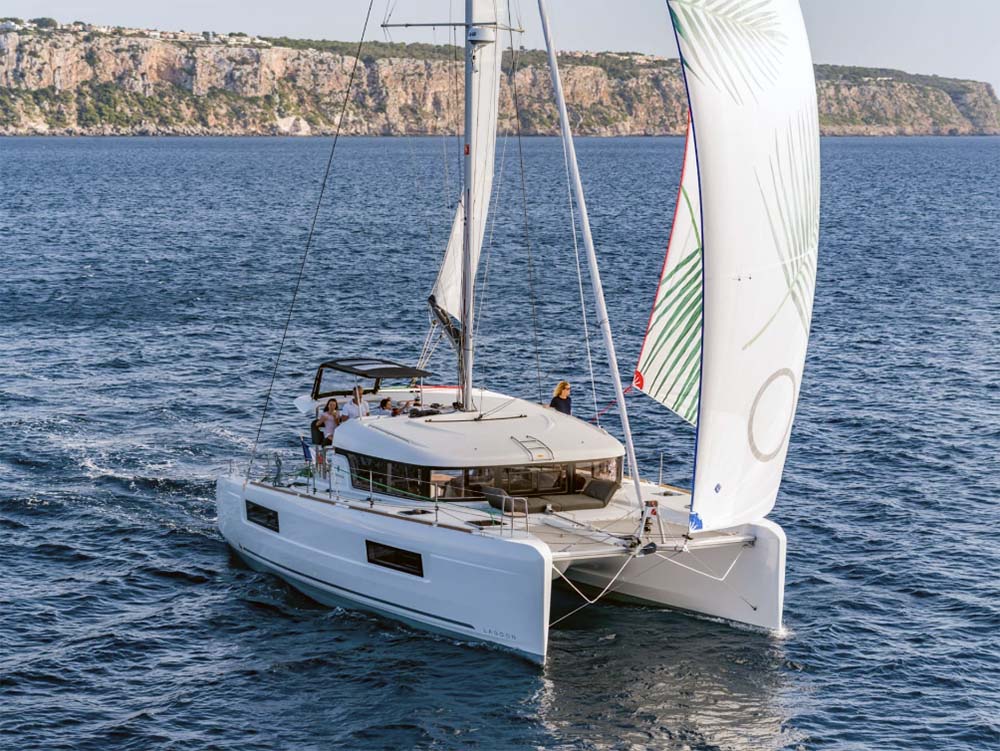
The Lagoon 40 is a purpose-built cruising catamaran introduced by Lagoon in 2017 as a family-and-charter oriented 40-foot platform. It was developed by the multihull architects VPLP (Van Peteghem / Lauriot-Prevost) with exterior lines by Patrick le Quément and interior layouts from Nauta Design, and launched to replace older 38–40 ft models in Lagoon’s range with a clearer emphasis on live-aboard comfort and easier short-handed handling. From the outset the 40 was positioned as a mixed-use cruiser — a boat equally at home in the charter fleet as a couple’s passagemaker or a family coastal cruiser — and that dual brief explains many of its design choices (mainsail and jib plan, spacious cockpit/saloon relationship and modular interior options).
Design and Construction
The Lagoon 40 is a modern production multihull built as a vacuum-infused polyester sandwich with balsa core on many surfaces and solid laminate bottoms — a recipe that balances stiffness, weight control and production efficiency. It is a fractional sloop with the mast stepped slightly aft (to simplify sail handling and enable a larger self-tacking jib), twin spade rudders and shallow daggerboard/twin-keel geometry that gives a modest 1.35 m (≈4’5″) draft. Twin Yanmar diesel engines on saildrives are standard, giving redundancy and excellent close-quarters control.
Those construction choices have practical consequences for an owner. Vacuum infusion and balsa sandwich yield a stiff, relatively light structure that translates into livelier performance and better fuel economy under power, but where a foam or balsa core exists it demands good hatch and deck-fitting maintenance: water intrusion is the long-term enemy. The twin-hull layout reduces heel and increases usable interior volume (and thus charter appeal), while the aft-mast/self-tacking headsail arrangement simplifies short-handed sailing — both important for buyers who prize comfort and ease of operation over pure club-racer performance. From a maintenance perspective, composite repairs are straightforward for competent yards, spare parts and service networks for common installations (Yanmar engines, standard sail handling hardware) are available, but some owners should budget for periodic attention to deck fittings, seacocks, and through-hull bedding to preserve core integrity.
Performance
On paper the Lagoon 40 is not a racing cat — it is a cruising platform that sails with purpose. Test sails and owner reports consistently note that with the optional larger foresail or Code-0 deployed on reaches the 40 will produce surprisingly brisk passage speeds, frequently touching near double-digit boat speeds in favorable conditions and holding mid-to-high single digits upwind in moderate air. Some published sea trials described reaching 10 knots in 16–18 kt true wind and still making nearly 8 knots as wind backed and the boat was pinched to a 50° apparent angle, illustrating that the sail plan and hull form work together to keep momentum in realistic cruising conditions.
The catamaran’s flat stability and wide beam deliver a comfortable, confidence-inspiring ride in beam and downwind seas, with limited motion compared with a monohull of comparable length — an advantage for live-aboard comfort and for crews sensitive to heel. Conversely, in very light airs or when heavily loaded the boat can feel underpowered on a tight beat, and like most cruising cats it rewards sail area (light sails, Code-0s) and careful weight distribution more than aggressive sail trim. Compared with performance-oriented twins in the same size class it may trade a bit of pure upwind pointing for interior volume and user friendliness; for many buyers that is an acceptable, intentional compromise.
Comfort and Accommodations
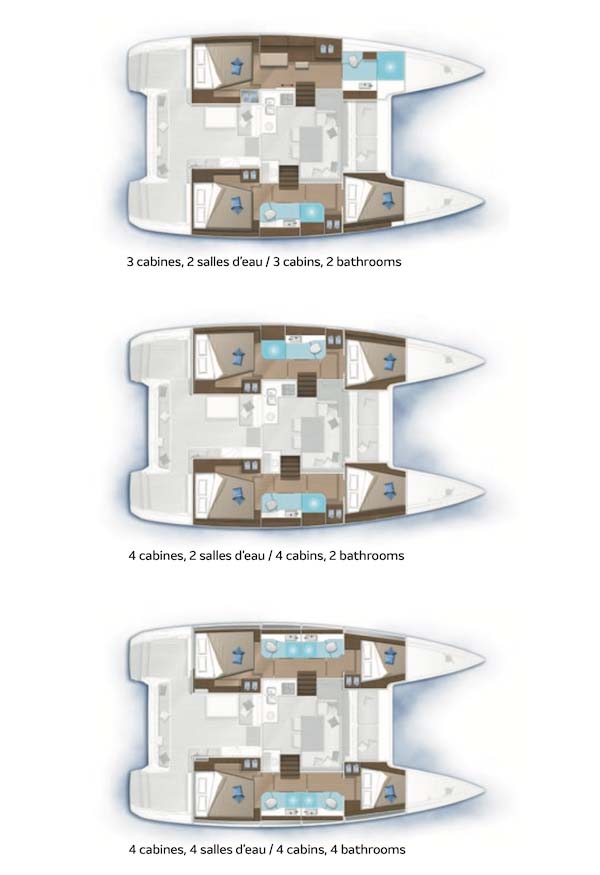
The 40’s interior packages range from three-cabin owner configurations to four-cabin charter plans; the saloon is open, the galley is an L-shape aft-to-port and headroom is generous for the class (reported at roughly 79″ in published layouts). Nauta’s approach emphasizes light, contemporary finishes and social flow between cockpit and saloon, which makes the boat feel larger than its foot length suggests — a practical plus for families and for owners who plan long weekends or season-long liveaboard use.
Storage is abundant compared with monohulls of similar LOA, and the separation of accommodation into hulls gives privacy and multiple heads (in many layouts), which is why the model is attractive to charter operators and families. For couples planning extended voyaging the single-owner cabin version gives a true owner’s suite and more storage/technical access in the opposite hull, but buyers who intend to cruise offshore should assess galley bracing, refrigerator capacity, and freshwater provisioning for their specific program. Interiors in the production fleet tend to age reasonably, though many owners upgrade soft furnishings and electronics after purchase to personalize and modernize systems.
Safety and Practicality
Deck ergonomics on the 40 are a deliberate blend of comfort and safety: a relatively flush cockpit, wide coachroof walkways and plentiful handholds make moving fore and aft straightforward, and the self-tacking jib plus control lines led to the cockpit facilitate short-handed operation. Twin engines give redundant propulsion for docking or motoring in adverse conditions, and the shallow draft opens anchorages and slips that are impractical for similarly sized monohulls.
Practical ownership issues to consider: while many service items are accessible, some wiring and plumbing in production cats is routed through modular structures that can complicate retrofits; buyers planning serious offshore work often choose to preemptively relocate or clearly label major service access points. For coastal and bluewater cruising with sensible upgrades (extra bilge pumping, good navigation electronics, and attention to hatches/seals), the 40 is widely regarded as a safe and practical platform.
Known Issues with the Lagoon 40
Owners’ forums and industry reports for Lagoon and related production multihulls have documented recurring themes that prospective buyers should inspect closely. Some Lagoon models experienced concerns related to forward bulkheads or bridgedeck areas where drainage or bonding details, if neglected, have led to localized rot or structural distress; these items attracted wider attention across the brand and have led many owners to proactively inspect critical laminate junctions and drainage paths.
Other, more common complaints are the sorts you see on modern production boats: water ingress through poorly sealed deck hardware or hatches leading to cosmetic or systems problems, finicky shore-power/electrical networking issues when systems are heavily customized, and occasional reports of the standard propeller choice being suboptimal for both performance and fuel economy (many owners fit folding or feathering props). The practical takeaway for buyers is straightforward: a careful survey that focuses on core areas (through-hulls, bridgedeck, rudder bearings, engine mounts and saildrive seals) plus a review of maintenance logs will reveal whether an example has been tended to or needs structural or systems work. Commonly recommended buyer upgrades include improved drainage around water tanks, upgraded propellers, and a cautious electronics refit plan that consolidates networking and isolates critical circuits.
Market Availability and Pricing in the U.S.
The Lagoon 40 remains a live model in dealer inventories and is widely available on the used market; there are both late-model new builds and pre-owned examples listed through major brokers and online marketplaces, so buyers can choose between a near-new turnkey boat or a previously chartered/private example. Geographic concentration tends toward Florida, the southeastern U.S. and the Caribbean for resale activity, with additional stock appearing in popular east-coast cruising hubs such as Annapolis and Maine, and on the West Coast through broker networks that import from Europe.
Price guidance based on active U.S. listings and broker feeds: typical used and near-new prices observed in 2023–2025 fall roughly in the range $350,000–$560,000, with older 2017–2019 hulls appearing toward the lower end of that band and recent dealer stock or highly optioned 2023–2025 boats at the upper end. Charter-fleet boats often price lower but will typically show higher engine hours and accelerated wear on soft goods; well-maintained owner examples command premiums.
Below is a compact comparison table of the Lagoon 40 and three contemporaries in the 40-foot multihull class
| Model | LOA (approx.) | Years (approx.) | Typical used price (U.S.) | Main differences |
|---|---|---|---|---|
| Lagoon 40 | ≈ 40–42 ft (12.75 m LOA) | 2017–present | $350,000–$560,000 | Maximizes social cockpit/saloon flow; production-boat finish; charter-friendly layouts. |
| Leopard 40 | ≈ 39–40 ft | 2006–2021 (various generations) | $300,000–$420,000 | Tends toward slightly sportier hulls and delivery markets; good resale where performance matters. |
| Fountaine Pajot Lucia 40 | ≈ 40 ft | 2016–2020s | $270,000–$420,000 | Lightweight feel, contemporary lines; slightly more performance bias in some versions. |
| Nautitech 40 Open | ≈ 40 ft | 2014–2022 | $300,000–$540,000 | Open-plan deck, performance-oriented layout, often marketed to private owners who race/fast-cruise. |
Lagoon 40 vs Leopard 40

The Lagoon 40 and the Leopard 40 occupy similar market space but approach the brief differently. Lagoon emphasizes accommodation volume, cockpit-saloon connectivity and broad appeal to charter operators and families; the coachroof lines and internal furniture choices focus on social spaces and easy circulation. Leopard, historically, has leaned toward a slightly sportier hull form and a design lineage that prizes passage speed and seaworthiness at the expense of a handful of cubic feet of interior volume. On the dock that means the Leopard often feels a touch firmer in a blow and may point a little higher, while the Lagoon trades that marginal pointing performance for a quieter saloon and more living area — a practical trade for owners whose priority is comfortable cruising rather than club racing.
From a maintenance and ownership perspective, both are production cats with broadly comparable running-cost drivers (twin engines, domestic systems, composite construction), but Leopard examples sometimes fetch premiums among buyers who prize sailing performance and have the time or inclination for a more hands-on, sail-trim focused ownership. The Lagoon 40 generally offers easier short-handed handling (self-tacking jib, control lines led to the cockpit) and a layout that is deliberately more “charter-proof” — that tends to lower the bar for novice owners and keeps resale demand strong in coastal charter hubs. For a buyer deciding between them, the choice usually rests on whether interior volume and simple operation (Lagoon) or a slightly more performance-oriented platform (Leopard) matches the intended use.
► Learn more about de Leopard 40
Lagoon 40 vs Fountaine Pajot Lucia 40

The Lagoon 40 and the Lucia 40 compete for the same family/charter buyers, but their design philosophies diverge in subtle ways. Fountaine Pajot’s Lucia 40 often feels a touch lighter and more performance-minded in its layout and hull shaping, with designers aiming to balance livability with a crisper helm feel; Lagoon skews more toward maximized deck and saloon ergonomics for social cruising. In practice this means the Lucia can be marginally quicker in light to moderate air when sailed actively, while the Lagoon rewards owners who prioritize comfortable living spaces, predictable handling and a cockpit that functions as an extension of the saloon.
Interior ergonomics reveal another practical distinction: both brands offer multiple cabin layouts, but Lagoon’s modular, more conservative finish choices are attractive to charter operations and to owners who want proven resale appeal. Fountaine Pajot buyers often accept a slightly firmer ride and a tighter focus on sailing performance in exchange for a sleeker profile and potentially better upwind behavior; Lagoon buyers accept slightly less sporting trim for an easier day-to-day experience and a larger social footprint below and above decks.
► Learn more about de Fountaine Pajot Lucia 40
Lagoon 40 vs Nautitech 40 Open

Comparing the Lagoon 40 to the Nautitech 40 Open highlights the tension between social comfort and sporty intent. The Nautitech Open series was conceived with an “open” feel and a performance edge — a low, aerodynamic coachroof, cleaner deck flow for sail handling and hulls tuned for speed; Lagoon aims for maximum usable cockpit/saloon volume and simplified handling for short-handed crews. On the water the Nautitech typically rewards an active crew with better acceleration and sharper helm feedback, while the Lagoon delivers a more cushioned, liveable ride and greater sheltered sociability in a marina or at anchor.
From an ownership viewpoint the Nautitech buyer is commonly someone who values lively performance and is willing to spend time on sail trim and preventive maintenance to keep systems race-ready, whereas the Lagoon owner is often oriented to family cruising, charter income or long-term comfort. Maintenance items and systems skill requirements are similar (both are production composite cats), but Nautitech rigs and deck layouts may require a more attentive boat-handling regimen to extract their best performance, which should factor into crew expectations and maintenance budgeting.
► Learn more about de Nautitech 40 Open
Maintenance Costs of a Lagoon 40 in the U.S.
Typical annual and periodic maintenance items (illustrative U.S. ranges and commentary):
- Mooring/Slip: $3,000–$12,000+ per year — varies dramatically by region (Florida and California premium marinas vs. more affordable Southeast or Gulf marinas).
- Insurance: $2,500–$8,000/year — depends on cruising area, declared value and cruising range (coastal vs offshore).
- Engine servicing (both engines): $800–$2,500/year — routine oil, filters, saildrive checks; major services add cost every few years.
- Antifouling (haul, paint, zincs): $1,200–$4,000 every 1–2 years — depends on haul location, number of coats and labor rates.
- Standing and running rigging inspection/repairs: $300–$3,000/year (pro rata) — full standing rig replacement every 10–15 years is a major cost.
- Sails (replacement / repair): $200–$1,500/year (repairs/patching); full sail replacement $8,000–$25,000 depending on mainsail and headsail options.
- Electronics and batteries (replacement/upgrade): $1,000–$10,000+ episodic — modernizing nav/comms or converting to lithium will jump costs.
- Annual systems checks (plumbing, refrigeration, genset if fitted): $500–$3,000/year.
Significant one-time costs to budget for include major sail replacement, a full electronics refit, composite repairs to core-affected areas if discovered, and larger upgrades such as solar/battery bank or converting props. In many cases reasonably handy owners can handle a portion of routine jobs (cleaning, varnish, filter changes, minor electrical work), but the scale and complexity of catamarans — two engines, two running systems, multiple through-hulls and spacious interiors — mean that professional yard time is common for haul-outs, rig checks and major servicing. Regionally, haul and yard labor are cheaper in parts of the Southeast U.S. and the Caribbean than New England or California.
Overall cost assessment: for a 40-foot production catamaran the Lagoon 40 sits in the medium annual cost band — higher than a similarly sized used monohull on account of dual systems and larger wetted area, but not extreme for its class. A well-maintained example with documented service history tends to retain resale value better, so sensible preventive maintenance generally offsets larger surprise costs down the line.
Conclusion
The Lagoon 40 is a deliberate compromise in steel-frame terms: it privileges livability, simplicity of short-handed operation and charter-friendly layouts without pretending to be a race machine. For buyers whose priorities are comfortable family cruising, social onboard life, easy marina handling (thanks to twin engines) and good resale prospects in charter-heavy markets, it represents a compelling package — particularly because it is supported by a broad dealer and broker network and a clear market for used examples.
Weaknesses to factor into a purchase decision are familiar: production variability on any widely built model, the need to inspect core areas and critical bond lines carefully, and a sailing performance envelope that favors reaches and off-wind miles over tight-angle competitive racing. If your plan is frequent weekend family cruising, coastal passages and occasional Bahamas runs, the Lagoon 40 is worth serious consideration; if your goal is club racing or the highest possible upwind VMG, a sportier cat or a monohull performance cruiser may be a better match. In short: for coastal cruising and family liveability the Lagoon 40 is a practical, well-thought-out choice with a healthy resale market — but buy with a thorough survey and a realistic budget for the dual-engine, multihull lifecycle.
Specifications
| Hull Type | Catamaran Twin Keel |
| Rigging Type | Fractional Sloop |
| LOA | 38.52 ft / 11.74 m |
| LWL | 37.96 ft / 11.57 m |
| S.A. (reported) | 828.82 ft² / 77.00 m² |
| Beam | 22.18 ft / 6.76 m |
| Displacement | 23,997 lb / 10,885 kg |
| Max Draft | 4.43 ft / 1.35 m |
| Construction | Vacuum infused polyester with balsa core |
| First Built | 2017 |
| Builder | Lagoon |
| Designer | VPLP Design |
| Auxiliary Power (orig. equip.) | Yanmar 3YM30 Saildrive, 2x 29 HP, Diesel |
| Fuel Capacity | 106 gals / 400 L |
| Water Capacity | 79 gals / 300 L |
| Headroom | 6.58 ft / 2.01 m |
| S.A. / Displ. | 16.00 |
| Displ. / Len. | 195.85 |
| KSP | 0.57 |
| Mast Height from DWL | 60.44 ft / 18.42 m |
Disclaimer
The considerations and analyses presented regarding the Lagoon 40 catamaran are of a general nature and are based on the available information and technical data on this model, interpreted to the best of our knowledge and understanding. It is important to note that the specific characteristics of any particular sailboat may vary due to custom modifications, maintenance performed, and conditions of use over time, among other factors. Therefore, the details and performance of the boat you are considering may not exactly match the information provided here.
We strongly recommend that, before making any purchasing or usage decisions, you conduct a detailed inspection of the boat in question, consult with nautical professionals and other sailors, and consider your personal needs, expectations, and capabilities. Each sailboat may have unique particularities that affect its performance and suitability for different types of sailing and sailors.
The information contained in this analysis should be used as a general guide and not as a definitive reference. Professional evaluation and personal inspection are essential to ensure that the boat meets your specific requirements and expectations.