


The Lagoon 400 S2 is a purpose-built cruising catamaran that trades outright racing ambitions for a balanced package of interior volume, straightforward handling and reliable passage-making performance. Developed as an update to the earlier Lagoon 400, the S2 iteration arrived in the 2010s under the long-standing VPLP (Van Peteghem / Lauriot-Prévost) design umbrella and was produced by Lagoon as a family and charter-friendly platform with a clear emphasis on comfortable cruising. (Boat-Specs.com)
That positioning—comfort first, tolerable performance second—made the 400 S2 popular with private owners looking for a livable coastal cruiser, as well as charter operators who valued its durable fit-out and guest appeal; today it is commonly traded on the used market where buyers include cruisers, flotilla/charter managers and families seeking an easily handled catamaran with proven pedigree.
Design and Construction
Lagoon’s S2 follows typical modern cruising-cat naval architecture: relatively symmetrical, beamy hulls for form stability, shallow twin keels to reduce draft and twin spade rudders for positive steering. The hull and deck are produced using fiberglass infusion techniques with lightweight cores (the S2 line uses engineered core materials and composite joinery to reduce weight while keeping stiffness), choices that deliver a comfortable, stiff platform but create the usual multihull maintenance considerations around through-deck fittings and core integrity.
The rig is a fractional sloop optimized for a furling genoa and a full-batten or square-top main depending on owner preference; that layout keeps sail handling friendly for short-handed crews while providing enough area for respectable passage speeds in trade-wind and coastal conditions. From an owner’s point of view the construction approach (infusion and engineered cores) generally reduces routine fatigue problems and supports a decent residual value, but it also means buyers should prioritise a survey that includes deck-to-core interfaces and window/chainplate bedding to avoid costly core repairs later.
Performance
On the water the Lagoon 400 S2 behaves like a cruising-first catamaran: steady, comfortable and predictable rather than athletic. Its relatively modest displacement for a 39-foot cruising cat and a sensible sailplan produce steady VMG on reaches and efficient off-wind runs; upwind the boat will not match a performance catamaran or a stiff monohull in pointing angles, but it makes reliable progress and offers a stable, low-motion ride appreciated by comfort-oriented cruisers.
Twin diesel engines (typically in the 29–30 hp range in factory spec) give good close-quarters control and redundancy that many monohull buyers find reassuring when switching to a multihull. For owners who prize passage speed the S2 is competent but not extreme—its strengths lie in comfortable cruising and simple, robust systems rather than extracting the last knot of speed.
Comfort and Accommodations
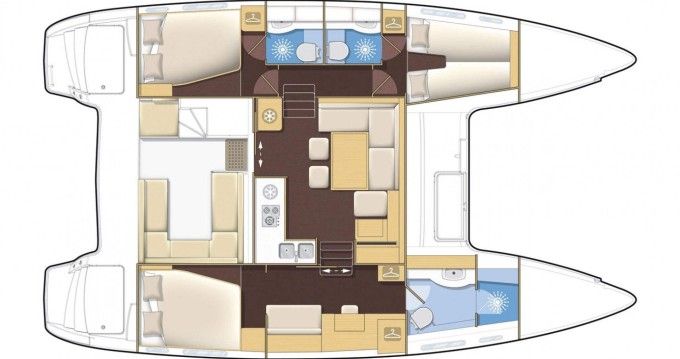
Interior volume is one of the S2’s headline attributes: large saloon windows, a social cockpit that flows into the living area and multiple cabin layout options (owner’s version, three-cabin, four-cabin) give the boat real flexibility. Materials and joinery on S2 models favour lightweight, practical finishes (laminate/alpi style joinery in many boats) intended to withstand heavy use in both private and charter service; as a result the boat feels bright and airy initially and commonly ages well when maintained, though many owners still invest in incremental upgrades—improved refrigeration, bespoke shelving, or upgraded upholstery—to tailor the space to long-term liveaboard needs.
For couples or small families the S2 is generous: comfortable berths, sensible storage in hull lockers and decent ventilation via hatches and saloon glazing. Full-time liveaboard use is feasible, particularly if owners upgrade systems (watermakers, upgraded fridges, and additional insulation) that are often minimal in charter spec boats but straightforward to install.
Safety and Practicality
Deck circulation on the Lagoon 400 S2 is conservative and safe—wide coachroof walkways, clear sightlines from the helm and guarded cockpit perimeters reduce the chances of slips and improve crew confidence when moving about in a seaway. The shallow draft expands cruising grounds (shoal anchorages, Caribbean islands and coastal bays) while twin engines and rudders provide responsive maneuverability in harbors. Systems access is generally user-friendly: engine/saildrive areas are reachable under companionways and through access panels, which simplifies routine servicing and inspection.
While the S2 will handle coastal passagemaking and moderate offshore work well when properly prepared, serious long-range voyaging benefits from a few common owner upgrades: redundant water/safety systems, careful bedding of all deck hardware, and upgraded navigation/electrical reserves to reduce single-point failures on extended passages.
Known Issues with the Lagoon 400 S2
Reports from owners and surveyors tend to highlight a handful of recurring themes rather than a single systemic design fault. Typical issues found in market surveys include sealant degradation around coachroof windows and deck fittings, saildrive seal wear (a routine item on twin-engine multihulls), and occasional cosmetic deterioration where charter use has been heavy. If neglected, sealant failures can lead to core damage around penetrations, which is the principal structural risk to watch for during survey.
Recommended practical upgrades or checks often include a full reseal of all windows and deck fittings at acquisition, routine inspection and service of saildrive seals, and verifying the engine/genset install for proper raw-water routing and exhaust protection—items that are cheaper to do proactively than to repair after water intrusion has occurred.
Market Availability and Pricing in the U.S.
The Lagoon 400 S2 is no longer produced (S2 production ran in the 2010s), so the model is only available on the used market; it is most frequently listed in Florida, the U.S. East Coast (Annapolis/Chesapeake), and in Caribbean brokerages, with occasional West Coast examples. Listings in U.S. brokerages and marketplaces typically place well-kept, later-model S2s in the mid-six-figure range; a representative U.S. used-market band is $260,000–$390,000, with prices clustering by year, equipment package and service history.
Relative to contemporaries, the Lagoon 400 S2 generally offers strong value for buyers prioritizing interior volume and resale liquidity—Lagoon’s brand recognition and broad dealer/broker network help keep resale paths open in charter-heavy markets. Below is a copy-and-paste-ready HTML table comparing the Lagoon 400 S2 to three commonly considered alternatives; all cells and headers are left aligned for easy copying.
Below is a compact comparison table of the Lagoon 400 S2 and three contemporaries in the 40-foot multihull class
| Model | LOA | Year (approx) | Typical used price (US) | Main differences |
|---|---|---|---|---|
| Lagoon 400 S2 | 39.3 ft | 2012–2017 | $260,000–$390,000 | Voluminous saloon and coachroof glazing, conservative cruising targets, strong dealer/broker network. |
| Nautitech 40 Open | ~39.3 ft | 2013–2020 | $285,000–$450,000 | Performance-biased hull and deck plan, sportier handling, typically lighter displacement. |
| Fountaine Pajot Lucia 40 | 38.5 ft | 2015–2019 | $270,000–$425,000 | Charter-friendly layouts, simpler systems focus, often marginally lower purchase cost for similar year boats. |
| Leopard 40 | ~40 ft | 2006–2021 (various gens) | $210,000–$420,000 | Wide charter footprint, good dealer support, variants with different performance priorities across generations. |
Lagoon 400 S2 vs Nautitech 40 Open

The Lagoon 400 S2 prioritizes interior volume and guest comfort; its hulls, coachroof glazing and salon layout are tuned for social life aboard and charter durability. Nautitech 40 Open, by contrast, is designed with a stronger performance bias—flatter stern sections, lighter displacement and a deck plan aimed at reducing windage—so buyers who prize lively passages and sharper helm feedback will prefer Nautitech.
From an ownership perspective the S2’s conservative systems and Lagoon’s broad dealer network often make maintenance logistics easier and resale paths more straightforward, while the Nautitech owner should budget more actively for sail inventory and routine rig/appendage checks to preserve its sharper sailing character.
► Learn more about de Nautitech 40 Open
Lagoon 400 S2 vs Fountaine Pajot Lucia 40

Both boats target family cruising and charter markets, but the Lagoon emphasizes salon volume and long-term liveability while the Lucia leans a touch toward compact efficiency and lower marina costs through a slightly reduced beam. In practice that means a Lagoon 400 S2 will feel roomier and more guest-oriented at anchor, whereas Lucia buyers often accept marginally less interior space in exchange for a lighter, slightly more economical platform under power.
For resale and practical ownership the Lagoon’s name recognition and dealer footprint can make it easier to trade in charter-heavy markets, whereas the Lucia sometimes offers lower initial purchase prices for equivalent spec—an important consideration for budget-conscious buyers.
► Learn more about de Fountaine Pajot Lucia 40
Lagoon 400 S2 vs Leopard 40

The Leopard 40 sits between the two in many ways: offering solid accommodation and a history of charter use like the Lagoon, but with some variants tuned for better sailing performance that narrow the gap to sportier cats. Leopard’s broad presence in charter fleets and extensive brokerage networks often mean well-documented service histories, while the Lagoon 400 S2 tends to edge ahead on pure cockpit/saloon liveability.
Buyers choosing between them should weigh dealer/support networks and intended use—if charter revenue, easy resale and a roomier saloon are priorities, Lagoon is attractive; if you want a flexible platform with potential for sharper sailing in some versions, Leopard is worth closer inspection.
► Learn more about de Leopard 40
Maintenance Costs of a Lagoon 400 S2 in the U.S.
- Mooring/Slip: $3,000–$15,000 per year (region-dependent; premium marinas in California and New England at the high end).
- Insurance: $1,200–$6,000 per year (depends on vessel value, cruising area and insurer; multihull premiums vary).
- Engine servicing (twin diesels): $800–$3,000 per engine annually for routine service and saildrive checks.
- Antifouling and haulouts: $1,200–$8,000 every 1–2 years depending on yard and hull condition; salt-water areas with growth may push costs to the high end.
- Standing & running rigging inspections/replacements: $300–$3,000 per year reserved; full rigging refresh every 8–12 years can be $8,000–$20,000+.
- Sails (maintenance/replacement): $300–$3,000 per season for repairs and servicing; full replacement $6,000–$25,000+ depending on material and asymmetric inventory.
Significant one-time expenditures often include electronics refits ($5,000–$25,000), genset replacement ($10,000–$30,000 installed) or structural/core repairs if water ingress has been neglected ($3,000–$30,000+ depending on scope). Many routine items can be owner-managed (oil changes, cleaning, small electrical work), but sail, rig and structural work generally require professionals—this mix pushes the coach-style Lagoon into a medium annual cost band for a 40-foot cruising catamaran. Sensible servicing history and a clean survey typically preserve resale value and mitigate long-term surprises.
Conclusion
The Lagoon 400 S2 is a pragmatic, occupant-friendly cruising catamaran that excels at what it was designed for: comfortable coastal cruising, reliable charter performance and sensible systems that are straightforward to maintain. Its principal strengths are interior volume, user-friendly deck ergonomics and the reassurance of a widely recognized brand and dealer network; its main purchase risks are avoidable and revolve around water-ingress points and saildrive/engine wear—issues that show up in many production multihulls but are manageable with a good survey and a modest upgrade budget.
For buyers seeking a comfortable coastal cruiser with good resale prospects in charter-friendly markets, the Lagoon 400 S2 is typically worth considering and often represents solid value for money. It is less compelling for those whose highest priority is peak passage performance, but for the majority of cruising families and charter-oriented owners it hits the right balance between liveability, safety and maintainability.
Specifications
| Hull Type | Catamaran Twin Keel |
| Rigging Type | Fractional Sloop |
| LOA | 39.27 ft / 11.97 m |
| LWL | 37.57 ft / 11.45 m |
| S.A. (reported) | 903.00 ft² / 83.89 m² |
| Beam | 23.79 ft / 7.25 m |
| Displacement | 22,531 lb / 10,220 kg |
| Max Draft | 3.97 ft / 1.21 m |
| Construction | Fiberglass (FG) |
| First Built | 2009 |
| Last Built | 2012 |
| # Built | 264 |
| Builder | Lagoon |
| Designer | Van Petheghem / Lauriot-Prévost |
| Auxiliary Power/Tanks (orig. equip.) | Diesel X 2 |
| Fuel Capacity | 106 gals / 401 L |
| Water Capacity | 79 gals / 299 L |
| S.A. / Displ. | 18.18 |
| Disp. / Len. | 189.67 |
| KSP | 0.61 |
| Mast Height (from DWL) | 66.60 ft / 20.30 m |
Disclaimer
The considerations and analyses presented regarding the Lagoon 400 S2 catamaran are of a general nature and are based on the available information and technical data on this model, interpreted to the best of our knowledge and understanding. It is important to note that the specific characteristics of any particular sailboat may vary due to custom modifications, maintenance performed, and conditions of use over time, among other factors. Therefore, the details and performance of the boat you are considering may not exactly match the information provided here.
We strongly recommend that, before making any purchasing or usage decisions, you conduct a detailed inspection of the boat in question, consult with nautical professionals and other sailors, and consider your personal needs, expectations, and capabilities. Each sailboat may have unique particularities that affect its performance and suitability for different types of sailing and sailors.
The information contained in this analysis should be used as a general guide and not as a definitive reference. Professional evaluation and personal inspection are essential to ensure that the boat meets your specific requirements and expectations.