


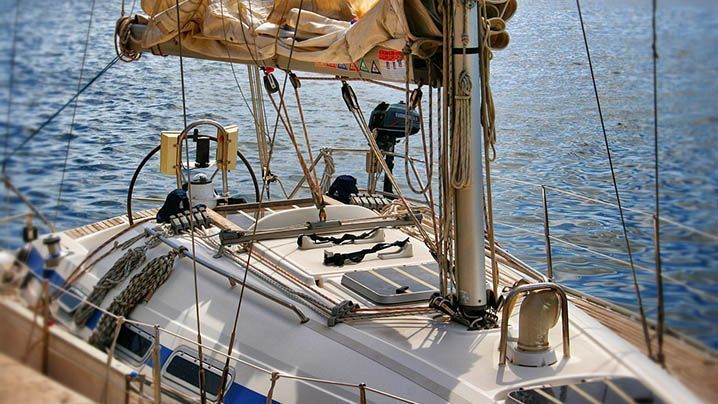
When the boat stops being a temporary refuge and becomes a floating home for several consecutive days of coastal cruising, the requirements change dramatically. Interior comfort, storage capacity, and water and energy autonomy take center stage. A week-long trip involves living, sleeping, cooking, and washing onboard, so what was previously optional now becomes essential. At this point, a 33–36 ft (≈10–11 m) sailboat usually marks the minimum recommended size to avoid feeling that the boat is too small.
Length, Draft, and Engine
The optimal length is 33–36 ft (≈10–11 m), enough to provide two enclosed cabins, a habitable salon, and a full bathroom without sacrificing maneuverability. The typical draft rises to 5.3–6.2 ft (≈1.6–1.9 m), a compromise that ensures reasonable sailing performance while still allowing access to reachable coves.
The engine should provide security for prolonged port entries, currents, or local weather conditions: 20–30 HP inboard is a range that balances power and fuel consumption. At this size, a bow thruster can often be included, which is highly appreciated when maneuvering in busy marinas.
Rig and Ease of Handling
A full week implies longer days and, often, stretches of sailing in variable conditions. Comfortable and flexible sail management is key:
- Genoa furler and mainsail with lazy-bag are practically standard.
- Slab reefing (2–3 positions) is essential: the crew should reduce sail area as soon as the wind increases.
- Autopilot: on passages over 2–3 hours at the helm, an autopilot effectively becomes another crew member.
- Generous winches and well-positioned sheet leads, optionally electric winches: allow a single crew member to handle sails without overload.
Here, the priority is not just ease but efficient effort management to prevent fatigue from affecting life onboard.
Autonomy and Interior Comfort
The boat must sustain the crew for a week without relying daily on the port:
- Water: 26–79 gal (100–300 L) depending on the crew. With four people, 53 gal (≈200 L) is the minimum to cook and wash comfortably.
- Galley: 2–3 burners, optional oven, and compressor fridge of at least 16–21 gal (≈60–80 L). Week-long trips make varied menus feasible.
- Bathroom: a full bathroom with interior shower is almost indispensable. A transom freshwater shower (even cold) greatly increases comfort after swimming.
- Cabins: two enclosed cabins (fore and aft) are the minimum recommended for a week to ensure privacy. If more than four people travel, the convertible salon can serve as a solution, but luggage and storage logistics must be planned.
- Storage: lockers, under-bunk chests, and galley space. Without sufficient storage, the interior becomes chaotic in two days.
Cockpit: Outdoor Living Space
The cockpit must be as habitable as the interior:
- Space: accommodate the entire crew seated comfortably around a central table, as many meals will take place there.
- Sturdy table: fixed or folding, stable enough for meals underway.
- Protection: sprayhood for wind protection while sailing and a large bimini for shade at anchor. Together, they turn the cockpit into an “outdoor salon.”
- Large lockers: essential for fenders, long lines, light diving gear, or even a folding dinghy.
- Sturdy swim ladder: used daily, must allow easy boarding even in some waves.
In summary: the cockpit functions as a living room, dining room, and terrace, as it is where most time is spent during a week onboard.
Energy and Onboard Systems
Longer autonomy also implies higher electricity consumption:
- Service batteries: at least two, with total capacity 200–300 Ah.
- Energy production: 100–200 W solar panels or a good engine alternator are recommended to avoid relying on the marina every two days.
- LED lighting: reduces consumption and improves habitability.
- Electronics: plotter, optional AIS, robust autopilot, depth sounder, and fixed VHF with DSC. On a full week, they provide peace of mind.
Safety and Anchoring
Autonomy also demands reinforced safety:
- Anchor: 33–44 lb (≈15–20 kg) with 98–164 ft (≈30–50 m) of chain; a second “reserve” anchor for difficult conditions or backup.
- Liferaft and harness-equipped life jackets: essential if sailing at night or away from the immediate coast.
In summary, a week onboard transforms the sailboat into a traveling home, and everything should be designed for comfort, autonomy, and safety. A 33–36 ft (≈10–11 m) boat provides just enough space and capacity to make the experience truly enjoyable rather than a test of endurance.
Quick Guide for a Week on a ~33–36 ft (≈10–11 m) Sailboat
- Length and Draft: 33–36 ft (≈10–11 m), draft 5.3–6.2 ft (≈1.6–1.9 m). Provides real habitability (two enclosed cabins and full bathroom), good stability, and solid sailing performance while still compatible with accessible coves.
- Engine: 20–30 HP inboard. Ensures prolonged port entries, maneuvers with current or wind, and an extra margin of safety. Bow thruster possible in this range.
- Rig and Handling: Genoa furler and mainsail with lazy-bag/lazy-jacks almost standard; slab reefing (2–3 positions) essential; autopilot recommended for long passages; generous winches and well-placed sheet leads, electric winches optional for easier management with a small crew.
- Autonomy and Comfort: water tanks 26–79 gal (100–300 L) depending on crew; galley with 2–3 burners, 16–21 gal (≈60–80 L) compressor fridge, optional oven; full bathroom with interior shower + transom shower; two enclosed cabins (fore and aft) + convertible salon; generous storage in lockers and chests.
- Cockpit: spacious, room for 4–6 around a stable table; deep lockers for fenders, lines, or light diving gear; bimini and sprayhood highly recommended for comfort while sailing and at anchor; robust swim ladder for daily use.
- Safety and Energy: plotter with updated charts, optional AIS, robust autopilot; 2–3 service batteries (200–300 Ah) with 100–200 W solar panels or good alternator; 33–44 lb (≈15–20 kg) anchor with 98–164 ft (≈30–50 m) of chain and second reserve anchor; liferaft and harness-equipped life jackets for night or offshore safety.
- Ideal Crew: 2–4 people with high comfort; up to 6 feasible using the convertible salon, with good organization of space and storage.
Models to Consider:
| Model | Length | Draft | Engine | Crew |
|---|---|---|---|---|
| Catalina 34 (1985–2008, very popular U.S. cruiser) | ≈ 10.36 m | ≈ 1.37 m (shoal) – 1.83 m (deep) | ≈ 23–30 HP (diesel inboard) | 4–6 |
| Hunter 34 (1983–1987, widely available used) | ≈ 10.36 m | ≈ 1.52–1.83 m (depending on keel) | ≈ 22–27 HP (Yanmar diesel) | 4–6 |
| Pearson 34-2 (1986–1990, classic East Coast cruiser) | ≈ 10.36 m | ≈ 1.68 m (standard) – 1.83 m (deep) | ≈ 27 HP (diesel inboard) | 4–6 |
| C&C 35 Mk III (1982–1987, performance cruiser) | ≈ 10.67 m | ≈ 1.65 m (shoal) – 1.83 m (deep) | ≈ 25–30 HP (diesel inboard) | 4–6 |
| Tartan 34-2 (1984–1989, quality U.S. build) | ≈ 10.36 m | ≈ 1.55 m (shoal) – 1.83 m (deep) | ≈ 27 HP (diesel inboard) | 4–6 |
| Beneteau Oceanis 35.1 (modern production) | ≈ 10.45 m | ≈ 1.50 m (shoal) – 1.85 m (deep) | ≈ 29 HP (diesel inboard) | 4–6 |
| Jeanneau Sun Odyssey 349 (2014–present, very popular) | ≈ 10.34 m | ≈ 1.49 m (shoal) – 1.98 m (deep) | ≈ 21–30 HP (diesel inboard) | 4–6 |
| Catalina 355 (2011–present, U.S. production) | ≈ 10.91 m | ≈ 1.52 m (shoal) – 1.83 m (deep) | ≈ 29 HP (diesel inboard) | 4–6 |
| Hanse 348 (modern, still in production) | ≈ 10.40 m | ≈ 1.55 m (shoal) – 1.90 m (deep) | ≈ 27 HP (diesel inboard) | 4–6 |
| Dufour 360 Grand Large (modern, available in U.S.) | ≈ 10.30 m | ≈ 1.55 m (shoal) – 1.90 m (deep) | ≈ 29 HP (diesel inboard) | 4–6 |
Conclusion
When the goal is to spend a week sailing, the sailboat becomes much more than a means of transport: it turns into a home, a refuge, and a living space. That’s why 33–36 ft (≈10–11 m) marks a balance that is hard to match: it offers water and energy autonomy, two enclosed cabins, a full bathroom, and a cockpit that functions as an outdoor salon, without the complexity or expenses of a larger boat.
Learn more about coastal cruising sailboats: