


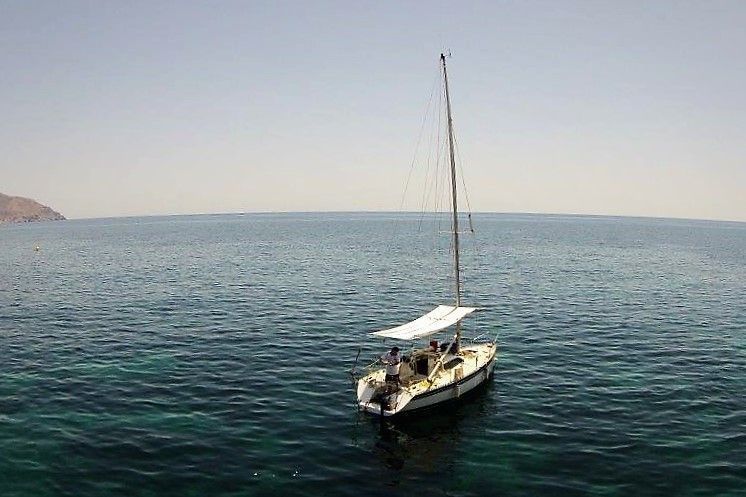
The charm of a short trip lies in its immediacy: minimal preparations and you’re ready for a few hours of sailing and an anchorage to swim or spend the night. For this type of coastal cruising, a large or sophisticated boat isn’t necessary; what matters is that the sailboat supports the plan without complicating it.
The temptation to look at larger boats is always there. That can make perfect sense, and if the budget allows, nothing prevents it. However, when the budget is limited—as is often the case—the wisest decision is likely to prioritize maneuverability, simplicity, and the minimum essential habitability.
Length and Draft: Why 26 ft (≈8 m) and a Shallow Draft Work
A sailboat around 26 ft (≈8 m) offers the ideal balance for short trips: enough length for a comfortable cockpit and convertible bunk, yet compact enough to be handled by a small crew, save on mooring costs, and allow for easy trailering.
A shallow draft (≈4–5 ft / 1.2–1.5 m) or a retractable keel is key because it lets you navigate shallow waters—the main appeal of a coastal beach day—without the frustration of having to stay far from shore. A swing or lifting keel multiplies anchoring options, though it comes with slightly higher maintenance.
Rig and Handling Systems: Reducing Physical and Mental Load
For short trips, the golden rule is that maneuvers shouldn’t take up most of the time. This is achieved with a deck and rig design optimized for a minimal crew:
- Jib furler: allows furling and reducing sail from the helm. Especially valuable for inexperienced crews, as it avoids having to move to the foredeck and enables quick sail changes when entering port or anchoring.
- Self-tacking jib: ideal for solo or couple sailing. Allows tacking without touching the mainsheet and provides great peace of mind in coastal sailing with frequent short maneuvers. It slightly reduces upwind performance (smaller area and less optimal shape), but when fun and safety are priorities, it’s worth it.
- Lines and controls led to the cockpit: halyards and sheets through tracks, winches, and cleats in the cockpit allow maneuvering without moving on deck. A well-thought-out system prevents bumps and reduces the need for technical skill.
Note: Self-tacking jibs and furlers sacrifice some performance; if you want to maximize every knot, they’re not ideal. If you want to head out, enjoy the day, and return stress-free, they’re a huge improvement.
Reducing Mainsail Complexity
For a day boat, it’s practical to prefer simple, robust solutions for the mainsail:
- Slab reefing: cheap, proven, and efficient. Maintains the sail’s proper shape.
- Mainsail furler: offers extra convenience but adds complexity, weight, and maintenance; for a short weekend, it’s not always worth it.
Auxiliary Engine and Tanks
For maneuvering in port and calm conditions, a practical engine provides sufficient thrust without being oversized: on an 8 m (≈26 ft) boat, 8–12 HP if outboard, or 10–15 HP if inboard, is a reasonable range. It gives enough power for docking, sailing against currents, and entering bays in moderate wind. A small fuel tank (e.g., 5–10 gal / 20–40 L if inboard) ensures autonomy for maneuvers and occasional extended use without adding unnecessary weight.
Why: More power increases cost, consumption, and weight; less power may leave you at the mercy of currents. For day trips, you don’t need the engine of a long-range cruiser.
Essential Habitability: The Basics for Comfort Without Complications
When spending one or two nights onboard, the “luxuries” list is reduced to the functional essentials:
- Sleeping: a convertible bunk in the salon or two single bunks is sufficient.
- Galley: a 1–2 burner stove and space for a portable fridge (or a small 12 V fridge) cover most needs. Avoid complex fixed-gas systems if you won’t use them.
- Water: for a day, 5–10 gal (≈20–40 L) is enough; for a weekend, 10–20 gal (≈40–80 L) depending on the number of people and shower plans.
- Toilet: a small portable toilet is sufficient, avoiding complicated installations and making cleaning and maintenance easy.
Why: More volume and tanks mean more weight, higher consumption, and increased maintenance complexity. For short getaways, simplicity reduces the risk of problems.
The Cockpit: The Heart of Life Onboard
On a day or weekend sailboat, the cockpit becomes the main space, even more than the interior. It should be spacious, with long benches and adequate backrests, allowing people to sit or even lie down. A folding table is practical for meals at anchor but should be easily stowed to avoid interfering with maneuvers. Lockers under the seats provide useful storage for fenders and lines, and a high lifeline improves safety for children or inexperienced crew. Finally, having a bimini or awning makes a big difference: in summer, the sun can be intense.
Quick Guide for 2–3 Day Trips on a ~26 ft (≈8 m) Sailboat
- Length and Draft: ~26 ft (≈8 m) in length, with a shallow draft of 4–5 ft (≈1.2–1.5 m) or a retractable keel for access to shallow coves.
- Auxiliary Engine: 8–12 HP outboard or 10–15 HP inboard; fuel tank 5–10 gal (≈20–40 L).
- Rig and Handling: jib furler, optional self-tacking jib, halyards and sheets led to the cockpit; mainsail with slab reefing (optional mainsail furler).
- Minimal Habitability: convertible bunk or two single bunks; 1–2 burner stove; portable or 12 V fridge; 5–10 gal (≈20–40 L) of water for one day, 10–20 gal (≈40–80 L) for a weekend; portable toilet.
- Cockpit: spacious, long benches with storage lockers; optional folding table; high lifeline for safety; bimini or awning recommended.
- Ideal Crew: 2 people for comfortable enjoyment, but up to 4 is possible.
Models to consider:
| Model | Length | Draft | Engine | Crew |
|---|---|---|---|---|
| Catalina 27 (1971–1991, out of production, very popular in U.S.) | ≈ 8.23 m | ≈ 1.07 m (shoal) – 1.37 m (standard) | ≈ 10–15 HP (inboard, some outboard) | 4–5 |
| Hunter 27 (1974–1984 classic, widely available used) | ≈ 8.23 m | ≈ 1.07–1.32 m depending on keel | ≈ 8–12 HP (inboard diesel) | 4 |
| O’Day 272 (1985–1989, out of production, U.S. favorite) | ≈ 8.28 m | ≈ 1.07 m (shoal) – 1.42 m (deep) | ≈ 9–13 HP (inboard diesel) | 4–5 |
| Island Packet 27 (1984–1992, out of production but highly regarded) | ≈ 8.23 m | ≈ 1.07 m (full keel) | ≈ 18 HP (Yanmar inboard) | 4 |
| MacGregor 26M (2003–2013, trailer-sailer, U.S. best-seller) | ≈ 7.87 m | ≈ 0.30 m (board up) – 1.75 m (board down) | ≈ 50 HP outboard (planing under power) | 4 |
| Precision 23 (1984–present, still built in U.S.) | ≈ 7.01 m | ≈ 0.60 m (board up) – 1.68 m (board down) | ≈ 4–8 HP outboard | 4 |
| Beneteau First 235 (1986–1994, popular in U.S. used market) | ≈ 7.10 m | 0.66–0.84 m (shoal/wing) – 1.16–1.75 m (deep) | ≈ 5–8 HP (typical outboard) | 4 |
| Catalina 275 Sport (2014–present, modern U.S. production) | ≈ 8.38 m | ≈ 1.35 m (fixed fin) | ≈ 14 HP inboard (diesel or optional gas) | 4 |
| Jeanneau Sun Odyssey 319 (modern, available in U.S.) | ≈ 9.80 m | ≈ 1.85 m (deep) – shoal versions ≈ 1.50 m | ≈ 21 HP inboard diesel | 4–6 |
| Hunter 27 Edge (2006–2012, hybrid sail/powerboat) | ≈ 8.23 m | ≈ 0.51 m (board up) – 1.52 m (board down) | ≈ 75 HP outboard (fast under power) | 4 |
Conclusion
Ultimately, for day trips or weekend getaways, it often makes sense to prioritize simplicity and maneuverability over comforts that are barely used in such a short time. A well-designed 26 ft (≈8 m) sailboat with a shallow draft, easy-to-handle rig, and essential habitability provides a light and hassle-free experience. It’s not a boat for long voyages, but it is the perfect vessel to enjoy the sea with the best balance of pleasure and cost.
Learn more about coastal cruising sailboats: